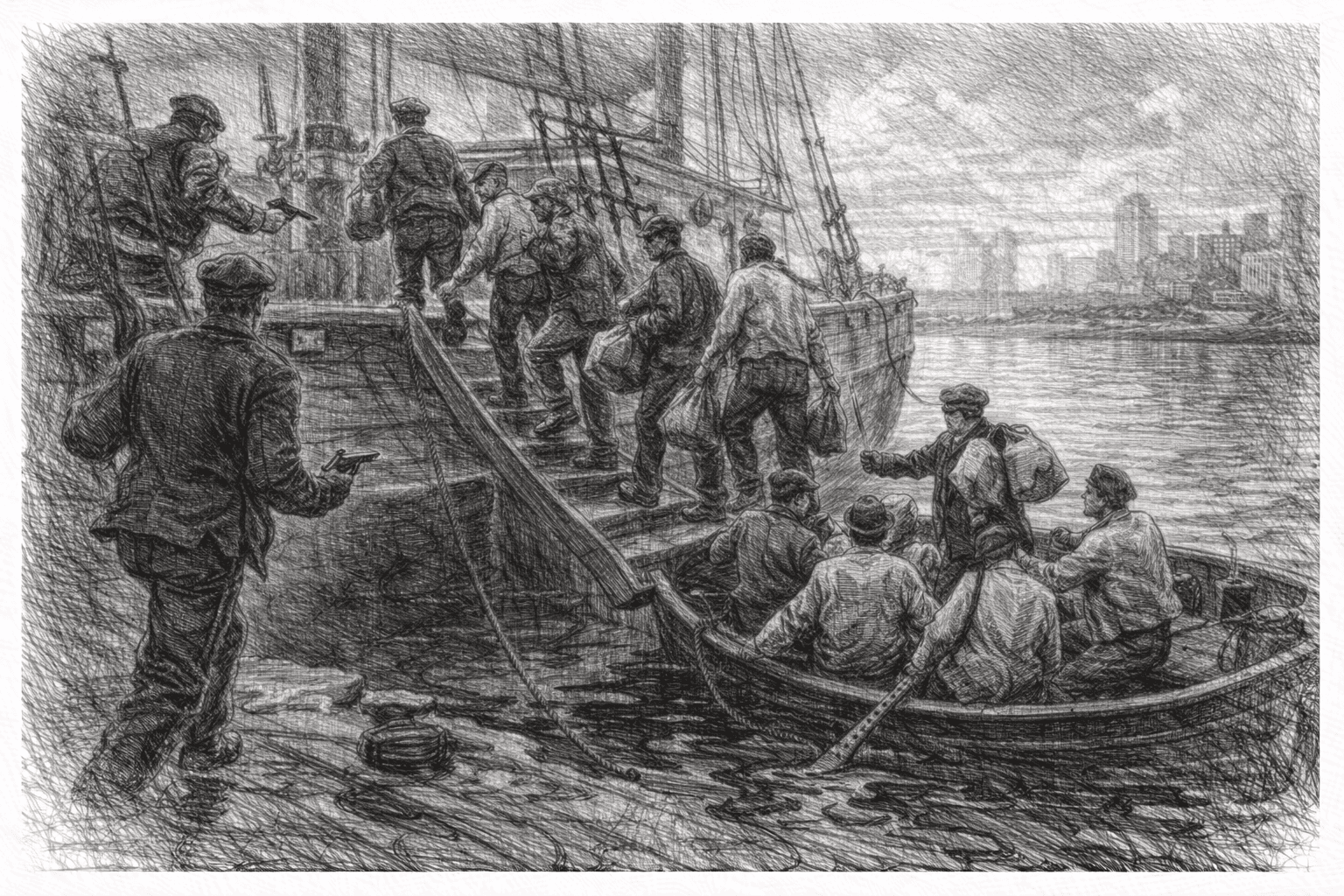

It must have taken 7 or eight weeks to make the crossing to New York. It was about noon, one day, when our anchor was let down outside of Brooklyn. The captain came to me and said, quietly: 'If the crew wants to desert, let them go. Do not attempt to stop them. I know they hired with me only to get a chance to come to America. So you need not oppose the runners, if they come on board.' I was more than glad about this. I knew the New York runners. They were dangerous boys to have anything to do with. They were regular kidnapers who came on board ship and took men ashore, whether they would or not, and in broad daylight. If anyone protested then the revolvers rested very lightly in the pockets of those kidnapers, and they were not slow to use them. The worst one among them was a native of Stavanger, Norway, by name Peder Gjesdal. He was notorious among Norwegian sailors who visited Brooklyn or New York; and even the police of those cities did not like to contact him, so he did about as he liked. But on two occasions things did not go as he intended. One day he came in a rowboat, intending to enter a Stavanger ship. The captain of it saw and knew him. He called down to him to keep away from the ship. Peder thought he would quickly scare the wits out of the captain, and sent a bullet from his revolver up to him. But the captain was prepared and promptly sent a bullet back, and that went through Peder's hat. This was not what he was looking for. That captain was too good a shot. He turned his boat around and got away immediately.
Another time there was a ship from one of the eastern cities of Norway that was about ready to sail from Brooklyn. The officers on board had been told Peder would give them a call that night. In conference with their captain the men all agreed that they would not desert, and when Peder came on board they would remain quiet in hiding, until he was well on deck. Then, at a signal, they would run from their hiding places and grab him. The plan was perfectly well executed. Peder thought the crew was asleep, and he was grabbed and held by men who knew how to hold tighet, before he had a chance to shoot. Then they took and lashed him to the main mast and there he had to stand all that night. In the morning they untied him, took his revolver away from him and let him get into his boat and depart before they weighed anchor and sailed out. Peder would remember that night a long time.
In this connection there comes to memory a little experience ofwhcih I was told, that happened to another Norwegian Second mate in New York. He saw two men in a boat that came and touched at the bow of his ship, where they evidently intended to get onboard by entering up on the anchor chains. He looked around hurriedly for some weapon, but could not find any. Then he saw the carpenter's grindstone, standing on the forecastle roof. He grabbed it, ran forward and looked down the bow. The boat was lying at the anchor chains. One of the men had begun to climb up the chains. The mate lifted the grindstone up over his head, then threw it down with all his might. It hit the boat in the middle and went through. The boat was full of water in a minute. The man who had begun to climb dropped himself into the water, and both of them began to swim for shore to save their lives.
Many similar stories were told, to which events I was not an eye-witness, but I held them to be true. As the reader will remember, I had a very serious experince with four runners when I was aboard the American ship. Those four threatened me with bodily injury if I did not go with them, and it has always been a puzzle to me that they did not carry out their threat.
We had just tied down the sails, about noon, and the crewe went to the forecastle for their dinner. Then, presently, the runners were in sight. Several of them came aboard, and went to the forecastle. I stood aft on the half deck and looked at them, but let them go. After a little, the crew came out. They had changed clothes, packed their belongings, and were beginning to throw their packages down in the runners' boat. I let on as if I did not see them. Soon they were all in the boat and on way to shore. All deserted, except the steward. The captain was right when he supposed they would desert.
But this was only the beginning of a long list of adversities I had with this time in New York. When the captain had been ashore, he came back with a number of letters. The first on e I opened, as one may well imagine, was the one from Olava. She thanked me heartily for the ship model. It was pretty, and she was proud of it. Many had looked at it, and some would not believe that I had made it. She also thanked me for the painting of herself, and said I ought to get one painted of myself, which I did.
Then I opened the letter from my Swedish friend. But what astonishment. She said, among other things, that she loved me above all, and wished to become my wife, promising that she would be a good and faithful wife. She also enclosed a picture of herself. This was very sudden, as the saying goes. I did not know what to do. I had not told her I was betrothed; but neither had she asked me; and I did not think it necessary. If I now told her about that I would lose her, even as a friend, and I did not like that. So I sat down and wrote what might be called a diplomatic letter. I told her I certainly was not the right man for her. I had my big faults, etc. So she must reconsdier, but we could be good friends, in any event. I thought it was too late now to tell her I was engaged. It would be very discouraging toher, but she outght to be told enough so she would understand I did not accept her offer. It must be said very carefully, so it would not hurt much. But if I ever made a mistake in my life I did so when I wrote that diplomatic letter.