
We had our cargo in hold, and now we must hurry with preparations to sail by Saturday evening. We expected that on the next day, which was Palm Sunday, we were to have a holiday.
But the captain had other plans. At six o'clock next morning we were called out to weigh anchor and go to sea. Then it was observed that the anchor chains had become twisted. One anchor lay upriver, the other down, to prevent the ship from shifting position when the tide or wind changed.
The captain went around and deplored the unfortunate situation that he did not have a tar on board who could put on crupper chains and get the twist out, saying that he would most likely have to do it himself. He ordered a boatswain stool and an earing (a 20-foot rope). These he got. We put a rope in the boatswain stool and lowered the captain in it down at the bow, gave him the earing and he proceeded to lash the chains. When he was ready, he ordered the carpenter to open the chain-lock and let the chain fall. But when it fell, both lashing and chain went down over the unreleased chain, and the whole thing went to the bottom.
Yes, this was master seamanship. There lay one of our anchors, with about forty-five fathoms of chain, on the bottom of the river. We could not leave them there.
After some consultation, the second mate, carpenter and myself were ordered to go aboard the English warship and ascertain if they had a grabhook they could loan to us.
We laid the Norwegian flag across the rear end of our boat and rowed over to the ship, saluted, and told our errand. They invited us on board for a visit. I noticed the thick steel plates covering the ship's side. We went onboard, were received in a friendly manner, and were shown all over the ship. There were many great cannons. They were mouth leaders, using big round iron balls. The bore of some of these guns was so big I believe a man could have crawled through them quite easily. It was a monstrous large ship, and it was clean and in fine shape.
The loaned us a good grabhook and wished us luck as we left them.
We rowed around and dredged in every direction all the forenoon. Finally, we got hold of something which we could not pull up. We secured a rope from our ship and pulled it up to where the grabhook was fastened. Then we set a heavy tackle in the foretop of our ship, fastened the dredge rope to it and put the runner around the capstan, and then proceeded to wind up. It was our anchor chain we had hold of, sure enough, and we hauled in until we saw it was the anchor-end we had caught.
When the whole chain was on deck, lying in a pile near the fore-shrouds, we took the loose end forward and put it thru the hawse-box. Now the whole chain had to be put out over the rail.
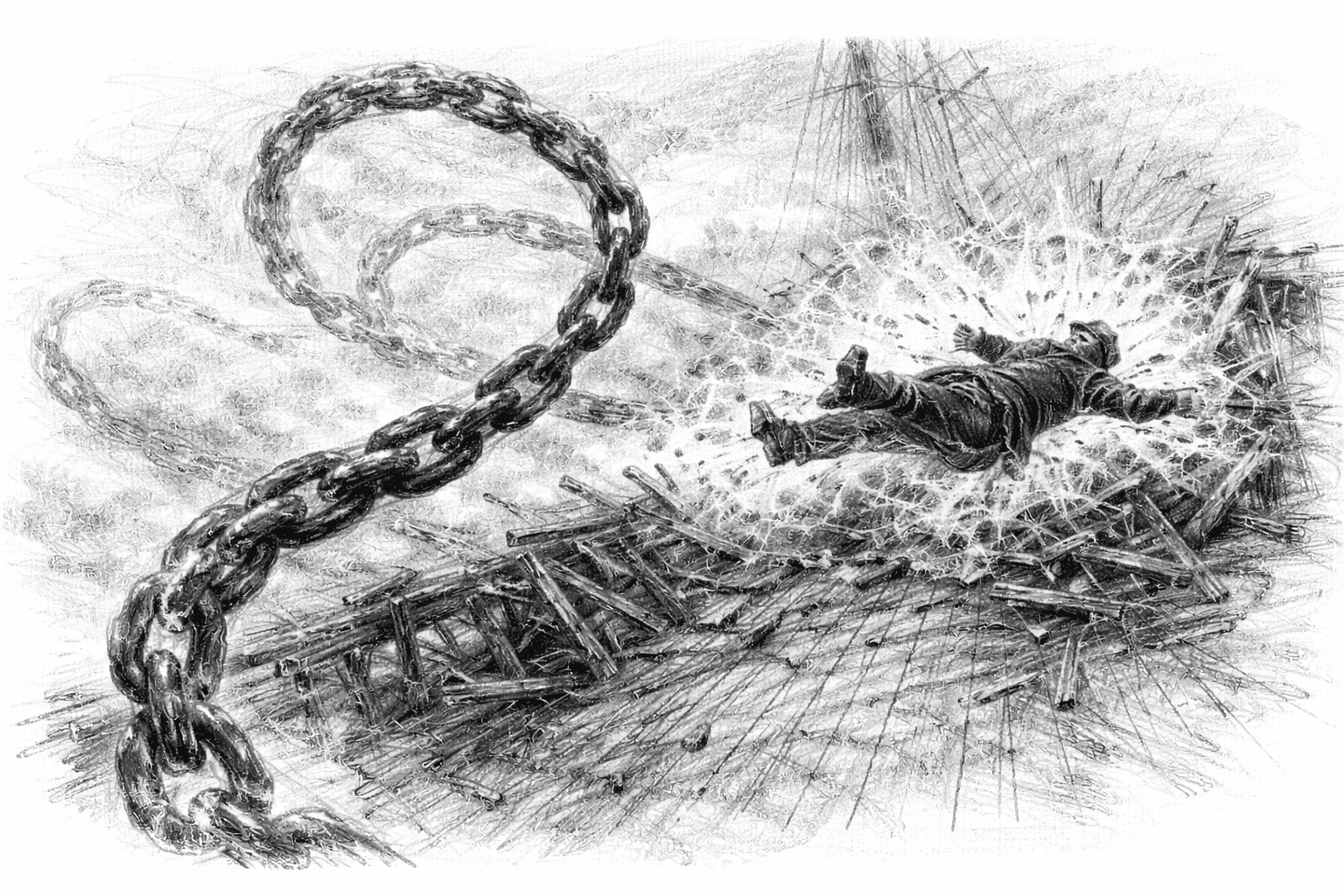
Then came the captain again, uttering regrets that he did not have a seaman on board that could make a chain-stopper with which to check out the chain. He ordered a little chain, out of which he made some kind of a stopper, and began to check it out, standing on top of the chain heap. He made two or three checks, whereupon the chain began to fly over the battlement in large coils, with lightning speed. The captain was thrown this way and that by the chain coils. Now he stood on one end and now on the other, till he was finally thrown clear away over on the deck. It was a wonder that he was not struck dead and pulled overboard. The railing was knocked in splinters by the chain, and there were big holes in the bulwarks. This was the second master-seaman's performance of the captain on the same day.
It was now evening, but he could not give us rest, even though we had fished up the anchor, on Sunday. We had to return the grab-hook to the man-of-war; then back and heave in our own anchors and set sail; and we had to make extreme efforts to get out beyond the fort before sundown. No ship was permitted to pass the fort between sundown and sunrise. It took us till far in the night before we got the anchors on deck and our ship in sailing order. This was a Palm Sunday I never shall forget.