
The Navigation school opened in early October. There were 120 students, 4 teachers, and a dean, whose name was Gabrielson. The students were divided in four rooms, with one teacher for each. The room in which I happened to be placed was in charge of Prof. Nilson, and sometimes the dean was in charge. There were about 30 students in that room. Some of their names I remember: Theodor Halvorson, Erik Rasin, Laland, Tonning, Hamre, Sivert Murer and Christian Naaden, from Finnøy. The hours were from 7 o'clock A.M. to 1 o'clock P.M. every workday. The boys were all good comrades, and the professors were kind and helpful.
The school was a government institution and was partly supported by public funds, but the students had to pay a monthly fee, and had to buy their own books, charts, drawing materials and instruments used in ascertaining positions at sea. All these things, however, did not amount to so very much. But the cost of board and private room, where one could study without being disturbed, came to a great deal more. I secured a very good room in the third story of a residence apartment building owned by one Kindingstad, located on Bredalmendingen. This location was convenient to reach all parts of the city and also to see the people who came to town in their sailboats and landed at this pier. And on Olava's frequent visits to town she did not have far to go to find me. If I had time to call on her, I could readily find chances with neighbors, or borrow, or sometimes loan-taking a boat, (not stealing), because I always brought it back. And if no boat was to be found at that place, then at Kjerringholmen was the next place where one might be found. Kjerringholmen was fenced around with a high stockade, and the gate was locked from 6:00 P.M. to 6:00 A.M.; and, moreover, it often happened the only boat available there would be fastened to the pier with chain and padlock. But all such obstacles were overcome. 'Love laughs at locksmiths.' I sometimes feared the police would stand ready to grab me when I returned in the morning, but was fortunate all except one time. I had loan-taken a boat at Bredalmendingen that belonged to a fisherman who lived at the shore on Roalsøy. I did not know the boat was his, but he knew Olava, and knew that a student of the naval college sometimes came to see her. He also knew I sometimes went over to Roalsøy. and therefore he mistrusted me for taking his boat.
There was something that seemed to warn me the owner would stand ready to receive me when I returned with the boat in the morning. So I landed in another place, a little distance from where I had taken the boat. And it was lucky for me I did this. He told Olava a little later that he had missed his boat one evening and that he stood ready to catch the culprit the next morning; that he thought I was the thief; and that if he had caught me I should not have got away easy; but, unfortunately the knave landed at some other place, so he did not get hold of him, Olava acted as if she knew nothing about it, which was true, as she had not seen the boat I used. But she had told me to be very careful when using his boat.
One thing I learned, before long, was that to go to school and at the same time have a sweetheart so near at hand was detrimental so far as the results at school was concerned. I wasted a great deal of time, and became very careless. The dean called me in one morning for a private conference. He was friendly, but told me it was too bad I had become so careless, and wasted so much time. He seriously advised me to take hold of my studies and use every hour, if I intended to be ready for examination at the end of the school year. He was entirely correct, and I admitted what he said.
At Roalsøy I was treated too well. They would always have me sleep in their best guest chamber when I stayed there over night. In the morning they would serve breakfast in my room. Olava was a good cook even at her young age, and had no difficulty in proving to me that she was the best cook on earth. By all this fine treatment, as well as that she waited on me, I became spoiled.
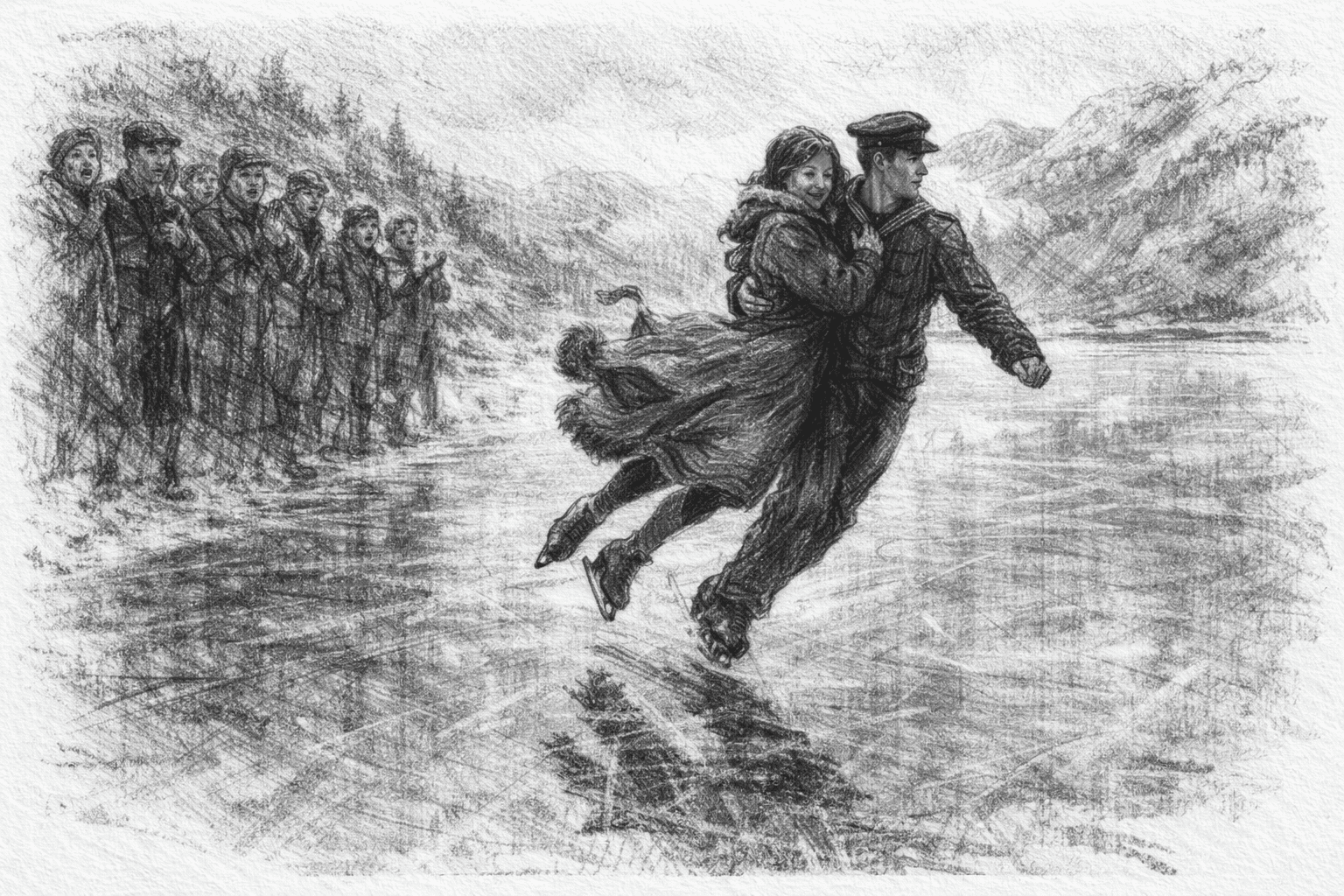
We also took trips, extending over several days, when I would be absent from school. One time we went home to Finnøy. It was winter. There was ice, and one day we went skating. A large group of youth had gathered. Olava had no skates, and probably could not skate. But that made no difference; I skated and carried her on my arm. My sisters were afraid I would drop her, but she did not have any fear, and seemed to like it. It must have been a very cold winter, because I can remember we went skating several times near Stavanger, once at Mosvannet. Another time we drove a horse and sleigh on Breivannet. right in the city.
All this, of course, was great hindrance to my progress at school. Olava was anxious that I complete my course, and take examination as soon as possible, and she seemed to have no doubt that I would pass. Every afternoon, when she came to town I always understood she did not like to go home unless I went along, so, what could I do? There was always chance to get back to town in the morning with the milk transport boat, though it would be late for school.
We went to the meetings held in the Bethania Chapel Sunday evenings, where we heard Rev. Lars Oftedal preach and his great choir would sing, under direction of Mr. Davidson. They sang a capella. so we could hear every word of the songs. And I also remember some of the songs Oftedal would sing as solos with his excellent and powerful voice. Journeying over to Roalsøy after those meetings, we would try to sing some of the songs. The words of one of them were about as follows:
Come to your Savior; do not delay, Here in his word he shows you the way. He loves you tenderly; hear him today, Calling and saying: Come!
[Chorus] Blessed, blessed will the meeting be when from sin and sorrow we are free. Then with our Savior glad we shall be, There in his angel choir.'
It was not seldom in those days people would sing religious songs on their travels over land or water. And the distant sound of song, especially at night on the sea, was extremely beautiful and cheering. Often, as we arrived at Olava's home, she would conduct evening worship with the whole family gathered for that purpose.
The time went rapidly. Soon it was spring. But now the clear sky of my fortune seemed to become overcast. Somehow I had acquired a kind of sickness that made me cough, at first only slightly, but very persistent. I did not feel really sick; but yet was far from in usual health. The vigor of youth and bright hopes were leaving me, and I was losing weight. My folks at home thought it was the hard work at school that was the cause. But I felt it was something else. I became despondent and dispirited, and the life on the sea began to appear less attractive. But I determined to say nothing about this to Olava, and would not go to any doctor for advice. I remembered that some of my brothers and sisters had died of tuberculosis at about the age I was now approaching, and I had seen how that sickness acted on them. And yet I did not entirely give up the hope of recovery.
It was now near the time of examination in the school, but the nearer that date came the more apathetic I became. If it had not been for the sake of Olava I had probably given up entirely. I had understood that the examination was difficult to pass, and that many who tried had failed. One day the dean told me that if I intended to be examined that spring I must make application. I did not care a great deal, but I knew Olava would be much discouraged if I did not try, and more so if I failed to pass.
There were only six who applied for examination at this time. It took three days to write the examination, each day on different subjects. The examiner was Capt. Knap, of the Navy, with Capt. C. H. Paderson and N. Hillieson. as censors. Two of our group failed the first day, the second day two more. So there were only two of us left, Hamre and myself, the third day. The prospects were not bright.
I had lost my desires for studies, and it seemed more like some mechanical process, which I would be glad to complete without further delay. The work we did each day was brought to the examiner for marking or grading. The third morning I was called into the office of the examiner, and asked: 'What have you done here?' as he pointed to my paper of the previous day. I saw immediately that I had made a wrong calculation and drawing. It was a difficult problem, as most of them were. In this particular one there was an imaginary voyage across the Atlantic in the equatorial latitude, and the noon-day observation was to be made and the position ascertained. First, we were to get our position by the log, or the measured distance traveled since last noon. From this calculation the present position appeared to be 10 minutes south. I had made a diagram showing that. Then I figured the position by observation of the sun, and by that it was shown our position was 10 minutes north. So I wrote under the drawing that the latter was the correct standing. This was the customary way of showing the correct reckoning. I said to him that the figure of the log reckoning was incorrect; that I had written underneath the correct calculation, namely, 10' north. Then he said: 'How can I understand what you mean when you put up a drawing like this?' I admitted there was probably nothing I could do about it now, but I had really meant the solution of the problem as was written at the close of the calculation. He said he thought it too bad, but finally indicated I had better continue with the third day's work. Later I found that the two boys who had failed on the second day's work had made the same mistake, which I made, but had failed to write below that the sun observation was correct.
The last day's work was 'To Sail By The Chart.' We had to imagine ourselves in charge of a ship, drawing 14 feet water, and mark its course on the chart from Skagen, Denmark. to Leith, Scotland. Wind and speed was given. The main difficulty was that when we reached May Island in the Firth of Forth we had to use a map laid on a much larger scale. We had learned that, in using two different size charts we must go over on the larger before we reached the black line of its limit. This could not be done in this problem unless we measured the distance according to scale at the lower end of the chart. If we measured the distance on the latitude scale given on the side of the chart, we would come exactly to the black line limit, and that was what we had learned must not be done. But I had learned that the distances always had to be measured by the latitude scale. Here were two conflicting rules. Which should I follow? There was a great chance for making a fatal mistake. I decided to take the distance according to the latitude scale, let it land where it will. No ship could be lost by running up against the edge of a chart, but to make a wrong calculation would be more serious.
To help each other, as students, while taking examination, was prohibited. Each man would sit in his stall, and see or talk to nobody else while writing. There was also an old chap who walked around the room and watched if any cheating was done.
Hamre sat in the next stall to me. He had difficulty with the problem I have just mentioned, and knew if he should fail on this he would not pass. 'Need breaks all laws,' is a saying, and when he noticed the watchman was not looking, he stuck his head out and asked me, in a whisper, how to measure the distance. I thought I ought to help him, and I said, 'By the latitude scale.' It appeared he believed I knew, but there was still some misgiving, and again he whispered: 'It is bad now if you are wrong.' I told him not to fear, but do as I said. Now, it so happened that he was called into the examiner's office before me. He took his chart along, but soon returned, red in the face. I knew something serious had happened. When he passed me he leaned over and looked at my chart, said nothing, and took his seat. As I later learned he believed I had told him a lie, but when he now saw my chart and knew I had done as I told him to do, he probably thought it would be well for me to take the consequences. Then I went in, by request, to the examiner's office. He grabbed his compasses and began to measure. Then he called out in a sharp voice: 'What have you done here? This is all wrong?'
I did not get nervous; but I noticed that he took measurements by the longitude scale. He looked at me sharply, expecting an answer. Putting on indifference, I said: 'I have not learned to take the distance by the longitude scale.' Then he seemed to become somewhat disconcerted, grabbed his compasses again, and began to measure. Then he looked at the censors and said: 'It was right the way the other boy had it, too.' And they nodded. I had been told before that the examiner would probably use trickery to scare me, so I had to be prepared for that. But I rather think he was mistaken in this instance, and did not at first notice it. He soon changed his attitude, becoming more mild, and told me all my work had been well done except, perhaps, the drawing I had made yesterday; he did not know what to do about that. Then he fired questions at me for a long time, covering nearly the whole subject of navigation. I felt sure he would catch me wrong on some question. But, thanks to the many good oral lectures of Prof. Nilson, to which I had given good attention; he was so well versed in the whole subject, and so clear in his explanation that I had absorbed most of what he had told us. It was good fortune that had directed me to listen to him.
When the examiner heard I was able to answer, he became more calm and easy. He understood I had some correct ideas, regardless of the erroneous figure I had made. Then he said, 'Now you may retire for a while, and you may tell the other young man in the room to wait a little while, and your certificates will be prepared.'
Then I told Hamre, 'It was correct as you had it.' He jumped up, as if out of a dream: 'Was it correct?' 'Yes,' I said, 'it was the examiner who had made a mistake.' He became amazed and overjoyed, forgetting almost where he was at.
After a little while we were called in by the examiner, and given our certificates. We thanked him and the censors by a handshake. They wished us success and good luck. When we came outside Hamre took my hand and thanked me heartily for helping him through. He said it would have been a great disappointment for his mother if he had failed. And as his money was all spent, he could not have continued at school and tried to take examination later. I said I was really glad to have been of help to him. Then we parted, and I saw him henceforth never.
This was April 1, 1879. and, sure enough, the attempt had been made to make April fools of us, without success.
The navigation course was thus completed. I had the diploma in my pocket. My family, as well as Olava's folks, was all pleased and extended all sorts of congratulations and well-wishes. But at the same time they had never had any doubt about my passing, and it seemed only a matter of course. And, really, what advantage was now gained? I was sick, and would probably not be able to make any use of the knowledge about navigation. It seemed impossible to take up service at sea in my present physical state.
And there could be no thought of getting married. My money was all spent. If we should have married it might have been only a short time and Olava would have been a widow. But no word was spoken by either of us about such things. If I had said so, she would have married me at any time. We could somehow read each other's thoughts. And there was a secret wish we both had that she ought to marry a real navigator, not one who had merely completed the course of navigation. She had an excellent home with her parents, and could be of much comfort to them. And for myself, her home and my own home were open and offered all reasonable comforts. Everywhere I was received and treated as a guest.
As spring came on with milder weather it was my thought that the cough I had developed might desist. I took life easy, but it became tiresome to spend week after week in idleness. And, gradually, it seemed, I was losing strength.