
Back in Greenock, I was told a Norwegian schoonerbrig, of Kristiansand, had come in from South America, with a cargo of sugar, and that it needed a second mate. I moved fast to get onboard that ship and find the captain. He had just discharged his second mate for drunkenness, and wanted another. I applied for the place, showing my papers. He accepted me gladly and I signed contract with him. The ship was to go to Cuba and take on a load of sugar for Boston. This suited my plans exactly. I wanted to get to a warmer climate, to get a complete cure for my frozen foot. And here, in a strong, fine proud little ship, by name 'Favorit', Captain Reinertson, of Kristiansand, I shipped as second mate.
As soon as mustered in, I took my belongings on board. The cargo had not been discharged. It was brown sugar, in sacks. It took a couple of weeks to get the sugar out. Then we moved down to Troon, and took on coal. This was about three weeks after I came to Greenock, and it was now about Christmas time.
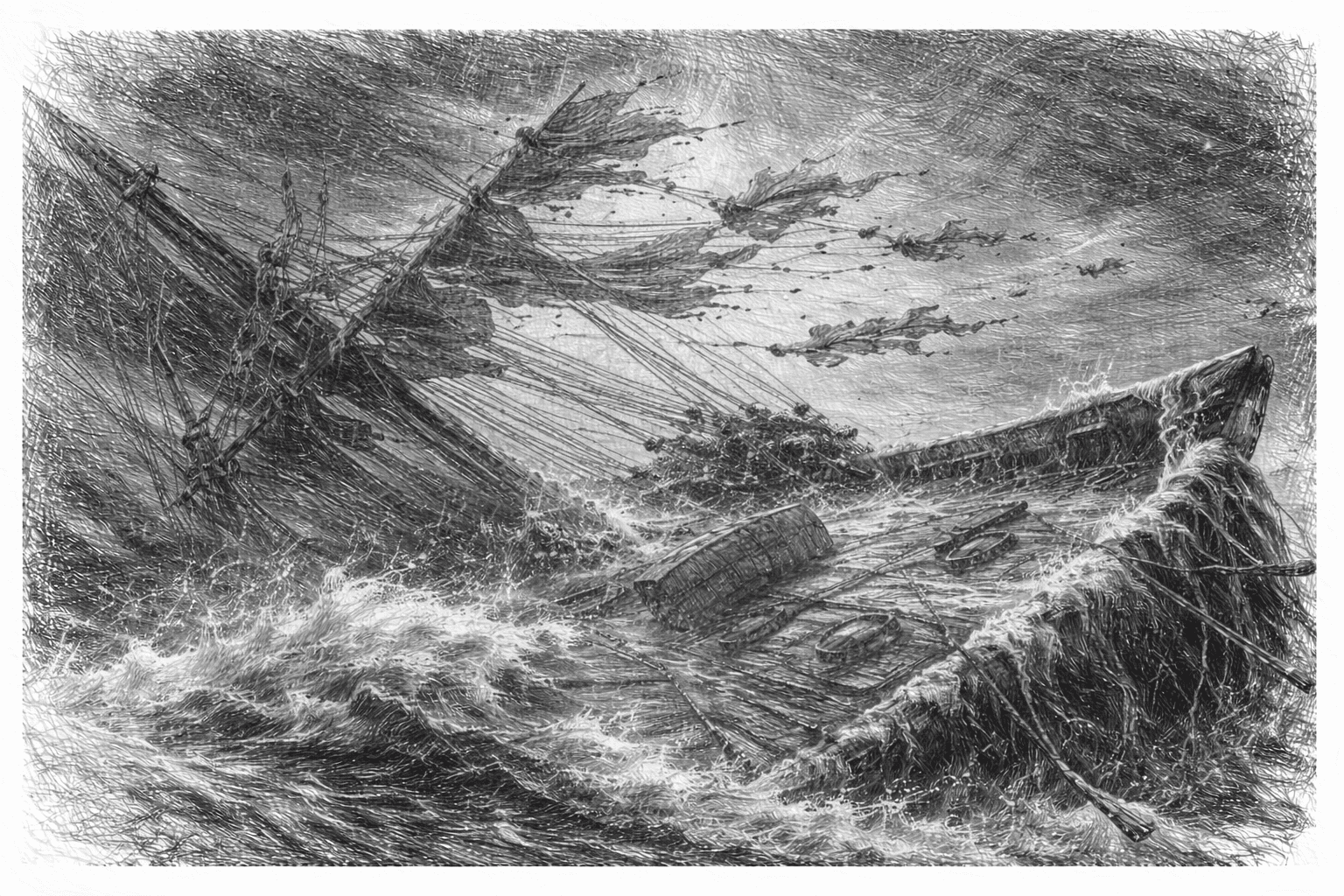
We stood out to sea, and set our course southward to the tradewinds. The wind was brisk from northwest, and she ran as in a race down the west coast of Englan, over into the bay of Biscay, where the wind moderated, and we set all sails. After a while there came up a black cloud in the west, advancing rapidly. The captain noticed this cloud. I asked him if it would not be best to stick up and make fast some of the sails. 'Wait a little,' he said, 'I believe it is only rain.' After a little I saw white foam on the water under the cloud. 'It is a storm', I said, 'See what a froth and foam there is on the water.' 'No', he said, 'It is only the rain that is whipping the sea into foam.' But the next minute the storm struck us, full force. The ship lay almost entirely over on her side. The captain and I had to grab hold on the windward railing, and hold on with all our might, as the dock was nearly vertical. There was din and roar and howling so fierce it was impossible to give any commands to the crew to do anything. They could not have heard a word, and they had all they could do to take hold and cling to whatever seemed solid, like we did. I happened to look at the captain. His face was white as a cropse. He did not utter a word. The ship lay entirely on her side for about fifteen to twenty seconds. The main staysail sheet snapped; then the sheet of the fore-course broke; then, one after the other every sail was blown to rags, and flew like flocks of sparrows off to leeward. The sea was all foam and froth. The sail-rags flew horizontally as far as I could see them. Every time the sails flapped and struck it sounded like a cannonade; the rigging shook and vibrated so I thought every second it would have broken down and gone overboard. But it was not long until the sails were torn to bits and strewn over the ocean, and then the ship began to life and come back on right keel again. Only once, besides this, have I seen such a tornado at sea. The sea became level as a floor. Every wave that tried to lift itself was made into foam and spray, and driven like a white smoke over the level surface of the water. It appeared almost like a fierce blizzard on the prairies of the Dakotas. But this storm lasted only about thirty minutes. As soon as it began to abate we were ordered to go up and make fast a few remaining little rags of sails. The biggest part remaining was about one-half of the fore-course. I went up ahead of the men, to get this done. But when I got on top of the rail and took hold of stays to enter up, the wind was so strong it held me aginst the cordage and i could not go aloft, but had to descend. We were all glad the rigging had not gone overboard.
Now, our bad luck was we did not have but a few reserve sails. Still, we had a good supply of sail-cloth. We beat the sails we had. Then eight of us, who could sew, set to work sewing sails. It took about three weeks before we had the new sails ready.
We reached the belt of the tradewinds when about three weeks out of Greenock. Then we went barefoot, and clothed only in thin shirts and overalss. I can remember so well how happy I felt, and how I pitied the boys who were then sailing in the frosty air of the North Sea and Kattegat, while we had sunshine and summer with such agreeable temperature. Since we lost our sails and had to make new ones, we did not proceed very rapidly, and it took about 6 weeks to reach Cienfuegos, Cuba. Here it was dry and warm, though not near so hot as in Jamaica. But this was early spring, so the sun was not as far north as it would be later, and it was plenty hot for us who came out of the wintry North.
To unload the coal took quite a while. It had to be done by the crew. But what did we care, if it took time? We had good fare, and the climate was agreeable, if we did not work too hard. And, as the Americans used to say: 'More days, more dollars.'
We went ashore frequently of evenings and Sundays, to get acquainted and inspect the place. The city lay nicely on the level ground, and had regular and roomy streets. The houses were not so bad; but the sanitation in the streets was poor. There was all kinds of debris everywhere. Many dead cats and dogs lay rotting and frying in the sun along the streets. So the air became polluted with smell and stench. It is not to be wondered at that Cuba was often infected by yellow fever.
The population was double mixture of Spaniards and Negroes; some wereone and some the other, and some were both or a little of each. Really, it appeared as if the Spaniards and the NEgroes made a suitable combination, as a mixed race. They were both proud and conceited.
We learned, however, that in this stinking place we could buy a most delightful perfume, called Florida water. We paid a Mexican dollar for a bottle of it. On the label on the bottles we could read that this perfume was made in New York. It was, nevertheless, and notwithstanding, a most refreshing perfume. Of course, I bought a bottle of it to take home to Olava. It lay in my sailor-chest for about a year. But when I finally came home and opened the chest to take out the bottle, I knew at once something had gone wrong. All my clothes smelled Florida Water. The cork had loosened and half of the contents had spilled on my clothes. What remained in the bottle was very much enjoyed by Olava. The bottle was also of fine form and the label was a master-piece. But the biggest thing about it was, it came from Cuba, and it had crossed the Atlantic three times.
We soon began to take on our sugar cargo. It was in great hogsheads, so it did not take us long to put in a load. Only about 580 barrels filled the hold.
We left Cuba, setting course eastward, to get out beyond the Bahamas before turning north. Small breezes made us advance slowly. Out among the islands, one day, we saw a shark in our wake. It kept at the surface, so its dorsal fin was out of water. These enemies are hateful sights to the sailors, which they are always ready to kill. It is said to be an ill omen when a shark follows a ship. This one was keeping itself at some distance from us. We took a chunk of pork, about two pounds, put it on a big hook at the end of a long line and threw it overboard. When the shark saw the pork it made an effort to get it, but we hauled in, because we knew our hook and line were not strong enough. The shark then lost sight of the port, and ran around hunting for it. Then we let it out again, but hauled it as soon as it saw the bait. By this method we coaxed it to come up to our stern. There I stood ready with a harpoon, which I drove into its neck with all my might. We had a strong line on the harpoon. Three men took hold of it and pulled but were not able to do more than lift the shark's head out of water. Unfortunately, the rod of the harpoon did not get out of the way, and when we had the shark under our stern the upper end of the rod interfered with the gold-plated name plate of our ship. When the captain saw that he said we were going to ruin that costly name plate. The shark was swinging its head from one side to the other, and our nameplate was struck severl times by the upper end of the rod. If we slacked off we would lose our victim, but the captain would not permit the scratches on our golden name, so we had to slack off. No sooner had we done so than the shark puts head down, tail in air, and beat the water so violently that its spray covered us and teh whole after end of the ship. The three of us had all we could do to hold it. In the flying spray, we could not see, and for a while we did not know what to do. But, all of a sudden, something broke; the line slacked as if broken, and we fell backward. As soon as I got my eyes open sufficient to look, I saw Mr. Shark gliding slowly away, with the harpoon standing straight up out of its neck, and the blood from its wound making a red streak in its trail. I judged its length about 15 feet. We found the rope had broken near where it was fastened to the harpoon. Thus, all we had for our efforts was a lot of hard work, a good wetting and the loss of the harpoon. But our enemy also had a mark from the battle, and might remember it a long time, carrying the harpoon in its neck.
With the load of sugar in the hold, we began to use sugar quite freely in our diet. 1st mate and myself had great taste for sugar, and here was an opportunity to eat all we desired. The steward took a sack, went to the hold and opened a hogshead, filled the sack and brought it up, and we helped ourselves. When the sack was empty, he filled it again. The captain knew about it. We had a great big bowl, which the steward filled every day and put on our table in the cabin at every meal. First mate and I frequently took a couple of tablespoon full each in our coffee, so the bowl of sugar did not last more than a day, and sometimes not so long. One day, as we sat about our noonday meal, the captain who was also at the table, took notice of the amount of sugar we used in our coffee and, with considerable empahsis, said: 'If I were to furnish you men with sugar then you may be sure you would not get that amount of it. But since it costs me nothing you can eat all you want of it.' But it was not only at meals we ate sugar. In the nights, when on watch and duty, I would go into the pantry and take a big slice of bread (the steward baked fresh bread every day), put plenty of butter on it, and then about half an inch of brown sugar on top, and then go out on deck and eat. Or, even when I did not feel particularly hungry, I would go to the sugar sack, fill my pockets, and eat. I could not notice that it hurt me in the least though I continued to eat sugar like this for several months.
North of the Baham Islands we met stormy weather and high sea. The ship rolled and pitched a good deal; and now and then we could hear a disturbance in the hold. Probably it was some of the big hogsheads of sugar that had in some way been set free to roll around, and now being crushed against others. We could do nothig about it. It was dangerous to try to go into the hold because there was a heavy gas from the sugar, and the air had been confined there for a long time, and there was danger of being crushed if we should try to go in among the hogsheads. We knew some fo them were loose. So we let them alone until the sea became more calm.
We proceeded northward rather slowly, as the winds were mostly contrary, but finally we swung west around Cape Cod and stood in Boston Bay.