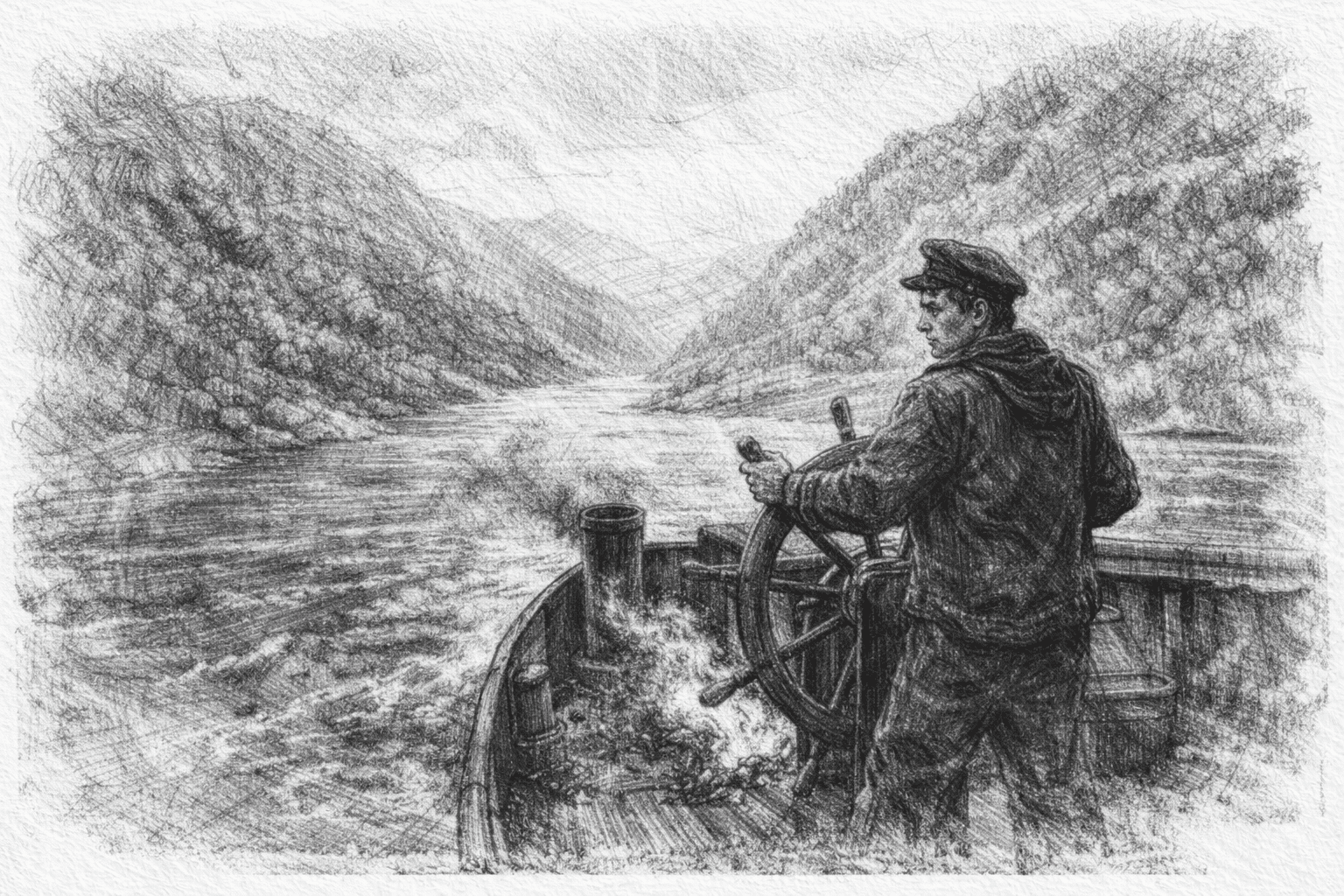

Time passed. The mild weather was here, but my cough would not leave. So I concluded to go to a doctor and hear his advice. I went to Dr. Due in Stavanger, whose father was a good friend of my father. He examined me carefully, and when he was through and I asked him if I had tuberculosis, he said, 'Not yet, but it can become tuberculosis.' I understood he did not like to tell me; but when he, among other things, told me to take codliver oil. I understood what it meant. I had seen that used by my brothers and sisters who had died. He might as well have told me plainly. He did, later, tell some people who were to see him that I had tuberculosis.
What was there now for me to do. I was not sick. I felt no pain; and yet I felt not entirely well. Probably even the doctor could be mistaken. Why should I now begin to wait for sickness, pain and death? Why not rather hire out and go to sea? Soon it would be mid- summer and the best of weather. Who knows but I might get over it?
So I went in search of some ship where I might find place. But few ships were in harbor; and a position as navigator, which would be 2nd mate, was not obtainable. But one day I met a Mr. Helland. who was a hiring agent of sailors. He wanted to know if I would accept a position of boatswain with a schoonerbrig. This was the best he had for the present, and if I would take it he would go with me and see the captain at once. It happened frequently that one could not obtain a position as navigator, or mate, first thing after receiving diploma from school. One had to take the best available, if he did not want to remain idle.
I went with Helland to the home of the captain. He was a rather small, middle-aged man, with black full-beard. I gave him some facts about myself, including that I had finished the course for navigator. He said he needed just such a man, as he did not have but one mate. According to the law of the sea, ships of less than a certain tonnage were not compelled to have two mates. But here, in event of need, I could take the place of mate. He told us that his schoonerbrig was loaded with salt, which was to be brought up to Vardøy. northern Norway, and he would be ready to sail as soon as his crew was complete. He wanted me to go immediately to the mustering office and sign contract. When we came there I learned the name of the ship was 'Allegro.' I did not know why, but I disliked that name, though I said nothing. I mustered in as boatswain and sailmaker, for two years, or the voyage. But I did not think such a little ship would stay out very long before returning to home port, at which my term of service would expire.
When the people at home and Olava learned that I had hired out they were surprised and did not know what to say. I did not think there was any danger in it. If I should become really sick I would not be so far away that there would be no opportunity to return. It was unpleasant to think of parting, in my present condition, but they were unable to either discourage me, or advise that I go on the voyage. If it was possible that the voyage would afford me a cure then it would be folly to hold me back. They thought I had better follow my own judgment in the matter.
The next thing was to get my things together and come aboard ship. Olava helped me. I had not seen this ship before; and when I came onboard I like the ship still less than its name. There was no overbuilt forecastle. It was all under the main deck. When I came down there I found it to be a little dark, dirty, stinking room, loathsome and disgusting. Nevertheless, I must now try to take up with things as they were. I had mustered in and could not very well refuse to serve.
Being the first man of the crew to come onboard, I had the right to choose the best place in the forecastle for my chest, and the best bunk. There was a little table fastened to the forward wall. I placed my chest so I could sit on it and use one side of the table. Later comers who have the right to choose the next best places not before taken. After I had placed myself, there came a seaman by name Frøyland. a very proud and self-conceited man, probably 25 years old. I soon noticed he was dissatisfied because I had the place he had intended to have. Thereafter came Tobias Bjøravaag. from Finnøy, a young, large and brave fellow. He was youngman, and I think this was his first voyage. The other members of the crew I do not remember well enough to give their names, but they were all good men. The mate was a middle-aged man, who wore a heavy brown full-beard. His name was Abraham Hjelm. a brother of Paul Hjelm. who was mate on 'Nanna.' the brig on which, as cook. I make my first voyage. He was a straightforward man with whom no one need have any disagreements.
It is not necessary to tell more about my departure from home and relatives, but it was unusually drab and heavy, as we all seemed to be well impressed with the possibility of never meeting again in this life. Better get away in a hurry and shorten the grief.
There was no singing when we lifted anchor and set sail this time. Sadness and melancholy pervaded all. The weather was, however, fine and we came out to sea readily; and now began one of the most remarkable and eventful periods of my life.
Well out in the North Sea, this wind became northerly, and we had to tack; and we learned that life aboard this ship would not be easy, because the rigging had been so clumsily made that we had to pull for dear life every time the ship was to go about. The sails could only be hauled around with extreme efforts, and the situation seemed to be by planned arrangement to keep the crew in slavery.
Now I also learned that a former captain of this ship, and part owner of it, and a man who was well known by all sailors in Stavanger, as well as in other ports, went under the name of 'Fa'en i Nordsjøan', (Satan of the Northsea ). When I heard this I understood the connection. He had, indeed, deservedly been given that name. Whether it was out of an evil heart, in order to maltreat his men, or on a plan to save money by not providing sufficient easy-working tackle and sheets, never did I see another ship where everything was so heavy, unhandy and awkward to handle. The crew consisted of only 6 men besides the 2 officers, and we certainly had to work like slaves. The food was, however, tolerably good, so there was no complaint about that. But that man Frøyland had a grudge that he could not suppress. The place I occupied, in his opinion, belonged to him. He finally began to express the reason for his claim, namely, that he was a man of superior character and reputation; and he was therefore entitled to have the use of the little table. He repeated, in many versions, what great experiences he had had, and how well he consequently deserved to hold a superior position in the forecastle. I let him understand that I, as first man in the forecastle, had the right to the place I selected; that I also, as boatswain, had the right to be placed ahead of him; and that he must not think I was disposed to yield to him in this matter.
He knew he could do nothing about it, but he never forgot his grudge as long as I was aboard the ship. When he noticed I did not listen to all his stories of self-exaltation, it made him no less inimical. But by good fortune he was placed on starboard watch, while I was placed on larboard.
With fine weather, sunshine and fair sailing breeze, the progress was good enough; but with prevailing conditions of a small, stinking hole of a sleeping room, where there was no other ventilation or light than through the small hatch, one may readily understand this was no place for a sick man to regain his health. My supply of several large bottles of cod-liver oil, though taken regularly and in large doses, did not seem to have any effect. The cough continued, but no worse than before.
Gradually we worked along the coast to the north. The nights became lighter, until we were where the sun did not go down. It was in the month of June. In tacking, we took long runs to sea, so we did not have to turn so often. One time we came in quite near the mountains of Lofoten. and observed what a dangerous coast that is, on which to carry on fishery in the stormy winter season. There was not a green spot visible; only naked, gray rocks.
After we passed Lofoten and the coastline turned easterly the wind became more commodious, and it was just strong enough so we could use all sails, so our progress was now all that could be expected. Soon we passed North Cape. We sailed near enough to get a good view of this most famous northern promontory, lying at 71° 15' north, and 26° east; but we did not think it was a great sight. There was only naked gray cliffs and mountains everywhere. The stillness and loneliness was something impressive. The endless sunshine also had its effect, and the long, cold and stormy winter night would be equally if not more dreary and depressing.'
After a while we also passed another promontory which extends equally far north, and is called Nordkyn, or Kinnarodden. From there we followed the coast southeasterly, quite near land, with a favoring wind, until we reached Vardøy, the most northeasterly point in Norway.
This was a fearfully barren and rocky coast. Not a green spot was visible, not a tree or a straw of grass, only crags and gray cliffs, and moraine of loose rocks and stone reaching down to the shoreline in some places. Here and there a gray hut could be seen. We could not understand how people could subsist in such surroundings. There were no human beings ever in sight around or in the vicinity of these houses.
The harbor at Vardøy was a snug little bay with a narrow entrance, which had been made even more narrow by a stone and cement breakwater. Thus, its harbor was excellent. Vardøyhus fortress lay on a little elevation near the insailing. It is the most northerly fort in the world. At the inner end of the bay the city was built up along a valley.
It was a town the like of which I have never seen. Gray, bare rocks came right down to it on all sides, or there were gray, rocky morasses in places where inclines were less steep. The exterior of all houses were weathered wood, without paint. Great quantities of codfish hung on drying frames or stakes, on the outskirts of the town. A large pile of gray deer antlers lay a short distance from the wharf. Many small folks, Finns or Laps. clad in gray deerskin coats, were to be seen. Everywhere and in all directions, wherever you looked, it was gray, gray, gray.
Going ashore and looking closely I found there were a few places, in small crevices in the rocks, where a few spears of grass and some flowers grew. It was all the vegetation I could see.
These Finns or Laps were queer looking people, disposed to take life easy, much like our American Indians. They did not hasten, but with a rolling, duck-like step, they would lolly along, as if thinking, 'if we don't get there today we may get there tomorrow.' But something else about them I must mention. They had black caps, with square, flat tops, just like our college graduates. It made me wonder whether it was the Laps that had adopted the mortarboard from the college students or vice versa. It must be the latter, because the Laps had probably never seen a college student. Something more remarkable about those caps; they had a red line sewed in all around the top. This I thought was an improvement the students should also have adopted. Some had even the topknot, like the mortarboard, others were without it.
Not long after we had anchored, aboard came Russian fishermen, to buy salt. The Russian fishing boats were odd and peculiar. They had a large mast forward, and a small one aft. They were apparently very roughly built. Nothing but an axe had been used for a smoothing tool for the planks, the oars and spars. No such luxury as paint was seen on them. It appeared as if paint was rather an unknown article here in the north. The Russians bought salt in 50, 100 and 150 barrel lots.
In this place there was now no difference in night and day. People were on the streets, and the stores were open at all times. It was a 24 hour business day. Our time for rest and sleep became somewhat irregular. When the fishing smacks would come for salt, one after the other, we would work until all had been supplied. Thereafter we would try to catch up on eating and sleeping.
Soon we learned there was an abundance of small codfish in the waters of the harbor. So we secured lines and caught many of these very excellent tasting fish. Whether it was at noon or at midnight, after we had worked for 16 or 18 hours, and sometimes up to 22 hours in a stretch, we would enjoy a good meal of these small, fresh cod.
The captain developed the habit of turning the hands of the clock back or forward, to suit his taste and notion, thinking it was best for us not to know exactly what the time might be. But after a little we learned what to do. We looked at the compass and there we could see where the sun stood, and would then know what time it was without the use of a clock or watch. The captain feared we would refuse to work at all odd hours, but no complaint seemed to be made for the length of hours; rather, we became somewhat lazy, caused by all the fresh fish we ate. There were periods when no Russians showed up. Then we slept. One Sunday I went ashore to look around. A great many wooden vats stood on a part of the wharf. They were probably 8 – 10 feet across, and 4 – 5 feet in height. These vats were full of cod liver. This had decayed underneath, and on top there was a foot or two of clear, fine codliver oil. This oil which had come to the top is what is called No. 1 codliver oil, and is used for medicine.
Cod fishing here is pursued in the spring. At this time all boats of local fishermen had been pulled ashore. I inspected them somewhat closely. Some of them were large, probably 8-oar boats. They had a small covered compartment aft, which I suppose could be used for a place to sleep. They were tarred or pitched inside and out. Then I looked at the stockfish drying racks. There were wooden stakes elevated about 6 -7 feet above the ground. All these were about 4 feet apart. Seven of such racks, so far apart, extended about ½ mile over the bare rocks. The fish hung so close on the stakes that one nearly touched the other. At this time it was all dry as wood. The weather is cold in the fishing season. As soon as the fish is cleaned it is hung up, two by two, by the tail fin, slung over the stake, one on each side. It freezes almost immediately, and remains frozen until it is dry in spring or early summer. All stockfish here was round, not split, and was in natural shape, minus head and guts.
The flow and ebb of the tide here was greater than in other places on the Norwegian coast. I believe it had a variance of about 23 feet from high tide to low ebb. Near in to town there was a fine solid sand bottom, and when our cargo was out, the captain decided to take the ship in there at high tide. When the tide went out the ship ay dry on the sand. We were then ordered to clear the bottom of barnacles. This ship had no copper coating. First we scraped off the barnacles, then scrubbed it clean, and then applied a coat of coal tar. By moving a few things on deck from one side to the other, we could make the ship lie down on one side or the other at will, so alternately we cleaned and tarred both sides of her bottom.
One day, during this work, I managed to take a bad cold. The temperature was low, even though the sun was shining constantly. The associations on board ship had not been cheerful, not was there now any improvement. I had continued to do my assigned work, although it had at times seemed very tiresome and heavy. The coughing had continued. But now I was compelled to go to bed and stay there for a couple days.
Then I asked the captain if I might go and consult a doctor. He gave me permission to do so, and went with me to the doctor, who was a friendly and agreeable man. He examined me carefully, and when he had finished I asked him, as I had asked the doctor in Stavanager, if it was tuberculosis I had. 'No yet,' he said, 'but it may come to that.' Then I thought: 'So they are entirely in agreement that I have tuberculosis. I asked him if there was any danger in continuing on the voyage. He did not believe there was any particular danger if I was careful.
The captain was sitting there, and I understood the doctor was not saying exactly what he meant. I was given some medicine, and when we came out of the doctor's office I asked the captain if he would have me mustered out, as I was sick and had, apparently, no prospect of early recovery. The ship was to go to Vadsøy and take on codliver oil and go to Hamburg. 'No,' he said, 'I cannot let you go unless you get a man to take your place.' 'How can I find a man to take my place, bound as I am to be onboard ship all the time?' 'That is your concern' he meant. I did not believe there would be any sailors available here where there were scarcely any ships, and no place for idle men to stay. So I went back to the ship quite discouraged. I began to work again, but I felt I had to get away, if there was any possible chance. This ship was a prison, where there was no hope of ever recovering my health.
After a couple days the captain came and told me he had found two men who would go with him to Hamburg, without pay, so now I could be mustered out if I cared. I was overjoyed. So there were sailors here, too, looking for hire or a chance to go somewhere. Yes, I told the captain I was glad to be discharged, and off I went with him to the mustering office. The officer there was a very kindly and accommodating man. He asked if I had received all that was coming to me from the captain. I knew I had very little coming to me, as I had drawn a month's pay in advance, so I was not worrying much about that, but, as he asked me, I said, 'no.' He looked at the captain, who suddenly appeared somewhat uneasy, and asked him if he had paid my doctor bill. He said he had, and that it came to much more than I had coming. Then the officer told him the doctor's bill should be paid by the ship, and he ought to pay me what was coming to me over and above that. I had known before that the captain was tight fisted and would take advantage of his men, but I did not think he was as small as all this. He had to pay me all of four kroner, ($1.00), but that seemed to hurt him as much as if he had lost 400 kroner. And he gave me some unfriendly words at the same time, while the officer stared at him, and, no doubt, wondered what kind of captain he could be.
Coming out of the office I felt as if in a dream. Now I was discharged, but, now what to do? No money, and here in a desert place where there was no employment to be had. Now I had surely put myself in the very worst kind of situation. I had been wishing to get away from that ship, but had made now plans for what to do after that. The truth dawned on me. 2100 miles from home. No money in the pocket. Sick and helpless. This was a discouraging prospect, indeed.
Looking out over the harbor and along the docks, and there lay a steamer, from Bergen. loading stockfish. It was the only ship in port, besides 'Allegro.' It struck me at once: Here I must try to get out of this tight place. I must get in a boat and row out to the steamer, and try my luck. When I came alongside, I saw an elderly good-looking man, standing up on the pilot house. I greeted him and asked if he was the captain. He said he was, and wanted to know my errand. 'I want to know if I can work my way down to Bergen.' 'No,' he said, 'I have full crew and need no more men.' That answer sounded like thunder over my head; but I looked on this as the only chance, and at once another question came out of my mouth: 'If I help you load, could I go along with you to Bergen?' 'Yes, if you will do that, then come, and we will take you along to Bergen,' he said, in the broad. grating dialect of Bergen which, indeed, was quite pleasant when one became accustomed to it.
If I had been up there I could have hugged him, I was so elated. It appeared as if this ship was there by order of Providence, to take me home; and I believe the same even today, - the reader may think what he will. It did not take me long to get my things and get aboard this steamer, a little freighter, by name 'Diana ', Capt. Sars. As soon as I was onboard I saw at once that here was a ship in which I would feel better. Everywhere inside, over and under deck, it was painted white. The forecastle was above deck, and had large round windows which could be opened for ventilation. There was an unoccupied, good bed, - as if planned for me. The crew consisted of young men by exception of one, and the matest and all received me as a friend and treated me very well as long as I was with them.
The loading continued, day and night. The crew was divided in two watches. One slept while the other worked. I was placed on my watch at once. The work of loading was not heavy. The fish was stowed and packed like cordwood; To make it more compact, we had to drive wedges into it here and there until the layers were solid.
The food served in this steamer was excellent, something like that at a good hotel. I have never been on any other ship where the food was so good all the time. Half bottles of beer were served to every man for the noon meal. Speak about change, - but here was a real change from former experience.
The elderly man of the crew was a Christian who read his bible every day. He was quiet and did not have much to say; but his influence on the younger men was easily noticeable. Not an oath or a rough word was spoken by anybody onboard, though the boys were spirited and lively.
One day I happened to look down in a boat which brought stockfish to our ship. There were boys and girls in that boat, perhaps not so very young; but I noticed that the girls were also gray up here. In fact, everybody was gray in the face in this town. I was told this was on account of the fish diet, and the cold climate. Grain was dear, and fruit was almost unobtainable.
The time passed rapidly and pleasantly. I believe we kept on loading for two weeks after I came onboard. Then we set out for Bergen. We had a man onboard who was acquainted on the course we had to take between here and Berge. He had acted as pilot on the way up, and now he was going to show the way back.
To sail the inside course down that coast of numberless island shoals, rocks and hidden obstructions, and know just where to go and keep out of danger would in my estimation require an extraordinary memory. From the time we passed North Cape he was on deck steadily for three days and nights. The captain eventually prevailed on him to go to bed. I was at the helm for a while, and all at once here comes the pilot on a run out of the cabin, as if he was scared. The captain asked him what was amiss. 'O,' he said, 'it appeared to me we were running amuck.' But the captain assured him there was nothing wrong, and he must take it easy and get some sleep. The responsibility for ship, load and crew weighed so heavily on his mind that he was in danger of nervous prostration.
Serving on a watch regularly it was my understanding I must do my work like any other man, but I soon learned the other men would make my work as light as possible. There were many brass railings and stanchions which needed polishing and I did some of that, yet I was made to understand there was no need of hurrying. I could take my time at it. It was little work, and rather only amusement. Often I had opportunity to talk to the officers, who were agreeable fellows.
We passed Hammerfest. and later, Tromsøy. I believe it was near the latter place we went through a strait called Rystrømmen. The current happened to flow in the direction of our course. I was told the spped of it was 7 miles per hour. The speed of our ship was also 7 m.p.h. I was at the helm when we went through, observing the beautiful green slopes and small patches of birch woods on either side. This was the first time I had seen any vegetation in a month. Men and women in small boats were fishing and seemed to be hauling them in quite lively. I could not see what kind of fish they caught.
Going inside of Senja. Harstad. and other Lofoten Islands we came down to Vestfjord to Bodøy. I do not remember many places, but Torghatten. an island with a hole through it, I do remember.
After a month, in latitude where the sun does not set, we came back to where it would go down. There had not been a cloud in the sky all this time. Now, one evening we were near Folda. where we had to steer out to sea, the sky became clouded, wind arose and there were signs of storm. The captain and pilot decided they would come to anchor in the shelter of some small islands and await morning before crossing the Folda.
Next morning, the weather being fair, we proceeded south toward Kristiansund. where I remember we passed through a sound so narrow I believe I could have jumped ashore either side. Passing Molde and later Aalesund. we came into Nordfjord, and passed a steep mountain wall with jagged peaks at top. As we passed close to this mountain wall the captain gave a blast of the steam siren, and we head the most remarkable echoes. They went from mountain to mountain many times. It was as if all the rocks were full of steamboats blowing their sirens, some nearer, some farther away. Another blast of the siren repeated the music. No wonder the old Norsemen believed the mountains were full of goblins, ogres and fairies.
Not long after this we pulled into Bergen, after 7 days voyage from Vardøy, and tied up at a piear near a large warehouse.
Now I was not so far from home. But what had become of my sickness and cough? I tried to think when the coughing had ceased but could not recall. That I was now in normal health was not to be doubted. I really began to wonder if it was tuberculosis I had had. Now, the reader will say, it was not. But let me tell something of very recent occurrence. Last spring, 1937, I felt sick, and went to young doctor Quevli, in Tacoma. He took some x-ray pictures of my chest. When he saw the pictures, he asked if I coughed. I said 'no', 'my lungs are in good shape.' 'Have you had tuberculosis at any time,' he asked. 'No', I said, 'I have not.' 'Yes,' he said, 'but can you not remember some time in your life when you had a bad lasting cough?' 'Now I remember', I said, 'When I was 19 years old doctors told me I had tuberculosis.' 'Well', he said, 'it was right there', and he pointed at the location of the upper part of my right lung. I was astonished and asked again if he really could see it now after the lapse of 58 years. 'Yes', he said, 'it is plainly visible. How did you get cured', he asked. 'Well, I became tired of going around and waiting for death, so I went to sea, and before I knew I was well and over it', I told him. And the young doctor said he thought that was the best cure I could have taken.