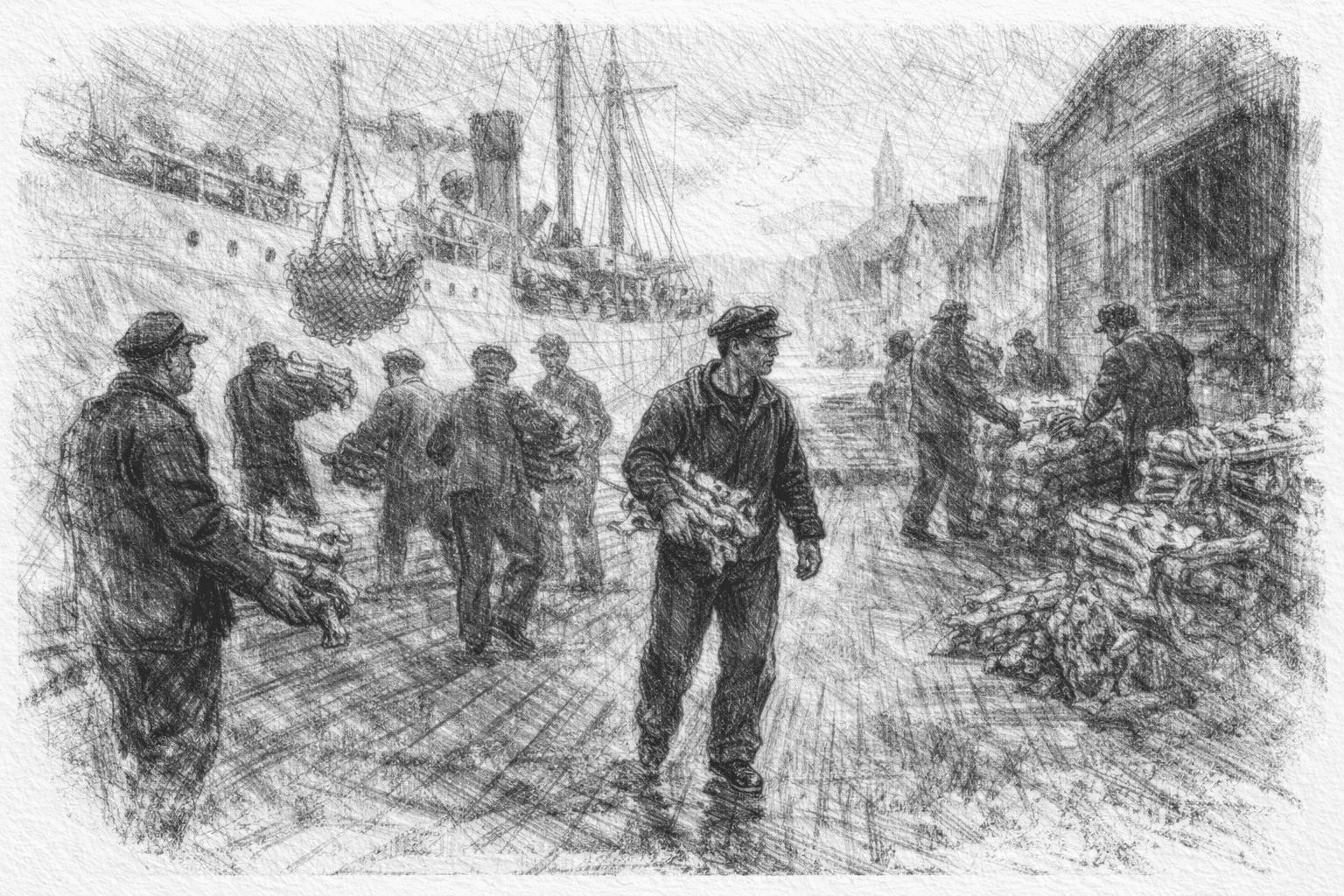

Now, in Bergen, I began to think of how to get over to Stavanger and home. Captain Sars then asked me if I had any money. No, I had no money. 'You may give us a little help to unload', he said. It is usually only men who have families that are employed on unloading, but since you have been a member of the crew, I will let you take a hand.' I was, of course, very thankful for a chance to earn a little money. 'You can lodge on board ship,' he said, 'so all you need is to go ashore for your meals.' This was a very good offer. No need of my hastening home now, if I could make some money. And I enjoyed life onboard that boat more than I had on many a big ship. It had been like a pleasure trip ever since I came onboard here. So I went to work next morning.
The longshoremen who were hired to unload were not of the kind one may observe in other harbors, who will run as if it was a matter of life and death. These fellows took it easy that one might say it was snail's pace. No haste was tolerated by them. I naturally had to do as they did; so it was certainly nothing but play work. And these Bergen stevedores all addressed each other by nicknames, and with their use of the broad Bergen dialect seemed to me something of the most amusing I had ever heard.
The work continued, day and night. Each shift was 24 hours. Then a rest of 12 hours. So when I began at 6 A.M. I worked till 6 A.M. next day. Then I began at 6 P.M. the same day and worked 24 hours. The pay was from kr. 4.50 to kr. 9.00 per day. My ration of food was served aboard ship, as before, making it unnecessary for me to go ashore for my meals. This made me think the captain had said nothing to the steward about it, or had really intended that I should have my meals free It was truly remarkable how this man seemed to regard me with a fatherly care, favoring me in every way since the moment I stepped aboard at Vardøy. Now I was earning a lot of money as I thought, and had nothing to pay for board and lodging.
When the cargo had been unloaded the captain asked me if I cared to stay and help load. I was, of course, glad to have this opportunity. This work was by shifts of 24 hours each, as before. Two groups worked in the hold, one fore and one aft. 8 men were in each group, but so divided that 4 men were in each shift.
We loaded stockfish again, which was now to be taken to the Mediterranean. But this fish was trimmed, that is, necks and tails had been cut off. Whether it was the same fish we had just brought in from the North I can not say. The trimming had made it easier to pack, and thus a larger load could be taken. The work was not hard, and I could well have continued with it for any length of time. Nobody hurried and there were no orders to hurry.
Feeling fine now, I would really have liked to go along to the Mediterranean. One day I asked the captain if there was a place for me. He said if a certain man of his former crew decided not to go there would be a place. But a few days later I learned the man had decided to hold his place. I thanked the captain for all his favors to me, and said goodbye to the fine men of his crew, gathered my belongings together and left the ship.
One of the coast-steamers, sailing between Bergen and Hamburg. took me to Stavanger. It was now early September; and what a change since three months ago, when I left here, sick in body and mind. During the first month out it appeared to get worse, then it turned, and now I was here, entirely well, and with renewed courage and bright prospects. And that was not all. My pockets were now full of money, too. I think I must have had about 200 kroner. It was at least twice as I could have had if I had stayed in the 'Allegro'. Throughout my life since that time has the steamer 'Diana' and captain Sars remained with me as a most happy memory. The 'Diana' of Bergen, had, indeed, quite a history. The men onboard told me that on a former voyage to the Mediterranean she had collided with a private yacht of the Russian Emperor in the Black Sea. and the yacht sank. 'Diana' was taken by an escort of Russian warships, brought in to Odessa. and fastened to the docks with chains and locks, and the whole crew was arrested. They said Captain Sars wept and said he thought that would be the last of all of them, as he did not think there would be a fair trial for them in Russia. The sinking of the Kaiser 's costly, goldplated ship would doubtless be a serious matter. But when the hearing was held in the maritime court it was decided the 'Diana' had held its course correctly, and that the officers of the imperial yacht had been at fault. And one may well believe Captain Sars was glad to escape the claws of the Russian bear.