
To be at home again, and under such favorable circumstances, made great happiness for my folks. Not long after I had returned home it was reported that the 'Allegro' was sunk near Kuxhaven, a seaport near Hamburg. All men were saved, but they lost all their belongings. I have many times thought of it. What shall we call it? I, regaining my health, on a veritable pleasure jaunt, and earning good money; while the men who remained in the 'Allegro' doubtlessly had many hard experiences, and at last their ship foundered and they lost all their belongings. I have mentioned Providence, and I continue to believe there is a mightier hand which guides and directs out lives, sometimes most strangely, and I have had many experiences to prove this in my life.
Great pleasures of home surroundings and associations with relatives and old acquaintances eventually change into a longing to get out again. With renewed health and strength this longing for far away lands came on apace. This is probably characteristic of the Norwegian people, and especially of those from Rogaland. In all the historic centuries they longed to see what was beyond the wide open ocean. The spirit of exploration and romance has led them. I felt it, as in childhood I used to sit and look out over the sea. There was a mystical something drawing me out and away. As if by magic the visions were made great and eventful. One could not be satisfied with a life of the common activities and mere wage-earning. And when one had once taken up the seaman's career he must follow through, whatever the fortune might be. I lived not only for myself, but for my betrothed.
Therefore, I looked again for a ship that was going out. There were few ships in port, and no places for officers could be found. There was one bark; I think its name was 'Vesterlide', which I heard needed a second mate. When I came to the mustering office I found the place had been filled by another man only half an hour earlier. That was poor luck, but I had to look further.
One day, soon after, I met broker Helland. He stood and talked to some sailor lads, and I learned that he was trying to hire a crew for a large bark, by name 'Semiramis', which was now lying at Flensberg, Sleswig-Holstein, and was to make a voyage to East India. He wanted fifteen men. He had already hired most of them but still wanted two common seamen, and asked if I cared to go along. Praising the fine ship, he said it would be a pleasurable voyage of about a year. I had hear much about East-Indian-men, and this was a tempting offer. A voyage to East India was something entirely new to me and I looked at it as something great. It was what was called a long or a great voyage and one could not really say he had been much of a sailor unless he had been to India or China. Moreover, there was here a prospect of a pleasant trip through the tropics practically the whole way, sailing in the tradewind areas, with the ease and comfort of which I was somewhat acquainted. The desire for adventure drew me toward distant, unknown lands. I must go.
The next day the whole group of us were to depart in the 'Kong Sverre', a coast steamer, to take us to Hamburg. From there we were to go by rail to Flensberg. Not long time to get ready; but this was something a sailor had to get used to. Be ready at any time for any event. This came to be my habit; decide one day and go the next. To bid goodbye to the folks was hard enough even though one did not think of it for days and days. It seemed best to hurry and get done with all the farewells. We were mustered in and it took me only a few hours to get my things together. Toward evening we were all ready on the deck. Weather was pleasant and calm. Many relatives of the men in the group, together with friends, had come to see us off. When boys were departing for distant lands all the folks were interested. Many people seemed to think it was a farewell for good and all. On a voyage of two years or more many things could happen. And there were probably a few families in Stavanger at this time of which there was not a member on the far-flung oceans and in foreign lands. It was something of community interest to see another group departing. Stavanger, at that time, had the greatest number of ships and sailors of any city in Norway; and Norway, at that time, was No. 2 among the maritime nations of the world. The people of the city felt they were a sea-faring people more than any other. Present on the deck were also a number of sailors who happened to be idle at the time, or who had come home for a vacation after years of absence. They had to be there to give their comrades a suitable send-off.
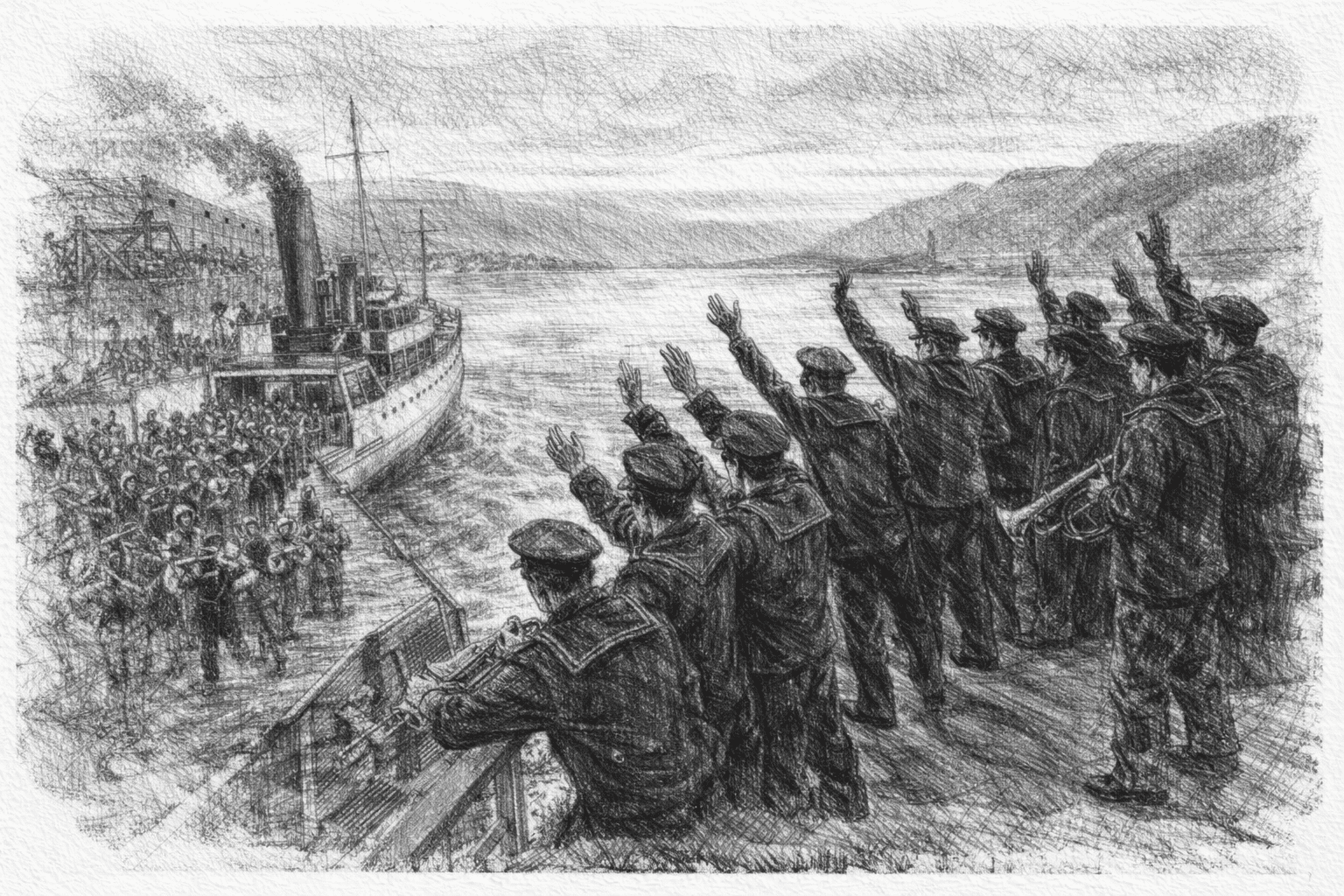
As the 'Kong Sverre' comes to dock there begins a stir of activity to get belongings on board, and then the handshakes of parting friends and relatives. The handkerchiefs are in evidence. As the ship moves slowly away from the pier these fifteen boys, together with a number of others, were on the top deck waving farewall to the friends on shore. A large German band was onboard and their music added festivity to the occasion. During the maneuvers of the steamer turning around and heading out the fjord there was much time for expressions of feeling on the part of those onboard and those left behind. Some of those in our group were in high spirits and they brought out a three-fold hurrah, promptly answered by those on the pier. The musicians stuck up a lively march and continued to play until we were out near Tungeneset.
It was not getting dark, and while I stood there, engaged in thoughts of past and present, here came Old Thompson, who was boatswain in the voyage to Lisbon, heretofore described, when I was youngman. I had not seen him since that time, He had heard I ahd taken examination as navigator and, being now under the influence of too many of the parting toasts, he was talkative and imparted some of his deepest thoughts. He was also hired to go with 'Semiramis'and he now seemed somewhat envious of me having gone ahead of him. Thus, he expressed the wish that I would not be so blind as to think he would eseteem me higher because I had obtained that certificate. 'You can do what you please', I said, 'but remember that now we are equal so far as rank and position are concerned.' At that he became silent and walked away.
At time for super we were called to the dining salon. A long table was set for 15 men; with a bottle of beer and a glass for each. My comrades were already at the table. I asked what this meant, and was told that the owners of 'Semiramis' had ordered this special service and the best meals that were served on the steamer and for the whole trip will we came aboard the East-India-man. Other passengers stood around and watched and wondered at the royal treatment given these sailors, regarding us with something like mock-reverence. There was no no more tears, but visible hearty joy and merriment, quite natural in a group of young me. There was no seasickness and no lack of appetite.
The next morning we touched at Christiansand, and from there the course was direct for Hamburg. With pleasant weather, and well treated as we were, the trip was enjoyable. The owners of 'Semiramis', of course, paid well for our treat. On reaching Hamburg we were directed to the railway station and were given 1st class passage to Flensberg. The German people know how to make it pleasant for their guests, and we were shown every courtesy by the trainmen.
The 'Semiramis' was a big, fine ship of something over 1000 tons burden. It looked like new. On board when we arrived were captain, 1st mate, carpenter, steward and cabin boy. We took place in the forecastle in the order we arrived onboard, our chests in the best obtainable place and our bedclothes in the best unoccupied bed. The forecastle was large and well lighted; and there were dining tables ach for two men, fastened to the four walls. All places at the tables had been taken when I came in, except one, which I took and placed my chest near it. But thereby hangs a tale which I shall mention later.
The captain on this ship was Hans Hamre, of middle age, large and brave appearing, and fearfull proud, as one might well expect. He had been an officer in the American navy, was a freemason of high order, had both uniform and flag of that order, and was now captain of one of the proudes ships in the Norwegian merchant marine, - an East-India-man. He was moreover married to a daughter of the owner so one could not wonder at his pride; but he might possibly have been a little more modest without much harm to himself or the owners.
1st mate was an elderly man who had formerly been a captain, but had been reduced, probably on account of drinking too much. He was easy to get along with, but he was in great fear of displeasing our captain. 2nd mate was John Lund, from Hundvaag, a big man of middle age, who also was striving mightily to be in favor with the captain, and that was not easy. The boatswain was 40 or over, had been mate for many years, but had somehow fallen from that rank; was well enough liked, but did think himself a little better stuff than any of the rest of us in the forecastle, which we somehow did not begrudge him. The carpenter was a little, modest man, from Hogganvik or Etne. He had sailed with this ship for some time, and was a favorite of the captain. A quiet an orderly man.
Not describing all the members of the crew, there are two or three more I must mention because of later events. The tall, thin and taciturn Thompson the reader will remember from former references. Sailmaker was a tall and husky man from Stavanger. There was also a common seaman by name Wilhelm Jacobson, an extraordinarily well built man, about 28 years old. One could see he was strong. He was good-humored and a good comrade. Another seaman, named Sven, who was, no doubt and illegitimate son of a woman named Thora, and was called Thora's Sven. He was also about 28 years old, small and rather think, could blow and boast beyond all limits, and was exceedingly proud of the fact he was a city lad in contradistinction to the country boys, whom he would refer to as 'bondeknøler.' He also professed to be a great fighter and, to begin with, would tell endlessly about the fights he had won and all the policemen in Stevanger he ha licked in a fight. He was, moreover, an old acquaintance and comrade of Wilhelm Jacobson, by whose moral support he though he was entitled to the first and last word in the forecastle. There was probably a majority of city lads in the forecastle; but the minority of country boys did not long relish the repetition of 'bondeknøl'. Neither did they like all the swelling boastfulness about the city boys. I had a premonition that this would sooner or later result in a collision and test of strength; and so it did.