
I found there was place for a second mate on a brig, lying in the harbor. This brig was the 'Olivier', of Drammen. I went aboard, and met the captain, who told me they were on the way to Sundsvall, Sweden, for a load of lumber, to be carried to Scotland. Showing him my papers, he took me on at once for the voyage. The things I had bought in Rangoon, for my girl, I sent home to Stavanger with some of the boys from the 'Semiramis' who were going home. But I was going to be navigator (styrman) in reality, and not simply by dimploma, before I returned home. Here was my chance.
Here I came on board this brig that was 42 years old, and had originally been a french man-of-war. It was built something like a trough, very blunt on both ends, and almost impossible, as a sailer, except in favorable winds. The people onboard were agreeable, and there was nothing to complain about.
Then began another memorable voyage. Sundsvall is a town up in the Gulf of Bothnia. The voyage thither was slow. Autumn was on, and when we got up there the weather was cold, as there is no Gulfstream to warm the waters of the Baltic. We loaded the square-cut timbers by taking them in through our bow port. They were coated with ice, and came into our hold with such speed and force that there was great danger of life and limb. The crew had to do the loading. It took some time. When the hold was filled with logs, we took on our deck an extra load of boards, piled up as high as top of railings; then fastened the deck-load with chains and spars. Before we were ready to sail there was a foot of snow on land, and ice was forming in the harbor.
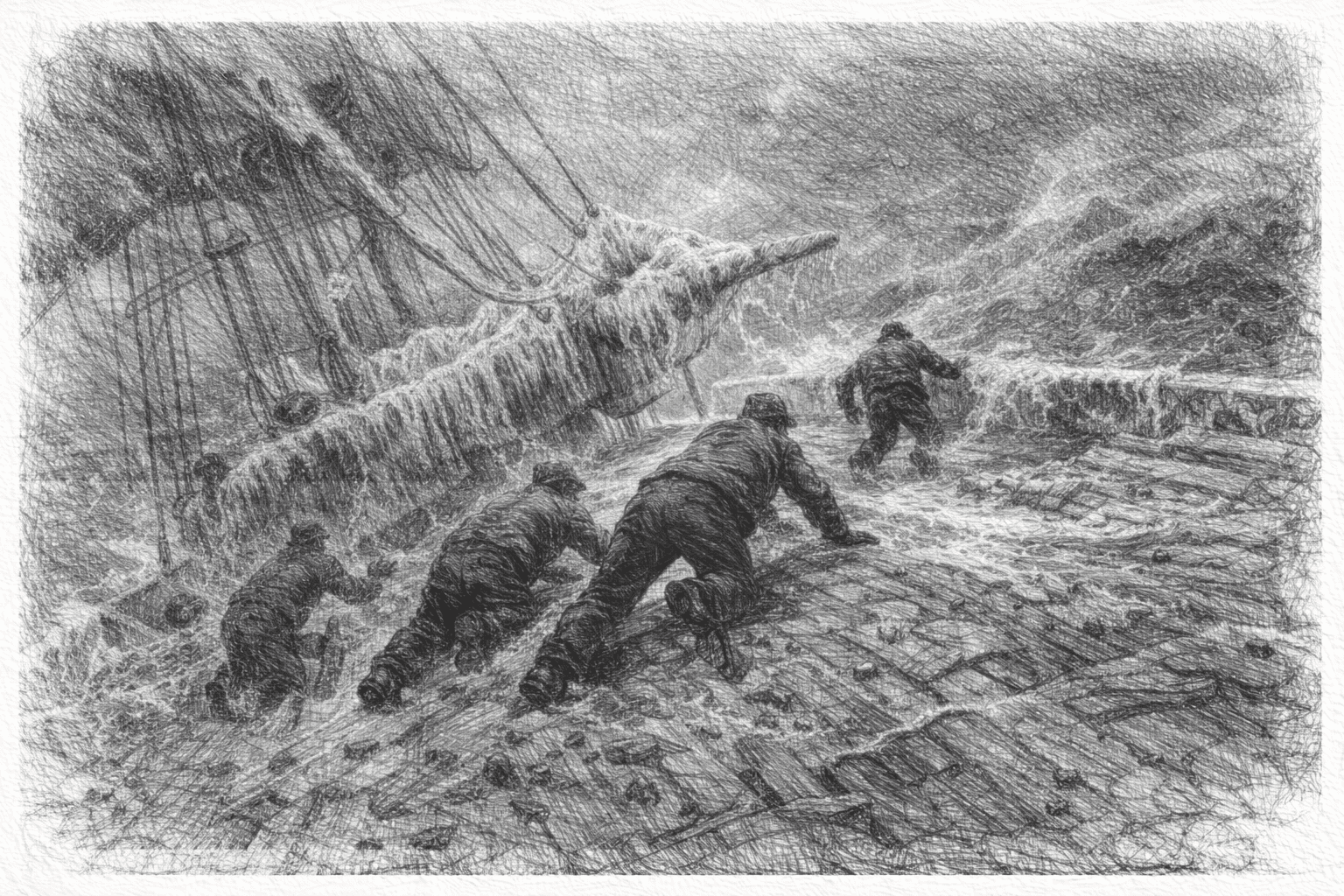
Sundsvall is not a large city, but it is prettily located. Lumber was the principal export. Ready to go out, we engaged a tub. It had all it could do to break the ice and take us to sea. There we came into a northeast storm, with biting frost. Every drop of spray that flew over, striking the ship or sails, would freeze. The exterior of our ship, above waterline, became coated with ice a foot thick. Bowsprit, jibboom and backstays froze into one solid piece of ice. We were in danger of capsizing from the weight of the ice.
I had bought a pair of sea-boots in Copenhagen. They were really cavalry boots. When I used them I noticed there were humps on the inside soles near the toe. The humps prevented the circulation of blood to my toes, and often when I came off duty my toes seemed frozen to the boots and I had great difficulty to get them off. After some repetition of the process, the whole foot was affected, and the soreness of the toes was such that I could not put the boots on. Then I could only use a pair of loose carpet slippers; and they were about as good as nothing to use on the icy deck. One of the crew had an extra large pair of sea-boots he was not using, and offering them to me, I accepted them. They were so big I could put a lot of straw in them, and good, heavy stockings, and still they could be put on and off easily. If I had not got those boots, I had probably lost one of my feet.
The lumber carried on deck was covered with a heavy coating of ice. The form of this ice was convex, and it was almost impossible to walk on these rounded pieces of ice, so we had to crawl on all fours from one place to the other. one day it blew so we had to lower the topsails. But all haliards were covered with ice clear up to top. We had to go aloft with hammers and clubs and knock off the ice before we could get the cordage loose.
This was somewhat different from our experience in sunshiny trade-winds and tropical temperature. If I had expected anything like this, I would never have taken hire on this ship. But this was only a beginning of trouble. When we reached the sourth end of the Gulf of Bothnia, the ice around the ship began to melt, so we could put up more sail without danger. A sleet storm, one night, froze to the sails. The wind increased, so we were bound to shorten sail, but when we came up to furl the topsails there were several inches of ice on them, and they were stiff as boards. We went down and told the captain the sails could not be tied down. So they were left standing.
After a day or two of this we ran into milder weather. The ice began to thaw, and fall down in big chunks or sheets. Then we were in great dnager of being killed by falling ice, and had to be very careful where we walked. With the moderating temperature came a southeast wind, by means of which we came as far as Bornholm. Then the wind changed, and blew a gale from northwest, so we had to lay her under storm-sail, have to and let her drift. She drifted like a wooden box, and we were soon in danger of going on the rocks on the west side of Bornholm. We were coming in between two forelands, one running out northwest, the other southwest. In the bay between them there was no harbor, but only rocks and cliffs. We had to try to save ourselves from this dangerous position, and laid her on a northward course to attempt clearing the foreland in that direction.
The captain went below to get some sleep, and told me to awake him if we appeared to come too near the clfifs. After sailing a couple of hours it appeared to me the rocks stood high and dark, and not very far away, so I went down and called him. When he came up he immediately ordered every man on deck, set sail and make every effort to clear the point. Putting up all she could carry, with railings awash, she eventually cleared the rocks, though only by a few hundred yards. The roar of the waves breaking on the cliffs under such circumstances sound like the growls of a gigantic monster standing near and ready to swallow ship and sail.
When the point had been passed we were north of Bornholm and in the strait between it and Sweden. HEre we tacked in the contrary northwest gale, under storm sail, for three days, until it abated. And one morning, as the wind had changed to sourtheast, we set her bow westward, leaving Bornhom. While the wind was now at our stern, the waves from the recently abated northwester were aginst us, and made her pitch and dive most uncomfortably. We were about to eat breakfast. The table coule not be used. Dishes would be thrown in every direction by the violent tossing of the ship. We though the safe way would be to sear ourselves on the floor; put our backs against one side wall and our feet against the other. The captain sat farthes forward, and other mate and I sat nearer the stern. We held our coffee mugs between our knees, and began to eat. In a moment, the ship raised its bow rapidly, then dropped it, and up went the stern with such speed that I was thrown up and forward, landing on the top of the captain, my coffee and whatever ontables I had in my hands being spilled over the other two men. I had seen some queer actions of ships rolling and heaving sidewise, but I had never seen and end for end hop like this before. The captain only laughed ans asked if I wanted to sit on him. It was a joke on me. We had to straighten ourselves out again and finish our breakfast.
Toward evening the wind veered to south, and snow began to fall, continuing all that night. When I came on deck about 4 o'clock next morning it was still snowing. The wind had veered to west. We were then not far from Falsterbo light, located on a long, flat point of land, extending out from the southwest corner of Sweden. With the wind turning westerly it became a question whether we could clear Flasterbo without tacking. In conference with the captain, he advised a sharp lookout for the light and land on our lee bow and also for a light ship lying at a distance from the lighthouse at sea. I went forward and told the lookout man and in short time he called, 'Light on lee bow.' I reported that to the captain, who said: 'All right, that is the lightship. We are out of danger.' But I was not sure whether it was the lightship or the lighthouse on land we saw. If it was the latter, we were now sailing straight for a shallow sand-bar lying between the shore light and the lightship. I could not trust this ship holding its course, sailing in side-wind. Then I went forward and watched for the appearance of a light from the lightship on our windward bow. Straining my sight for some time, and trying to hold the eyes open against the snowstorm, I thought I saw lights in many directions. But finally one appeared that was sure enough a light. I rubbed my sore eyes and stared again. No doubt about it. There was a light. Then I ran toward the stern and called loudly: 'Light on windward bow.' The captain, who happened to be on deck, grabbed the helm and swung her about in a moment. When the sails began to flap and strike the men who were off watch and asleep came running on deck in the nightclothes, thinking we were about to be ship-wrecked. We had a fearful time to get the sails hauled about, as they now all stood aback. When that had been done the captain went down to examine the charts and ascertain our position. We could now see both lights. When he came up he said: 'Two minutes more, and we would ahve stood on the sandbar, and never got away from it. This was the second close call we had had in a short time. Then it began to be daylight, the snowstorm thinned somewhat, and I took a spyglass and looked back to where we had been. There I saw the remainders of three wrecks, and how near we had been to share their fate.
The weather was cold and sour and we had much tacking to do. The captain said we would take a rest when we reached Copenhagen, as the voyage, so far, had been very strenuous. After a few days we reached Copenhagen. Here we found about 300 ships that had not been able to go north on account of snowstorms and contrary winds. Our main staysail had been destroyed, and the next day our captain asked me if I could sew sail. I said I had done some of that kind of work, and he then asked me if I would undertake to mend up the old or make a new staysail. It was unfortunate that a few days before this a piece of skin had been rotn from the place where the sailpalm fitted over my right hand. Sitting there on deck in the cold, unpleasant days, sewing sail, with that injured, bleeding hand and also suffering from a frozen foot which was without feeling and apparently dead, was an experience which one does not easily forget. The captain had been good enough to let me see a doctor in Copenhagen, who told me to bathe the foot three times daily in salt and whiskey, and saying it would take time for a complete cure.
A day there came which was bright and sunshiny, and there was a fine little breeze of southwest. Ship after ship weighed anchor and stood out Øresund. Soon the whole fleet was under sail, and it appeared like a forest of masts and spars. Our captain watched them from the cabin roof. He had promised us a good rest in Copenhagen, but we had not had much of a rest yet. What was now to do?
Finally he came and said: 'This will not do, boys. Now they are all going, and we cannot lie here in this fine weather.' So it was to lift anchor and set sail, and we came dillying out Øresund at the tail of the fleet. It was a gret sight to see all these white sails, in such a close formation, going out the strait in the fine, favoring breeze and under sunny skies. Shortly after noon we were out in Kattegat, the strait between Sweden and Denmark. The wind blew a little more briskly. The sky was clear until about 3 o'clock. Then, gradually, clouds covered the sun, while the wind increased. At about 5 o'clock it began to get dark, and a few flakes of snow were flying. The wind had now compelled us to tie down our royals.