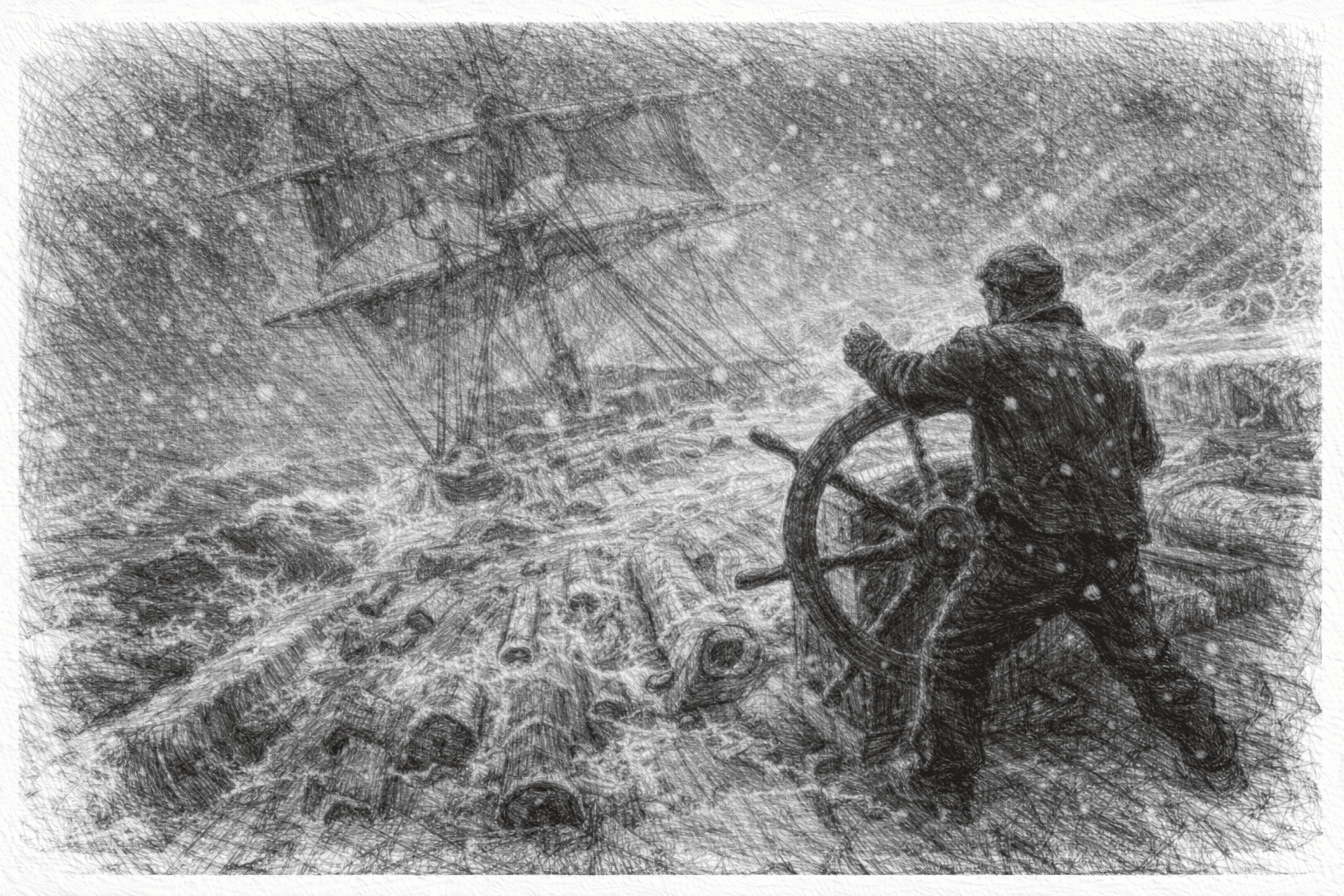

Then the captain comes up to me and says: 'If we are not outside of Skagen light before four o'clock tomorrow morning we shall be shipwrecked.' I smiled and looked at him to see if he was serious. Then, with a rather stern look he repeated with emphasis what he had said. Now I saw he meant it, and he added: 'We shall have to let the topgallants stand as long as the rig will hold, and see if we can make that distance during the night.' 'As you please, sir,' I said, 'We shall let them stand.' This meant another run for life, and poor prospect of making the run with a square hulk as the brig 'Olivier'. But we had to make the effort. There was no way out except by forced draft. After darkness fell the snowstorm became heavier. The rigging creaked and snapped from the great press of sail. Soon the man on lookout at the bow began to warn of lanterns ahead, now on starboard and now port. We were catching up with and passing some of the ships. It appeared they did not think of any danger, but had trimmed sail at the increase of the storm, and were now under lower topsails or smaller sails, taking it easy. We passed quite close to some of them, and we could see the officers on the half-deck, staring at us. No doubt they thought we were drunk or crazy, who were now driving like mad, with topgallant standing, while every other ship was under small storm sail. They probably thought we would soon sail our rig overboard, which was not so unlikely. By our good luck, it might not happen.
At 8 o'clock, P.M., when the watch was to be shifted, a man came to take the wheel, without any mittens on his hands. I asked him if he owned any mittens. He said he did, but forgot to take them along. 'Go and get them,' I said, 'you can't stand here in this kind of weather with bare hands. I am holding the wheel till you get back.' He went; but the captain stood near by, watching me steering. When the man came back the captain said to me: 'Will you remain at the wheel for a while? I have no other man onboard who can steer like you can. And now it depends on keeping a straight course.' The ship lay to the top of railing in water. The cargo on deck was afloat, and if it had not been tied down it would have washed away. The ship soon began to leak, and all men were called to the pumps, where they had to remain all that night. I had a very difficult task holding her to her course under such great press of sail. She danced, now this way and now that, like a top. She was not easy to steer in fine weather, but almost unmanageable now. Meanwhile no one came to relieve me at the wheel. I stood there from 8 o'clock P.M. to 4 o'clock next morning in that frightful snowstorm and gale. And my nerves and body were so agitated I had no chance to get cold.
Out of Kattagat, the wind at our starboard quarter, eight hours at the helm, in a raging snowstorm, with topgallants standing, that night set a lasting mark in my memory. At 3:30 o'clock in teh morning we passed Skagen Light, and had thus reached our goal. But now, all at once, the storm abated, and it was a calm. And now our captain ordered that all sails be stuck up and tied to yards, as rapidly as possible. I was dumbfounded. Here we had gone nearly all night with nearly all sails set, in a wild storm; and now, when the storm had ceased, we were to tie down every rag. There seemed to be no sense in that. But orders are orders, on board ship, and every one was alert to the job. And no sooner were the sails tied in tan a storm from northwest broke, as if dropped out of a sack and with the power of a hurricane.
Now I understood what the captain had meant. He had already the day before understood this change would come. He was an old Baltic Sea sailor, and knew how the weather changes would come in these waters at this time of year.
We laid the ship toward north. Now we had room to drift a while. Now there was not a ship in sight, though the snowstorm was over, and we could see some distance. They were all in Kattegat. We drifted all forenoon, without any sail set except a main stay, to hold her to the wind.
At about noon the northwester had blown itself out, and the wind became more favorable. So we set sail again, and continued to Leith. After the great strain of sail was over the ship did not leak so much. We anchored at a little town called Venness in the Firth of Forth outside of Leith, our port of destination.
The captain went ashore, and after a couple of hours returned. When he came on desk, he said: 'Do you know what? The morning we were outside of Skagen there were 120 ships wrecked in Kattegat. They were thrown on the rocks, right and left. Some of them reach back to Helsingor Road, where they threw both anchors, but they would not hold; then they cut down the rigging, but to no avail. They were thrown on shore as naked hulls, with two anchors out, and people drowned right there in the harbor.' We were astonished to hear this. There were many fine vessles, fast sailers, and, no doubt, manned by able crews, and many of them were ship-wrecked, while we, with the poorest sailer, most rotten and unwieldy ship of all that fleet, came out of it without any harm to ship or crew. If this was not a miracle, it was a piece of great luck. The hurricane took them all like mice in a trap in Kattegat, where there is no harbor against a northwester. It was the greatest catastrophe at sea in those waters which had happened in that half century.