
The day before we sailed the captain brought onboard his newly hired crew. Watching the men as they entered, I was considerably disappointed. He had hired the cheapest crew he could find. They were all Norwegians, but some of them were young boys who had never been on sea, except on a voyage from Norway to America, and a couple of older men of the lazzaroni type, having hardly enough clothes on to cover themselves. There were 8 of them; but I could see there was not a real seaman among them.
As soon as they had brought their belongings into the forecastle and found their places, they were called on duty. I had to have a pair of iron hooks spliced into the new forecourse sheets. I asked one of the men who appeared to be one of the best of the group, if he could splice in these hooks. 'No, he could not.' I asked another, and got the same answer. A third one said he had never done it before, but would try to do it. It was, as I had thought, a flock of landcrabs, and a pair of drunks, who appeared to have all they could do to stand on their feet. Wait, I thought, till we get into a storm then there will be an exhibition. The boys were not to be blamed, but here was a captin who would hire a worthless crew, and if they failed in their duties he would most likely charge me with their shortcomings. I promised myself, however, that this should not happen.
The next day a tug took us out beyond Sandy Hook, while we bent sail and laid in the anchors. All went well, as the boys were willing workers, and we were in sailing order before the tug left us. The watches were set, and we set course for Helsingør. There blew a stiff breeze of southwest, but no stronger than we could carry all sails. As soon as we got out to sea the captin took to the cabin and left the maneurering of the ship to the mates. He appeared to be depressed, and had probably had too much of a good time in New York, which was now showing after-effects. He was seldom sean on deck, but would now and then stick his head out of the cabin door to see what was doing, and sometimes calling for the steward to bring him a mug of strong coffee. The captain always use the same coffee mug. It was old, and had a crack from top to bottom on one side. It was white, with a blue stripe around, at tome and bottom. I was wondering why he always wanted his coffee served in this mugh. Later, learning its secret, I found there was a story connected with it, which I shall tell by and by. The captain was never to be seen on deck in the night during my watch. If he were there during his own and second mate's watch, I do not know.
It was now late autumn, and beginning to get cold, especially nights; but the captain had a good, little stove in his salon which had a warm fire in it; thus keeping him warm externally, while he frequently warmed his interio with warm, strong coffee. We had been a few days out at sea when a brisk southeaster came up, and we had to begin shortening sail, as the wind increased. In the evening we had to make fast the main course before larboard watch was released, because the full crew was needed for handling that sail in a storm. When that had been done, we or the starboard watch turned in. We left the lower topsails and the forecourse standing, besides a couple of staysails, so we could no be quite safe in a gale.
Everything had gone tolerably well up to this time, though we sailed rather slowly. But when we came on deck at midnight, the gale was heavy, it rained and a high sea had developed, so the ship rolled and tossed, and waves were going over the deck occasionally. We had to stick up the forecourse and make it fast before it blew out. To stick up a sail means to pull it up under the yard by several ropes. When it had been stuck up I sent all the men up to make it fast. Half of the crew took place on the yard on one side of the mast, the other half on the other side. Second mate and carpenter were on the windward side. That side is always easier to tie up, because the greater part of the sail hangs over to lee side. On windward side it was seen made fast, and the men there went over to help on lee side. There were now nine men on that side, yet they appeared unable to fasten the sail to the yard. The sail was, of course, wet and heavy, and the wind strong, but the nine men ought to be able to complete the job shortly. But time passed and there they were, seemingly unable to do anything with it. The time had come when it should appear whether the crew the captain had hired were sailors or not. I could not see what they were doing up there, because it was dark; but the sail was not fastened.
The captain had probably heared when we stuck up the sail, because the men sang while they hauled (opsang). Now it was probably an hour since that was done. Presently I heard the captain yelling from the cabin door: 'Mate.' I yelled fully as loud: 'Hello,' 'Have you not fastened that sail yet,' he roared? 'No, it does not appear to be done yet.' I roared back. 'Then it is for you to go up and help them.' That kind of command from him ignited the powder in my mind, and I answered him emphatically that it was not my place to be up there, and that I know my place as well as he knew his. 'My place is here on deck,' I said, 'but to show you that I can fasten that sail I am going up.' And with that I ran up on the yard, rather angry. I had not expected such a cutting insult from him. That first mate and officer of the watch were to go aloft and furl sail happened now because he hired a crew of landcrabs.
When I came up on the yard I called out as roughly as I though was fitting for the occasion: 'Get yourself down from here as quickly as possible, if you don't want me to kick you down. Second mate and carpenter stay here.' They descended in a hurry. I did not mean to kick them down, but I had to blow off a little steam. The poor fellows had simply been lying there and trying to keep themselves from falling down, while the yard moved up and down with the heaving of the ship and the storm piped in their ears. The
~~ missing pp. 301 - 303 ~~
'Are you going to sail the rig overboard?' 'Yes,' I said, 'now we shall not lay and drift any longer.' He heard I was angry and might do anything, so he said nothing more. But, then our jib broke, with a loud report. I was rather old, and not very strong. We hauled it down as rapidly as we could. But now the captain began a fearful Jeremiad. Now I had sailed to pieces the only jib he had, and now we had nothing to put in its place. This was, indeed, terrible. He was, however, quite tame, as he understood I was angry, and kept himself at a distance.
Then I said, 'Have you any sailcloth on board?' Yes, he had that; could I sew sail? 'O, I think I can mend this rag of a jib,' I said. he had no sailmaker onboard. Yes, he would find sailcloth; and he was soon in pearly humor. Next day the remainders of the old jib were unbent, I cut out the torn parts and set in new pieces, while the captain paced forth and back, looking at me working, smiling through his whiskers and thinking there would be a new jib, so to speak. When it was ready I sent some men out to bend it, and when we hoisted it up the captain came and took a look, seeming to approve, and finally said: 'It appears to be fully as good if not better than the old one. The old one had a big, ugly sack in the lwoer end, and that sack I ahd almost eliminated, so there could be no two opinions, the new sail was better than the old. The captain, therefore, was well pleased.
But, remarkably enough, from that day forward i never heard another word from him about my using too much or two little sail. He was a good navigato. I had to ascertain our position every noon, so he could see if it agreed with his own calculations, and I never heard that he found any fault with mine.
The weather was very changeable; mostly disagreeable. Slow was the sailing most of the time. In the late fall and coming winter I did not look for pleasant days in the North Sea and Baltic. The floor in the cabin was not entirely solid, and we noticed considerable of fumes there from the petroleum in the hold. Some barrels had been injured and were leaking. We also noticed oil in the water from the pumps. The crew was accordingly forbidden to strike matches in or near the cabin. OCcasionally the men would come into the cabin at night to see what time it was, and strike a match so as to see the clock. As the gas smell increased, we became more apprehensive. One night, as I had just gone to bed, a man came in to see what time it was. Forgetting about the orders given, he struck a match. There was a great flash, as of lightning. I jumped up and asked the man excitedly if he had not heard he must not strike matches here. He was much frightened, saying he had forgotten. I told him he might be glad the explosion had not blown up the ship. destroying it and all of us. Luckily the gas was not strong enough to cause a real explosion; but we had a serious warning, and no matches were lighted there after that.
Unexpectedly, the weather became more agreeable as we passed through the North Sea and Kattegat; and, one of the first days of November our anchor was dropped in the harbor of Helsingør.
The captain, going ashore, came back in a little while with the news that we were to proceed to [Danzig] (https://en.wikipedia.org/wiki/Gda%C5%84sk) with the cargo. INto the Baltic again, forsooth; and now it was winter. I had little desire to go in there, as I remembered the last experience I had had in the brig 'Olivier.' But I consoled myself with the thought this was a much better ship.
Two letters were deliverd to me by the captain, as he remarked: 'Bad for you to have two sweethearts.' I had never mentioned the Swedish lady to anybody; so I hesitated a little, till I recalled that it was he who had taken my letters ashore, and he also brought these letters. He had, sure enough, paid attention to the addresses on my letters. My main thought, however, was to see what there was in these two letters. Naturally, I opened the letter from my sweetheart first, and there I read that all was well, but she wished I would return home now at the end of this voyage, and that she had now waited a long, long time for me.
Then I opened the other letter. It almost took my breath away. Talk about love-letter. It takes a Swedish lady to write a real glowing, flaming love letter. I have never seen the like in my life. She threw herself, body and soul, in my arms, without any conditions or reservations. She said I must come to her as soon as possible, and if I could not leave the ship then write her and say where we were going next, so she could come to me. I became almost sick. This, then, was the answer to my diplomatic letter. Here I had put myself in a fine fix. There is a saying that one is between the tree and the bark; but to be between two ardently loving women is no fun. What was I to do? If I should now write her that I was already betrothed, it would be a terrible disappointment to her, as it was plain as day she was head over heels in love. And it may not be denied I was also influenced by and sympathized with her. Who could be unmindful of such love? I must by all means save her from too much sorrow and pain. Here I had two sweethearts, as the captain had said. I could certainly not keep both, but it was certainly very sad to have to lose even the one. It was, however, predetermined which one I must lose. But how was it to be done, without sever pain to her?
Even if I wrote her that I was engaged I could not be sure that she would not come to see me, and play her last card of love in my presence. This must be prevented. I had seen an example of such a tragedy one time in England, when a girl from Trondhjem had fallen deeply in love with the captain of the ship with which I was then sailing. When we were ready to sail, she had secured two men in a boat to take her onboard with all her belongings. She approached the captain and told him she was going with him on the voyage. 'You can certainly not go with me' he said. 'I am a married man.' But, no matter, she would go with him. She wept and begged, and said she could not live without him. Finally we had to take her by force and put her back in the boat, and told the two men to take care of her. It was one of the touching and pitiful scenes I have witnessed. 'Strong as death is love,' say Solomon. It is not to be played with, and I felt that here and now.
After reading her letter several times I came to the conclusion that she doubtlessly would follow me no matter what I wrote to her. 'Love is powerful as death.' There was probably nothing in the world that could prevent her; and, in that event, it would be very bad for both of us. This had gone too far already; and the further it went the worse it would be.
The best way I could think of was to end the matter abruptly, and not let her have another word from me; and that she would never know that her glowing loveletter had ever been received by me. I thought this would be easier on her than to let her know her love was split. Probably time would hear her wound. But I confess it was hard for me to think I must forever forego hearing from or seeing her again. It had to be done so, for her sake. Thus I lost my Swedish friend, as quickly and unexpectedly as I had met her. Still, there is a tender spot in my heart for her. She was like a luminous meteor in the sky of my earthly life, - coming and disappearing quickly. It was like a lovely dream from which one awakens when it is at its loveliest, and then exclaims, 'O, what a heavenly dream.' Or, it was as a large and pretty soap-bubble, always most wonderful just before it bursts. This bubble bursted only from pure, unrestrained and unlimited love.
Thus the delicate situation ended, and the reader known how I felt. Then I thought of her, there at home, and a longing for home took possession of me. At once it occurred to me that my term of service in this ship was at an end. I went to the captain and reminded him that now the anchor was in bottom, my time was up, and I asked him kindly for a muster-out. It was the rule that, being mustered in for the voyage, a muster-out could be demanded when the anchor was down, whether it was at the destination or where the ship anchored for orders.
The captain was astonished. He had not thought of that. He could have had someone row him ashore while the ship lay under backed sails, without letting down the anchor. Now, that the ship had been anchored, he could not deny me my dischargte. 'O no,' he said, 'you don't want to leave me here, do you? What is wrong?' 'Well, I am tired and sick of everything,' I said. 'Now I have been away from home nearly 26 months, and now I want to get home as soon as possible.' 'No', he begged me not to leave him. 'When we have discharged cargo in Danzig we are going home to Norway, and I thought you would go with me home. Come and go along,' he coaxed. 'You will never regret it.' I thought it was bad for him to be disappointed in me, since he implored and pleaded so kindly.
Now, however, something else came to my mind, and I said: 'I will go with you only on one condition.' 'What is that?' he asked. 'I don't want to hear another word about the ropes that were stolen in New York,' I said. 'No', he said, 'not a word shall be mentioned again about it.'
So, that was also settled. And for that, also, I owe thanks to my Swedish friend. I had never thought of discharge here if I had not received that flaming love-letter from her. Now that debt of $15.00 for lost cordage was settled and cancelled and no more to me mentioned. She had done me a material favor in less than a half hour after I received her letter, and netierh was this the last favor to me by her, and without her knowing anything about it.
Anchor up, and we set out for Danzig. From now on, the captain was an entirely different man, friendly and obliging, and even entertaining. When we had passed the southern point of Sweden and set course for Danzig, he found there was a little sand-bar right in our course, lying a little southwest of Bornholm. The chart showed there was only 14 feet of water on this bar, and our ship drew 14 feet, so we might strike bottom. Then he said: 'Now I think I will do as the Englishman did, under similar circumstances. The sand-bar in his course was also small. And he said, 'When I set course in a certain direction, but a little to one side or the other. Therefore, when I now set course direct for the sand-bar I shall not hit it'. So it was done. But he struck the sand bark, and remained standing there. Then he said, 'I have never been so dead right before in my whole life.'' Now, we also steered directly for the bar. The wind was northwesterly and we shot along rapidly. When we came where the sand-bar was supposed to be, the captain asked me to stand ready with the lead, and throw it when he said so. I took the lead and stood ready, and on his word, 'throw', I threw it forward. As soon as I felt it was in bottom I pulled up, and found the line was wet exactly 14 feet; and when we looked aft in our wake the water was yellow with a mixture of sand, but we did not strike. There was considerable sea running, and one of the billows probably helped to carry us over the shallowest part of the bar. But we hit it just as truly as the Enlgishman.
When we arrived off Danzig a big tug came out and took us into the city, where we were assigned place at a big pier, before a large warehouse. The fire authorities ordered us to take the covers off the hatches, and keep them open day and night, so the gas could escape from the hold. We were not permitted to stay on board at night, but had to go to a hotel for lodging. A short time before we came into Danzig there had been an explosion and fire in a petroleum ship. There had been great dnager of setting fire to the city before the ship could be moved out on the harbor, and there it burned to the waterline. So when we quit work at 6:00 P.M. we had to go ashore and remain there till 6:00 A.M. A watchman was placed near the ship at night to prevent anybody from trying to go aboard. It was not much of a hotel where we were lodged. It was more like a pensionate, where out own steward prepared food for us from provisions taken from the ship. No fire was permitted onboard. Thus we slept and ate ashore.
Beginning to unload, it again became my job to sit aon the pier and count the barrels together with a checker representing the company which had bought the cargo. This checker was a very interesting, middle-aged man, exceedingly talkative, like most Germans. He talked endlessly from morning till night, telling stores about everything. Oftentimes I could not follow him, and did not know what in the world he was talking about. But, no matter whether I understood him or not, he continued as if I understood everything he said. And, as the Germans nearly always do, he talked both with his mouth and his arms. But the barrels he, nevertheless, counted well enough.
The captain did here as in New York, stay absent from the ship, and I seldom saw him. Once in a while he would show up and ask how everything was going; and then he might take me along up town for treats. But he never permitted me to pay for any treats.
One Friday evening he came onboard and asked how many barrels were still in the hold. I told him about how many. Then he said: 'It would be well if they could all be unloaded tomorrow, because our dock permit ends on Sunday.' When the permit expired a certain daily fee had to be paid for the extra time the ship remained moored. I promised him to do the best I could. Saturday morning, on entering the ship, I told the men what the captain said, and I promised them all the beer they could drink the whole day if they could get all the cargo out before night. Yes, they were ready to do it. The crew was doing the unloading here too. Then the first thing to be dones was for one of the boys to take a pail and go a little ways up town and get it filled with beer and bring it on ship.
Now the crew proceeded with full vigor. There was much perspiration, but the boys did not mind that now. It was a gladsome sight. As soon as the beer-pail was empty someone went up and got it filled and brought it back. In the afternoon, when they were going for another pail of beer, I saw a man wearing a silk hat and a walking stick, standing on a platform near the warehouse, looking at us. He stood there quite a while, and I wondered what he was looking for. I was soon to find out. In the evening when the work was ended and the cargo all out, the captain came onboard. I could see something was wrong with him. He asked: 'What kind of life are you permitting among the men? Is it drunkenness and disorderly conduct?' 'Who told you this?' I asked. 'The clerk of the broker I am dealing with,' he said. 'Let me get hold of his neck,' I said, 'and I would show him who was drunk.' 'He is a liar.' So he was the fellow who stood up there at the warehouse all that time. 'I promised the boys that if they could get all the cargo out today, they would be given all the beer they could drink, and they worked at break-neck speed all day; but there was neither drunkenness nor any kind of disorder.' 'Is the cargo out?' he asked. 'Yes', I said, 'and it would not have been out if they had not go the beer.' The captain said no more. But I was angry at the clerk, whom I understood was sent by the captain, as a spy, to watch our work.
The fates work in a curious manner sometimes. I was yet to meet this broker's clerk, under entirely different circumstances. I told the captain we had a barrel more petroleum than we were supposed to have; and that I had told the checker in New York I believed he had omitted counting one barrel, but he maintained his count was correct and I did not want to make any further argument about it. It was better for us to have a barrel too many than to lack one. The captain said he would call that to the company's attemtion and demand pay for the extra barrel, and divide the proceeds between us. That was done, and we received each 20 Marks.
We took in ballast, and in a couple of days we were ready to sail for Norway. It had been chilly now and then in Danzig, and occasional little snow-falls. I provided myself with seaboots and oilskins, the best and cheapest I have had in my life, before we left the city. A big side-wheeler took us out clear of land.
Well out to sea, there was a gale from north. We laid in the anchors, and set sail, so we were ready to use our own power as soon as the tug should release us. When we were almost ready to let the tug go, there came a man running out of the cabin. He grabbed the railing with both hands and looked out over the water. To my astonishment, I recognized in him the ship-broker's clerk, who was no accompanying the captain out to sea, having a joyful farewell party. NOw they had sat in the cabin and runk farewell glasses till the clerk was full. Seasickness was now upon him, and he must get some fresh air.
There he stood at the railing, pale as a corpse and with legs far apart, about like a new-born calf when it attempts to stand up. Then I thought, 'Who is drunk now?' Then the tug sounded its siren signaling departure, and all men took hold to pull in the towing-cable.
The captain had ordered a block and tackle to be fastened to the main yard arm in lee. One end of that tackle we fastened to an arm-chair, wherein we put the clark and tied him in securely, then hoisting and placing him over in the tug as it came up to our side. Because of high seas the tug could not come very near us, for fear of collision; so we had taken a hundred fathom long lead-line and fastened the middle of it to the chair, throwing one end over to the tug, enabling them to pull the chair over to them. The captain asked me to stand by the hoisting line, and second mate was to throw the lead-line. The tug came along side, we braced the sails aback, hoisted the man over the railing, and second mate thre the lead-line over to the tug. They grabbed it and pulled in while I slacked off, and the man in the chair was landed on the platform back of the starboard wheel-casing. The Germans began to get him loose from the chair; but we had fastened him securely, so it took some time to untie the knots. In the meantime the ships were drifting apart, and the tug had to go ahead to avoid collision. I had long rope, so I only slacked off as the tug went further away. But second mate had not prepared for this and had fastened his end of the lead-line somewhere in our rigging. He had given the 50 fathoms he had, but they had not yet go the man out of the chair. Now he tried to loosen the end and let the line go, but it already stood tight so he could not get it unfastened.
When the Germans saw that the man was about to be pulled overboard they grabbed the chair and held on with all their might. But the lead-line was strong, and they had to let go, and the chair, with man and all dropped into the sea and went under. We hauled in at the hoist, and go the man on board our ship again. I shall never forget how he looked when we got him on deck. He appeared more dead than alive, but he blew the brine out of his mouth and nose like a whale, saying not a word.
It was not kind of me, but I could not help laughing. Bareheaded, with his hair hanging down over his face, drunk both inside and out, and I was sure that what he had on the outside, at least, was not so warm.
The tug came back after a while. The man must be taken ashore. He could not go with us. Then we hoisted him up again, and threw the lead-line to the tug. When he now came down on the wheel-casing the Germans stood ready with big knives, and they got the man out of the chair in a hurry. Then the tug pulled for shore, and we braced full and stood out to sea.
When I came into the cabin and saw the captain, I laughed and said: 'Who was it that was drunk today?' 'It is bad for you to laugh at the unfortunate man,' he said, but neither could he refrain from laughing at this mishap. Then he turned serious again, saying it was shameful to treat a man like that. I said no one could help or foresee what happened. It was the fates playing in the affair; and the man had plenty of heat inside, so the cold bath did not harm him. It would not be long before the men in the tug would provide him with dry clothing.
The wind turning favorable, it sped us homeward. In a few days we were out of the Baltic, then passed Malmö and Copenhagen, those two memorable cities, between which there began that wonderful, most romantic and strange love affair of my life. Then we passed Øresund and Helsingør, with the unpleasant memories of our last stay at that harbor. How was it with her now? That I would probably never find out. We can go far and travel fast through the world, but it is remarkable how some memories follow us. One cannot sail away from them. They follow as twinkling stars, far out in the horizon of remembrance. And they sometimes whisper in a wonderful language of love.
In Kattegat there came up a southeaster again, like the previous winter, but not so strong, and not a snowstorm this time. As we passed Skagen the wind increased, and before we reached the Norwegian coast it was a storm with thick air and murky skies. When the Norwegian mountains came in sight and we were nearing the coast we had to heave to, as it was dangerous to come too near land without pilot, in a gale blowing on-shore. We tacked forward and back all that day and the next night, while the storm increased.
It was now about mid-December and it was not very pleasant to lay there off the coast, without a pilot. As daylight came again, and no pilot was in sight, we began to fear that it was impossible for him to come out in this weather, and our prospects were not bright. It was a question how long we could keep clear of land.
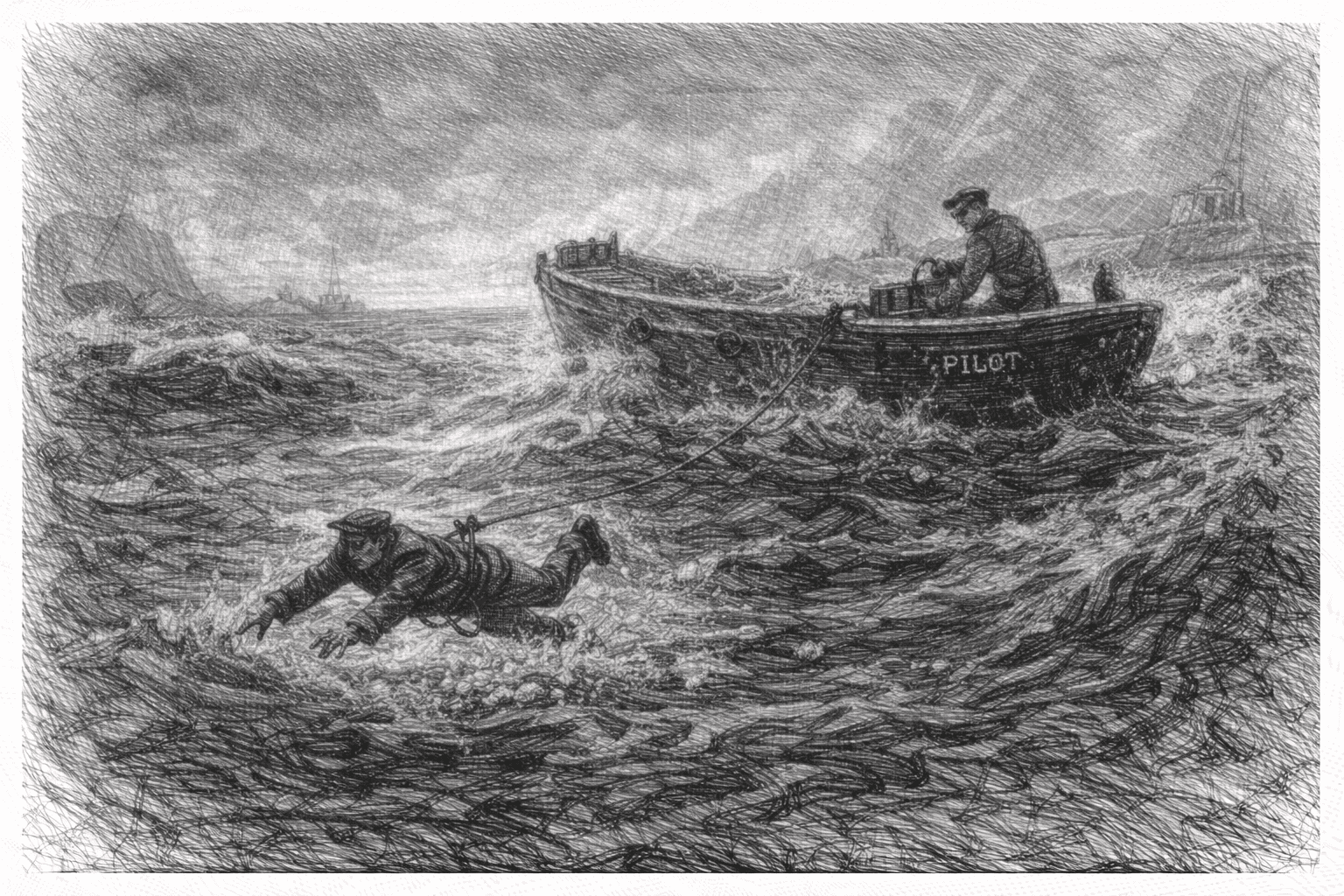
Finally, toward noon, we saw a little pilot craft tacking itself out our way. Most of the time we saw nothing but the sails of it. The boat itself was probably more under water than above. But, with a speed which surpirsed us, she did not go over all the waves, but went right through them. When she came near we saw only one man standing in the steering hatch, with sailcloth nailed to the deck round about, and edge fastened around his body, thus preventing the water from filling the boat.
I began to speculate on how he could come aboard our ship, and what would happen to his boat if and when he left it. But here he comes up to our side in full speed, and, while he passes, calls to us: 'Brace aback and stand ready with a line.' Then, going some distance beyond us, he went about and came back. We had done as he said, and stood ready with rope to throw to him But now we saw the man standing on deck, and a 15-16 year old lad standing in the steering hatch. He must have been under deck when they first passed us.
As the pilot boat comes up under our leeward about 15-20 feet from our side, he calls: 'Throw.' He grabbed the rope, put it around his waist hurriedly and then called: 'Pull in.' At that he jumped into the sea, while the boy in the boat speedily made away from our ship. We pulled the pilot up hurriedly, and I must confess that such brave seamanship as this I had never seen before.
The Norwegian pilots were men with Viking blood in their veins and their hands were steady and firm, - courageous and not afraid of a cold bath. Truly, their praises have been sung, but not too much. They deserve a great deal of praise. To board a ship in storm and heavy seas is more heroic than many understand. It takes a man with courage, good nerve and a steady hand to do it. They were men of few words; but their words were right to the point.
All he said when he came on deck was: 'Set sail and follow the boy in the boat.' And with that he went to the cabin to see if he could get on some dry cloethes. We hurried to follow his commands, and soon we were speeding shoreward, amid foam and spray. But there was soon another surprise for us. When we neared shore we could see nothing but hight, foaming billows and breakers everywhere. Our orders were to follow the boy, and he went right into the breakers. If I had wondered about the father, my wonderment now was greater about the that boy. He almost disappeared, at times, among the avalanches that broke on the rocks, and it appeared unsafe to the utmost for us to follow him. There was nothing but turbulent waters and froth in all directions, and how the boy could find the way between the skerries and shoals, with roaring waves everywhere, that was a puzzle to me. It was the speediest sailing I have seen; and, to think a fifteen year old boy had the responsibility not only for himself, but for ship and crew. But the father knew his boy. 'Just follow my boy,' was his command.
It was nerve-straining to go at such racing speed in among the dangerous roacks which we could not see, and we were glad when we saw the boy swing into an opening behind a rocky point. 'Stick up sails, and be ready with anchors,' came from the pilot.
As we swung in around the point we saw and came into a fine little bay, where there were no breakers or disturbed waters. As soon as we were in behind the point, the command came again: 'Let both anchors go.'
Probably no one who has not had the experience can imagine how a sailor feels when he has thus, out of raging storm and thundering seas, reached a good and safe haven, where destructive elements cannot do him any harm.