
When sails were made fast, deck cleared, and the ship had been pumped ry, out time was up. Now everyboy was free. Now we were in Tvedestrand, the home port of our ship.
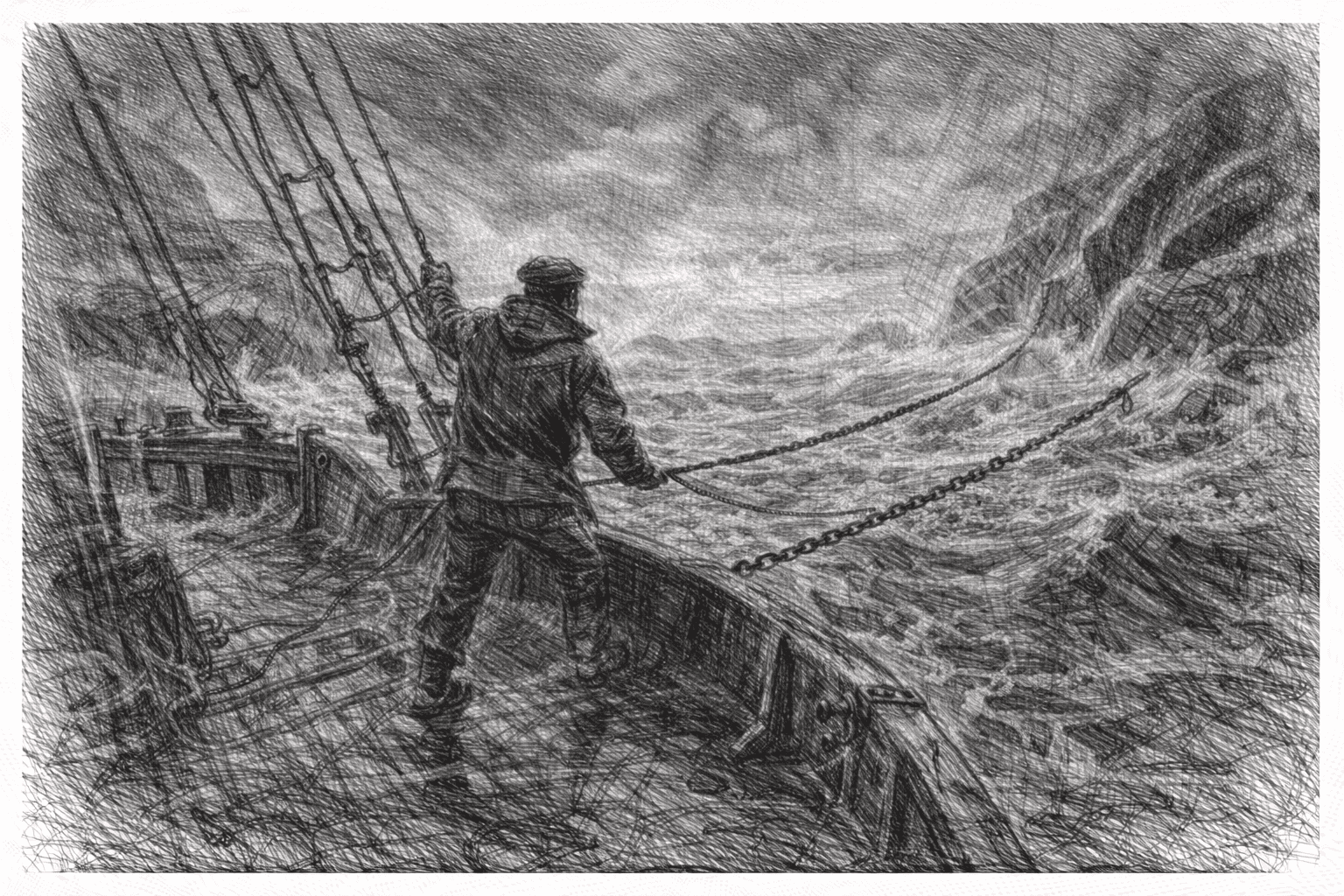
The captain wished to go ashore at once, and so did nost of the men. But some must stay and look after the ship during the night. Then he asked me if I was willing to stay on ship till next day. As I had no acquaintances in Tvedestrand, I could just as well stay on board ship. The carpenter was from Mandal. He also wished to stay during that night. Also our German steward. The rest went ashore. Before the captain went, he showed me a big iron ring fastened in the rock point at our bow, and said: 'If the storm should become too severe, so ther is danger the anchors may give way, then a cable can be put into that ring, and it will assist the anchros. But I do not believe the storm will be so bad.'
The wind was directly off the ocean and over the rocky point at our bow. The storm did increase as the darkness came on, and took on the violence of a hurricane. First we let out more chain so our anchros would have a better chance to hold. Finally we had to put the cable up in the ring on the point. The steward was with us but in the wild tempest and darkness, only the three of us had a hard job to get the line fastened. Finally it was done.
Fortunately there were no waves in lee of point. But, in spite of all precautions, we feared nothing would hold. Both anchor chains and cable stood as straight an taught as fiddlestrings. A little distance in rear of the ship there was a steep rock, and if we began to drift we would soon be up against it. Nothing more, however, could we do. The carpenter and steward went down and to bed. I walked the deck nearly all night, fearing the ship might take to drifting. It was a most unpleasant night, there alone on the deck, listening to the howling of the storm in the rigging, and the thunder of the waves breaking on the rocks of the coast outside. Worse yet would it have been, had we now been out there. It would quite certainly have been the end of our ship and all of us.
When the weather became so very rought, I had expected the captain to come on board with some men to help us. But that fellow could take things calmly when he had placed the burdens on the shoulders of somebody else. Toward morning there was a lull in the storm, so I could go to bed and get a little sleep.
When the captain came the next day and I told him about the bad weather and hurricane, he let on as if he knew nothing about it during the night. But I could understand he knew more about it then he was willing to admit.
'Now I want you to go with me to my home' he said, 'then we shall forget all our troubles.'
Saying farewell, then, to the carpenter and the steward, who both gave me their photographs, as a memorial of good comradeship, I took my belongings and departed with the captain. Coming to his house, I learned, for the first time that he was not a married man, but had a sister who managed the house for him. She was about 30 years of age, quite good looking, but somewhat pale of face. She was, however, a very pleasant lady.
Mentioning that I had to find out about a coast steamer, to go to Stavanger, he said he would attend to that when it was time for me to leave, but, until then we were to have a good time. Then it began with parties, one after another, day and night. It appeared to me as if the people of the town were all the captain's intimate friends; and we would go from one house to the other over the whole town, each succeeding party being more elaborate. It was nearly all I could stand. Never before had I been taken into such social flight. We didn't have time to sleep, only a couple of hours in the morning, then it was to go again.
I don't know what the captain's meaning was, but he insisted on me walking arm in arm with his sister when we appeared in the streets, going from one party to the other. She was also more than willing to have it so. But I had recently had my fingers burned, figuratively speaking, so I felt I had to be wary.
But, not enough with this. Whereever we came he wouldintroduce me as his mate and say that this was the best mate he had had as long as he had sailed ships. 'He is a man that knows his business,' he would say. I soon got tired of it; but if I protested he would go on with more and longer praises. I could not imagine what possessed him; - had he lost his balance or what was the cause of it all? He tried to make me out a hero, greater than any in Tvedestrand. I had done nothing worth mentioing, except what I was hired to do. It also appeared that people believed him, and were almost ready to carry me on their shoulders. It was an awkward situation for me; but there was nothing I could do, except let it go as mere amusement. The entertainments were not formal but cheerful and merry. There were all kinds of good things to eat and drink, yet no more drinking was done than to keep the compan in good, jolly spirits.
The third day I said again to the captain that I must go home. He answered, 'Tomorrow there comes a coast-steamer, the captain of which is a frien of mine. When he comes, I shall speak to him and arrange a good place for you. In the meantime, take things easy. I am arranging everything.' Then the next day he told me he had now spoken to the captain of that boat, and that all there was to do was only for me to step aboard, and he would take me to Stavanager in good shape. When I departed he gave me a very good recommendation, and then he said: 'If my old friend here in Tvedestrand, who has sailed with me before, as mate, does not wish to sail with me again on my next voyage, then the place is open for you, if you want it. I shall write you later and let you know.' I could do no more than thank him most heartily for it all. What had happened to this man? It was almost painful to part with him.
Well, I took my things and went aboard the steamer, - a pretty little freighter. Here I met a middle-aged, friendly captain, who gave me place in his own cabin, and invited me to make myself at home. 'Rest yourself on the sofa and take it easy' he said. There was no place for passengers on this boat. I took it easy and rested, and at mealtimes I dined with the captain. I surely needd rest. A run such as I had had during the last four days and nights I had never had before. I had not been permitted to pay a single penny, and now this extra comforable transportation in the captain's own cabin. It was like a fairytale. Even though Captain Thoresen had siad, when I asked him to discharge me at Helsingør, that I would not regret it if I stayed with him, I had never expected him to go as far as this to please me.
It took about thirty hours to reach Stavanger, and I had not asked the captain on this steamer how much he would charge me, but I had expected to pay well for such good accommodations. When I asked what my fare was, the captain answered, 'about $2.50 (kr. 10.00).' 'Ten kroner', I said, 'that is almost nothing.' He insisted that was all he would take. So I gave him the money and thanked him. I was almost ashamed. I have never been treated like this, but what I considered strangers, in all my life. This Captain Thoresen, of the bark 'President Daae', with whom I had many times been throroughly disgusted and often ready to fight him, had become an entirely different man in the last couple of months, and had done everything possible to befriend me. Honor to his memory. Everything is well that ends well.
It did not take me long to get to the home of my sweetheart, and anybody can imagine the joy of meeting with her after two years and three months absence. They are feelings that no one can properly describe. She had become more attractive, if possible, than she was when I went away. In her arms it was quite easy to forget the adversities and trials of life at sea. Our goal had now been reached, and we decided to be married as soon as possible.
It was now near Christmas, 1881. The day for the wedding was set for January 22, 1882 There had to be three Sundays' announcement of a proposed marriage, in some church, according to law.
But there is still something the reader expects to hear more about. That is, the cracked coffee-mug. About a month or so after I had arrived home I received a letter from Captain Thoresen, saying the old mate had decided to sail with him on his next voyage. A short while later I learned that they had started with a load of lumber. But eight days later I heard they had strandaed on the west coast of Jutland, the worst graveyard of ships in the North Sea. All the crew had been saved; but they had lost their belongings. The old coffee-mug, containing the captain's good luck, was not with him on this voyage. The captain's good fortune had departed. His last good voyage was the one on which his cracked coffee-mug was lost.
This was the third ship, in the last three years, that had been lost shortly after I got away from it. The 'Allegro' which I left at Vardø, foundered shortly thereafter near Hamburg. The 'Olivier', which I left at Vinness, near Leith, never got away from there. And now, 'President Daae' was alsoo wrecked, less than two months after I left it.
Here I was at home with my folks and my betrothed, in good health and spirites, and had escaped all these misfortunes. I believed an unseen hand had been my guide through it all, and had now made a happy ending of all these experiences.
Now I'm at home and now I must close My sailor stories of joys and of woes. My style of writing is simple, I admit, And but slightly adorned with humor and wit.
You could, perhaps, write more readable stories. Telling your sage from childhood and youth. Let us know hear of your life's greatest worries, Whether your sailing was stormy or smooth.
Put the together, and let us then follow YOu on your journeys whereever you went. Either on land or on rolling billow, Out in the world, far as fortune you sent.
Paint them quite clear from one end to other, Such as you saw them in springtime of youth. Then we may possibly all of us gather Therefrom some learning and wisdom, forsooth.
Hide not too much that which may seem ungracious, Nor, by hypocrasy, make yourself hero. Often the road one must travel is spacious, - Full of temptations to bring us to - zero.
Why should one hide of deny what i shuman, Just as it happens, whatever the facts? Excessive modesty hides genuineness, - Weakens our efforts in words and in acts.
Maybe your burdens were heavy to carry While lonesome, in want and in pain you went on. But, how delightful, when storms no more harry, - When you're at home and all worries are gone.
O. W. Vestbo Payallup, Wash., April 8, 1939
(P.S.) As I finished the above lines, which is my first attempt at a poem, and was writing the data, I was reminded that this would have been the 80th birthday of my wife, if she had lived. This poem will, therefore be in memory of her who was my greates joy on my journey through life.