
There sat a large, bearded man on a chair, and looked at us who stood around the floor, and he spoke out abruptly: 'I want you; and you; and you;' and so on, pointing at each one as he spoke until he had pointed out all he wanted. I happened to be one of the first he spoke to. I did not like the appearance of the face of that man. He looked like a grobian. But I had better accept the offer I now had.
We were mustered in for the voyage, that was, to New York and return to Europe. The man spoke English, but he did not appear to be an American, with that big, brown full beard. We learned later that he was Swedish, and was first mate on this ship. He was about 45 years of age and had sailed many years from America.
Then it was to get our belongings on board that same day. The ship was a large bark, and did not look so bad. But I was astonished when I saw the crew. The captain was a small, middle-aged man, sickly, sour and taciturn. Second mate was a Norwegian from Lillesand. but had resided in New York 12 years. He stood over seven feet, was broadshouldered, strong as a giant, and as rude and more vulgar than a wild beast. He belonged to the infamous band, called 'New York Red Shirts'. a lawless aggregation that would not hesitate in the perpetration of any crime or violence, so as to get some money out of it; and they were feared even by the New York police. He always wore a thick, red flannel shirt on the outside of his pants. He was probably thirty years old. The steward was an Austrian, small of stature, easily irritated, malicious, and dangerous as an associate. The boatswain was a German, reserved and silent, though not so bad. And there was a middle aged French seaman, whom it was safest to avoid under all circumstances. He bore cudgel-marks on his neck and down his back; also a mark of a saber-cut which had split his thumb up to the wrist. Where he had received these marks he would not divulge. Another seaman was Danish, had only one eye, but was the likeliest comrade to be found among this crew. There was also a very young Englishman, and a little Swede, about 25 years of age. The captain was the only American; while among the thirteen men on board there were seven different nationals.
Judge by the years of service I was at the time of the class called (fuldbefaren ) able seaman. In that class I also belonged when aboard the 'Cito.'
The first day onboard, another seaman and myself were sent aloft to fasten the topgallant and royal yards, which were lying on the deck when we came onboard. There was a bitter cold wind blowing, and I suffered intensely from it, while hanging up on the rigging all day.
In a couple of days everything was in order and we went to sea; and it did not take us long to find out where we were at. The mates proved themselves to be the worst slave-drivers I have seen or associated with at any time. Both of them had voices well calculated to frighten the fiends, and their orders were hardly ever given with less emphasis than salvos and rounds of curses, abusive terms and frightful oaths. The food we were given was not only of the very poorest, but we did not even get half enough of it. But work there was given us a plenty, day and night, and it was the worst and hardest one could think of.
The deck had been driven with oakum while the ship lay in Hamburg, and boiling pitch had been poured over the oakum between the planks. The pitch had spread somewhat out over the planks. One day, about a week out of Hamburg, we were ordered to scrape the pitch off the deck. We were given some scrapers and told not to lay on our knees on deck, but stand with head bent against the deck while we scraped.
Not having felt well for several days, and by reason of this stooping position while at work, I developed a great headache and dizziness, so that, several times, I felt like collapsing. After several bad attacks or fainting spells I was forced to give up working, going to the mate and telling him I was sick and could not work. He answered, 'No man is permitted to go to bed sick on this ship. Go to the captain.' I was so sick I could hardly stand up, but thought I better see the captain. When I came down into the cabin, (the captain was hardly ever on deck) he said: 'What is wrong with you?' I answered: 'I am very sick.' 'I know what is the matter with you,' he said, 'you drank too much while in Hamburg.' 'No,' I said, 'I had no money while I was in Hamburg, and I did not drink.' 'I know,' he said, 'you drank too much, and now I will order the mate to prepare some medicine that you are to take, and then go to work, and work as long as you live, and when you are dead I shall have you thrown overboard. Now you can go.'
Those were comforting words for a sick man; but the worst of it was I was not quite sure but that he intended to throw me overboard before I was dead, if I was unable to work.
There was evidently no law and justice aboard this ship, nor any human sympathy; only inhuman, devilish rudeness. After a while the mate came and offered me a big glass, half full of epsom salts, and he filled it with water, a dose big enough for a horse, and said: 'Drink this, and then go up and down the deck, and you will soon feel better, but do not sit down.' I thought it was best to do as he said as long as I was able, and I drank a good part, but it seemed impossible to take it all, and, remarkably enough, he did not compel me to drink the whole dose.
This was in the forenoon. I began to march forth and back on deck near the forecastle, taking hold of objects now and then to steady myself against falling. But it was not so very long before I got busy, as a result of the medicine.
It was a terrible cure, but resulted in recovery. Along in the afternoon, I felt better, but I did not think it was necessary to hasten going to work again. When my free watch came, I had four hours to sleep, and after that I felt much better. The sickness was no doubt caused by the bad chilling I had while working in the rigging before leaving port. But the cure I had taken was what might be called a horse cure.
We had mostly contrary winds, and did not make rapid progress. It was a siege of tacking, and the second officer, especially, had good opportunity to show his nature, and his 'love of humanity.' An illustration of this was when the main yards had to be hauled around. There was a narrow gangway between the railing and the cabin roof, and when we had tightened the braces on one side and were to go to the other side, we had to pass single file through this gangway. The mate was always the last man on this movement, and when we started to go through the passage, he would bellow: 'Run, you sons-of-bitches, run,' and with that he ran up and brought his heavy seaboot toe, full force against the seat of the boy who happened to be last in the line before him. Thus it seemed to be literally true here that it was 'every one for himself, and the devil take the hindmost.' There was no use of protest or resistance. The mate could strike a person dead at one blow. And he was also armed with a revolver, so it would be folly to resist him.
The best one could do was to keep as far from him as possible, and avoid being subject to his abuse, and I was quite successful in escaping his kicks.
But such bellowing cursing, oaths and execrations as out of these mates I have never heard on any other ship. Whether one was aloft to very tops, or out on the jibboom in a storm, or if in bed, night or day, there was no greater noise than these voluminous and longwinded curses and oaths from one or the other of the mates, so one could well expect everything to catch fire and burn up.
The captain was a consumptive, had a weak voice, and was seldom on deck. But what little we heard from him was pure evil and hatred; so we understood he was of the same breed as the mates. The steward appeared to be in accord with the officers most of the time. One could not well imagine hog feed worse than what he prepared for the men. I remember distinctly the hotchpotch stews or soups he would put before us. Peasoup or beansoups, several days old; potato peelings and pork rinds unshorn of the bristles, some of which were an inch long. All this he would make into a stew, and serve it to us for dinner. It was sour, salty, bitter, nauseating and loathsome.
There was, however, one of two things for us to do: Either eat it or starve. For breakfast we received one hardtack, about 6 inches broad by ¾ inch thick, and a cup of black coffee. No butter or anything else as a substitute. This was doled to us at breakfast, at 3 o'clock, and for supper. At dinner we could have as much as we desired of the 'hogfeed' that was served, and many times we could eat very little of it. Once in a while boiled meat was served for dinner. It was boiled in seawater after it was taken from the preserve brine. The kettle in which this meat had been boiled had a very heavy coating of solid salt in the bottom when we reached New York. The cook had never emptied the water from the kettle after cooking, but, when necessary, added some sea water for every cooking. I remember distinctly when we got those little pieces of salt meat doled out among us in the forecastle, they were as white as chalk on the outside from all the salt on them.
To make protest was also in this matter useless. We were told it was served in that manner by the captain's orders, and if we would not eat it we could let it alone. We were so hungry at all times that we could eat almost anything given us, but I am sure a hog would not have eaten what we were often compelled to eat.
But we had plenty of work. The first job was to pound all the rust from iron mountings on spars and yards. Then it was to be scraped and painted black. It was no fun to hang up there day after day, while the ship was tossing and heaving, and it was difficult to reach the places where the work had to be done, because sails were set and in the way. It was nothing but torment.
When that was done we were set to pounding and scraping the rust from the anchors and chains, and then cover them with coal-tar. We became exceedingly dirty and black from this work, but we could have nothing but seawater in which to wash, and one may imagine the sanitary conditions. One may think of slavery, but here was the most actual and veritable slavery that could be imagined.
And that slavery was not the only thing. There was no comradeship among the men in the forecastle. Every man for himself was the rule, and be careful not to come too near anybody, either in word or deed. One could not be sure that a knife would not be used, in an unguarded moment.
One day I said something in Norwegian language to the one-eyes Dane, in the forecastle. The Frenchman was also there. When he heard it, he drew out a good-sized butcherknife, and said, 'If I knew you talked about me I would put this knife through you. Be careful. Not a word but English to be used here. Look to your safety.' I did not doubt that he would cheerfully try to execute this threat.
It was as if life hung by a thin thread that might be easily cut, night or day, on deck or in our quarters. We dared hardly say a word. It was as if we lived in a cage with tigers. Every man had to be watched, and even at that it was a question whether we could reach our destination alive. No brotherhood here, no law, no justice, no mercy, no pity; only the rudest and roughest brutality, and a veritable hell on the sea.
To bear the 'Cito' across the Atlantic on our arms was hard enough, but this was worse. There we had the heavy seas and constant deluge of water to fight, but here we had men with natures as fierce and atrocious as the most devilish beasts of prey. Of two such bad conditions I am inclined to choose the first.
One day the Frenchman stood at the main mast, and was at some work. 1st mate was on the halfdeck and looked at him, and soon reared out, with an oath or a volley of them, that the Frenchman was not doing the work satisfactorily. The Frenchman looked at him and said: 'Don't talk that way to me. I have done this kind of work before, and I have also seen men like you before. If you do not speak to me like a man, you look out.' The he brandished his big butcher knife as a warning signal. The mate had to pull in his horns, so to speak. He understood the Frenchman was able to use his knife, and would not hesitate to do so, on provocation.
The little Swede had been taken under the protecting wings of the mate, because he also was Swedish. He was invited to sleep in the cabin, and given the position of cabin-boy. So, the only comrade I could talk to in the forecastle was the one-eyed Dane.
We all knew the treatment we were given onboard was for the purpose, among others, of making us desert as soon as our anchor struck bottom in New York. Then the officers and steward would divide among themselves all the wages we had coming.
But the voyage was long, almost 2½ months, so the Dane and I had made plan of what we would do. We did not like to lose the hard earned pennies, and I told him I had had bad luck since I deserted, and I now wondered if it would be possible to stay, if and when the others deserted. He said he had also tried to desert and had only bad luck like myself. We agreed that we would try to remain if we possibly could do so, and see how it would go. It could not be much worse than it was now, and if we were unable to endure it, and, if so, we could desert before the ship went out again. We said nothing of our plan to any of the others. We knew they would all desert, which could not be wondered at, considering the treatment we had.
Finally, we reach New York, and came to anchor in the East River near Brooklyn. It was forenoon, and we had fastened down the sails before noon. As soon as the men came into the forecastle they began to pack up their things. Runners soon came aboard, and the officers did not hinder them. The boys dressed themselves in their best, and were soon in the runner's boat. All went on in full sight of the officers. The runners wanted to know if we wanted to remain in this slave ship. We answered that there was no need of haste. We preferred to wait and see the outcome. Since none of their presentations and arguments prevailed with us, they rowed away with those who were going, passed around the stern of our ship, where the captain stood on the halfdeck and looked at them. When the Frenchman saw him he took off his hat and called out, 'Goodbye'. The captain did not answer. He knew it was no friendly 'goodbye'. But he appeared not in the least to regret their going. Now the Dane and I were the only men remaining in the forecastle, and for that we were glad. Now we could have peace, and feel safe.
But it was not the thought of the officers that we should remain on board. We were sent down in the hold to scrape some dirt and oil from some planks. It was the worst and dirtiest work they could think of, and we understood it was for the purpose of driving out of our heads the thought of staying with the ship. We went to work and did the best we could.
The next day the runners came again, and wanted to know if we were not ready to go with them. We said we had not thought of that yet. When no efforts on their part seemed to have any effect, they left for shore. We were kept at the dirty and unnecessary work down in the hold. The next evening the runners came again, - four of them this time, in one boat. When they came into the forecastle, one of them said, 'Well, aren't you ready to go ashore yet?' 'No', I said, 'We are not going ashore.' 'Don't speak so loud', he said, 'we can probably take you whether you will or not.' I knew that was not impossible, and I kept still, to see what would happen.
They were armed with revolvers, and they could, no doubt, take us with force of arms, if they would. But I let them understand we were unwilling to leave. After sitting and looking at us for a while they got up and, to our relief, slid down into their boat, rowed away, and came back no more.
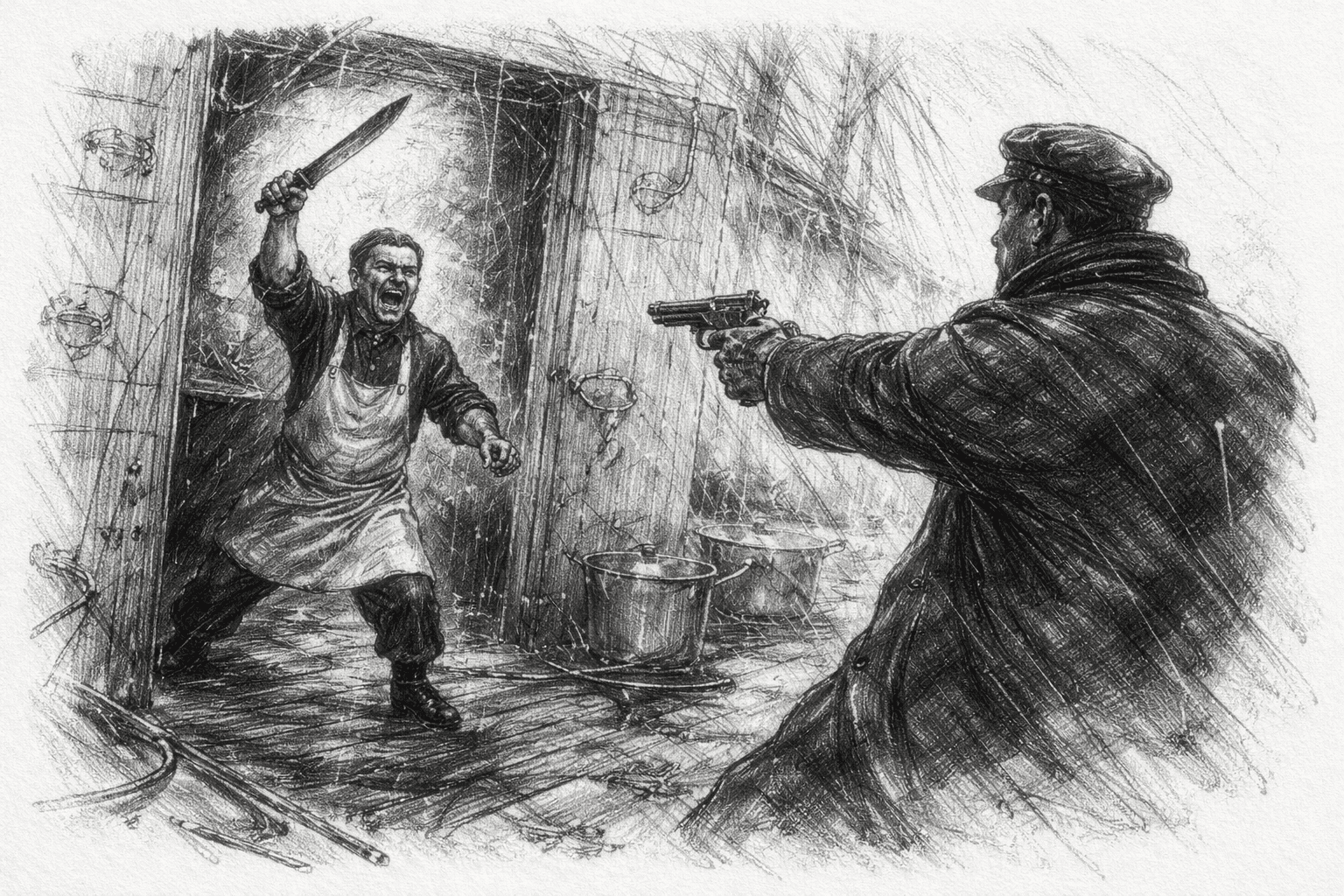
The captain, being sick, had now gone to his home. The next evening we were to scrub and wash the decks. We filled a barrel with water. The second mate took a pair of nicely painted buckets, bearing the ship's name, and which were not ordinarily used for this purpose, and began to carry water from the barrel and pour over the deck, while we used the scrubbing brushes. When he passed the door of the cook's galley the steward asked who had given him leave to use those buckets. 'That is none of your business. I don't ask your permission,' said the mate. The steward ran out, and quick as lightning knocked the feet under the other so he lay flat on the deck, the water flying in all directions. Then he ran back into the galley and grabbed a butcher-knife not less than 18 inches long, and arrayed himself with it in the door. The mate arose and began to threaten the steward, saying he would do this and that to him, while the steward stood swinging his big knife and inviting the other to come on and see what would happen.
The mate did not dare accept the invitation, and after some exchange of threats, he took the pails, went to the barrel and filled them again. When going past the cook's door he uttered some bad words to the steward again. Quick as a flash he was out on the deck again, knocked the legs under the mate the second time, and there he lay in the water again. He got up and ran to the cabin for his revolver, which he had not taken in his pocket that morning, and came forward to the cookhouse door, where he took aim at the steward's head and said: 'I shall blow your brains out.' The steward projected his downside out against the other, and said, 'Blow me there. But if you come in here I will make chopped meat of you, as big as you are.' With that he swung his big butcher knife forth and back over his head. He was so mad his head was blue. We expected they would certainly kill each other.
Remarkably enough, the big second mate did not dare to fire on the little whisp of an Austrian, who looked at the revolver, scorning death; and after a deal of rag-chewing the mate resumed his work, but did not pass the galley door after that.
The next night both of them deserted, probably each afraid the other would kill, if they remained in the ship. But heartily glad were we that both of them were gone. We saw them never again.
Now, the first mate expected he would be made captain of the ship. But soon he received word from the owners that they were sending another captain onboard, and asked him, in the meantime, to take care of the ship. Then the first mate also lost interest in the ship and was ready to leave as soon as the new captain should arrive.