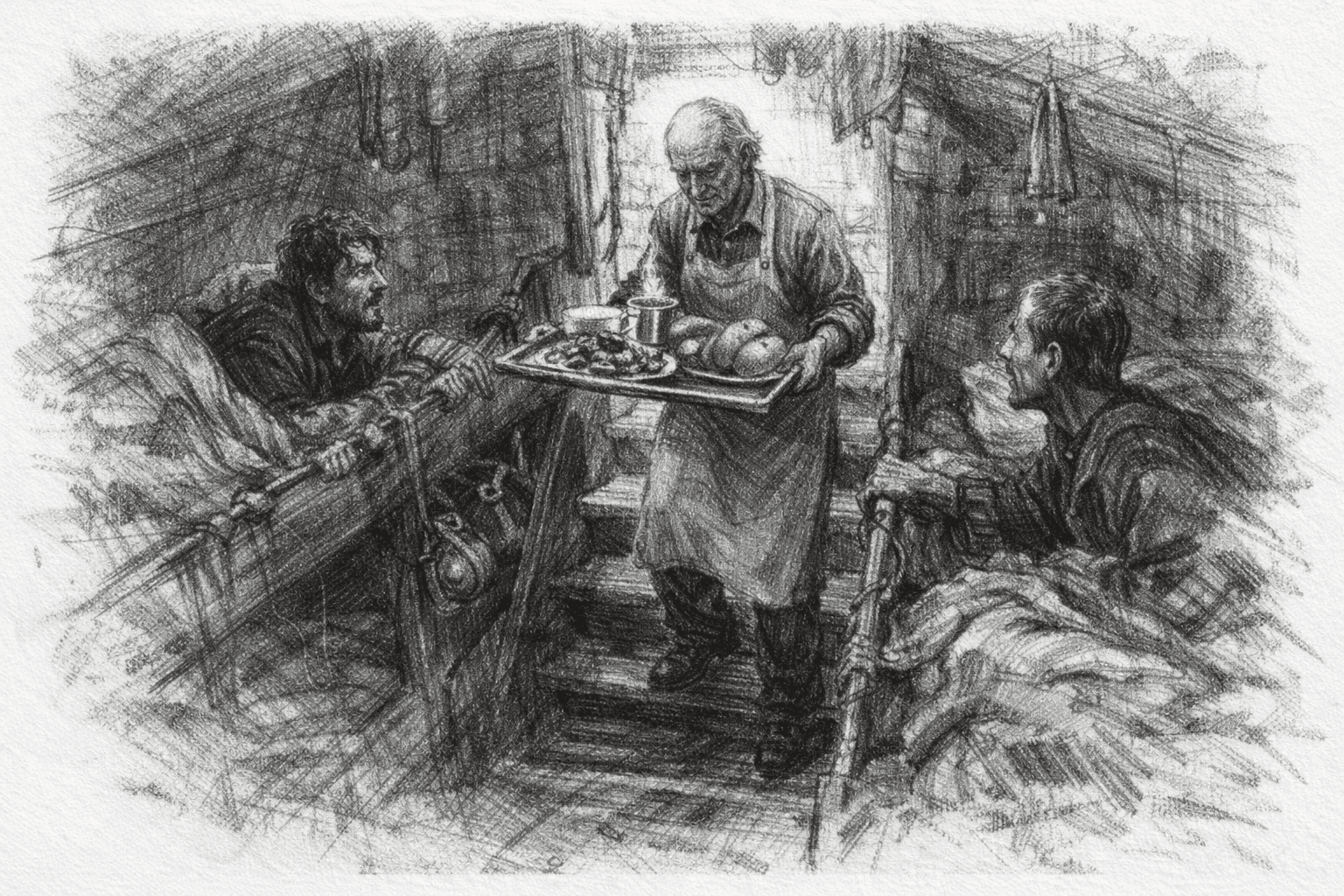

The next morning, I woke with a feeling that it was late. I called the Dane and asked if he had not been called. 'I have heard nothing,' he said. 'Well,' I said, 'We don't get up before we are called.' We lay there and waited for call until about 9 o'clock, when an elderly man, a stranger, came into the forecastle, carrying a large tray, on which there was beefsteak, fried potatoes, new-baked bread with butter, and coffee, and he said: 'If you please now, boys, you may arise, and have a little breakfast.' The smell of this excellent breakfast filled the forecastle, but we could hardly believe either our noses or our eyes. Was it a dream? Or had a miracle happened? We asked the man who he was, and was told that he had been hired to cook for us; and he also told us he was an old steward from Stavanger, but had now resided in New York fifteen years.
We needed no more than that first invitation to eat. We were hungry as wolves, and had not had much but hogfeed since we left Hamburg. And now, this wonderful and delicious wedding breakfast, - we could simply not believe it was a reality. But we ate until we were well filled, - for the first time in two and a half months. We eased ourselves into our clothes, opened the door, cast a random look forward and aft, to know we were in our ship sure enough, and then considered what wonders would happen next.
No officer called us out to work. And we had decided not to go before we were called. We took our pipes, lighted them leisurely, laid back in our bunks and smoked. But no mate came until about 11 o'clock.
What had happened to him? What a change? We were struck dumb, and could only sit and stare at him, while he, in a modest, civil tone, said: 'Well, boys, you may go up and loosen a couple of sails for drying, and then you may take another smoke till dinner is served.' Was it possible? Could we believe our ears? What had happened to this man to change him from a roaring lion to a meek lamb during one night?
It took about ten minutes to loosen the sails. Thereafter we did as the mate had said. At noon the old man came again with an excellent dinner of good quality and very well prepared. It tasted so good that we thought here was a steward who really knew how to cook. After this feast we took a good afternoon map. About four o'clock the mate came and told us to take in the two sails again and make them fast, and then you may sweep the deck. That would be all for today.
We were tempted to pinch ourselves in the arms to ascertain if we really were awake. This was a change the like of which neither one of us had ever seen or heard. What was the meaning of it all? And how would it end? We had, all at once, been accorded the treatment of guests in a hotel, instead of being slaves in a slave ship.
Men were hired to take out our ballast. We were not asked to take a hand in that work. We only swept the deck occasionally, ate and slept, and had what might be called feast-days. Now we did not regret that we had not deserted.
When the ballast was out, the ship was towed down to Staten Island, where a load of petroleum barrels were put in the hold. But the Dane and I still continued to have feast-days, and were not required to take a hand in the work. How long it took I cannot say with certainty, but probably about three weeks from the time we arrived in New York, until the ship was loaded. And still no officers or crew had come onboard.
Then, one evening, the Dane, the little Swede and myself thought we ought to go up town, buy a few trinkets and see the famous Bowery. It was the Dane who suggested the idea of going to the dancehall, but, as good comrades, we were willing to go along. The place was well known to the sailors. We took the ferry, and were soon there. The Dane danced and drank to his heart's content, while the Swede and I had a glass of beer, took our time to it, and looked at the fun.
We had understood that the last ferry to Staten Island would leave the Battery shore about 11:00 PM. We told the Dane many times that we ought not to miss the last ferry; but he had taken somewhat too much, and it seemed impossible to get him to leave, even though we threatened to leave him. Eventually we had to go alone to catch the ferry, as we only had 10 cents each in our pockets, just enough for fare. But when we came to the ferry landing we found the boat had left, and no more ferries till six o'clock next morning.
This was a great situation. Strangers, - and stranded in New York at midnight, without money; and this a place where we had heard murders and robberies were committed every night. There was nothing for us to do but try to pass the time as well as possible until next morning. We walked the wooden planks of the wharf till we were tired and sleepy. Not a human being appeared, but it was not entirely dark; whether there was moonlight or some small gas lanterns here and there I do not now remember. I had on a big sea-coat or overcoat. We laid down on the planks, put the overcoat around both of us, and intended to sleep.
After a while I woke up and saw two suspicious appearing men standing over and looking at us. When they saw I was awake, one of them asked: 'What are you doing here?' I answered truthfully that we had come too late for the ferry, and had no money for lodging, so we had to wait here till morning. They said no more, but looked at us closely.while we got up and began to walk forth and back, and conversed as if nothing had happened. They disappeared without saying anything more to us, and we again laid down and tried to sleep.
Soon I woke again, and saw the same two standing over us, saying not a word. The one was tall and big, with a black felt hat pulled down over his face. The other was small, wore a gray cap, also pulled down in his face. I touched the Swede in his side, and we got up and walked again. The men said not a word, but stood still and watched us. I did not want to have them think we were afraid, which we certainly were. Those men were not here for any good purpose. Therefore we began to talk aloud to each other, laugh and whistle as if we were not the least concerned about any possible danger.
They scanned us closely for a time, then they departed, not saying a word to us. They probably though we had nothing valuable for them to take, as they noticed our clothes were not worth a whole lot. But we were glad when they went away. I feel sure that if they had thought we had anything worth taking they would not have hesitated to knock us unconscious, then take what we had and, like as not, thrown us over the wharf into the river.
Not daring to lay down any more, we walked up and down the pier till morning.
When we came to the ferry station, here was the Dane, sitting on a petroleum barrel asleep, outside the closed gate. The barrel stood up against a wall, as he reclined against it. He was pale, soiled and worn. I roused him out of sleep, and we began to tell him of our experiences in the night.
Here was a fine representation of the three Scandinavian countries. When we looked at each other we had good cause both to laugh and to weep. Poorly clad and penniless, we had now spent our first night on shore in this great American city, on a naked wharf or pier, where even the wharf-rats did not deem it worth their efforts to have anything to do with us. The wharf-rats are those suspicious, ghoulish characters that infest the ship-wharves at night, to see what they can get by stealing, robbing and killing. The Swede and I had been visited twice by these night-birds, but it was probably our great good luck that we had not appeared inviting to them.
We had nothing but working clothes, and we had determined not to buy clothes in America, as we had been advised that it was a land of fraud, deception and cheating, where men demanded big prices for the poorest kind of goods, and where money-greed drove people to commit all kinds of knavery and villainy.
But glad we were when the gates were opened at 6 o'clock that morning and we got on the ferry and came aboard our ship, which now appeared to us like a cozy home, and where we had no more fear of wharf-rats.
To me, a boy of about 18 years, the sight of the great cables and the mighty towers that were to carry the Brooklyn bridge was something to be remembered. We were told the bridge would hang about 145 feet over the East River. In those days the construction of this bridge was the wonder of the world.
The new crew came on board, and we were naturally curious to know what kind of men we would meet now. We found them to be entirely different from those who had left. Friendly and congenial were they all. The captain was American. His home was near Boston, the ship's homeport. First mate was Finnish, and second mate was German. All were fine and able officers. Among the men foreward there were 2 Hollanders, 1 Scotsman and 1 Englishman. With the Dane and myself we represented five nations. But if there were not an international brotherhood now on this ship then I know not where. As a group they were the most companionable and friendly men I have ever known.
The former mate took the little Swede with him when he left the ship. I saw them no more.
Next morning we lifted anchor and went to sea. The captain approached the Dane and myself and said: 'I consider you, from what I have been told, to be good, reliable boys. Now, you are the only men who are acquainted on the ship. We are all strangers but you. And if you now will help the other men get acquainted on the ship I shall be greatly obliged to you.' It sounded as if he valued highly that we had stayed in the ship and not deserted. The owners had probably been told all about us, and had done everything they could to make us comfortable. They must have hired the old steward who made all the fine meals for us, and paid for the provisions and his services. And it may be they had also heard about the suffering we endured on the way over from Europe. Be this as it may, the captain had been told about us and seemed to know us quite well before he came onboard or had seen us.
There was a new steward now. I cannot remember his name or nationality. But he gave us good food, and all we could eat, if not quite such hotel fare as the old Stavanger steward had served while we were in New York.
One of the first nights when we were well out to sea there blew up a gale. First mate came and asked me to go up and take care of something aloft, I don't remember just what. I went up, and found there was a haliard. which was fastened down below and needed to be loosened before I could do my work above. Then I called down to somebody that might hear me on deck to throw it loose. The mate came and called: 'Bill, come down.' I was called Bill on this ship. I could not understand why he called me down, but I obeyed order. When I came down he said: 'When there is anything you want done then you come down and tell us. I do not like to hear loud calls and yells onboard the ship. We have time enough for everything. Come down and say what is wanted.' I was so astonished I did not know what to say. Did he call this loud calls and yelling? What would he have said if he had been onboard here on the westward passage? And so calmly and agreeably he spoke! Talk about change. Never in my life had I seen such change as had come on this ship. It was unbelievable. From the worst kind of slaveship, it had become a pleasure yacht. No work except the absolutely necessary maneuvering of the ship, good food, friendly and kind officers and men, and a cozy good ship. What more could we wish?
The weather was fine but we were making only moderate progress. And what did we care? The greater number of days, the more money for us. And the time passed rapidly in such company. I don't believe we ever heard an oath or a bad word out of the mouth of any man onboard.
Several weeks we spent thus pleasantly at sea, and finally nosed into Bordeaux, France. This city, on the coast facing the bay of Biscay, lies about 20 miles up from the mouth of the Gironde River.
Ships loaded with petroleum were not permitted to come nearer than three miles from the city until the oil had been discharged. It was feared explosions might occur, caused by sparks of fire from chimneys or other places where fire was used.
The trip, so far as the Dane and myself were concerned, had now been completed, and we approached the captain with request to be discharged. It appeared he was disappointed, and did not want us to leave. He asked if we were dissatisfied with the treatment or anything onboard. We said we were not, but now we had been out nearly 2 years and would like to go home. He said he was more than satisfied with our services, and did not like to let us go, but would be pleased to do anything within reason to make it worth while for us to stay, and go out with him again. We thanked him for his offer, but repeated we had to go home; and I also said it was my plan to attend navigation school. I said nothing about going home to see my sweetheart.
He could not deny us a discharge, but regretted having to do it. We went forward to make ready to leave. Then came the steward and told us the captain wanted to see us in his cabin. We went aft again; and he said: 'Now, boys if there is anything you have been dissatisfied with on our trip from New York you should say it to me. I do not want you to leave me if it is possible to make it so you can stay.' 'No,' we said, 'you have been very good to us and we have liked the treatment here very well; but we are longing for home.' He let us go; but the steward came back again to the forecastle and said the captain wished to see us. When we came to the cabin, he said: 'Boys, I do not want you to leave me. I believe I know what you want. You would like to get your money, go ashore and have a good time. Then, when your money is gone, you will hire to the first and best ship you see. Now, I tell you what I will do. I will give you all your money, and five days ashore on full pay. Then, when you have had a good time, you may come back and sail with me again.' 'Many thanks for your kind offer,' I said, 'but it is not what we want. If we did not intend to go home there would not be a ship in Bordeaux with which we would rather sail than with yours; but we are determined to return to our homes now, and, as I have said, I wish to attend a navigation school, and try to get a little further than the position of a common seaman.' 'Then, let me see that you go home,' he said. 'Yes, that you shall see,' I said, and then left him. Such an offer as he had made was quite unusual.