
We left, and were discharged, and were paid off with 400 - 500 francs each. A franc was worth 20 cents in those days. This was quite a sum of money in a sailor's pocket at one time, in a European port. When we looked at our discharge papers we found the captain had given us special notations for ability and good deportment.
We found a boarding house, if I should call it that. It was, indeed, a very fine place, where the food and service was as good as at any hotel I have ever patronized. Aside from everything of the best in eatables, a whole bottle of portwine was set before every man at every meal. One could empty the bottle if he wished, but if he took more than half its contents he would be unable to see the flies on the wall. Nobody seemed to drink any more than he was able to carry and behave properly. The price at this boarding house was not more than 5 francs per day.
But we had to look up a tailor, where each of us secured a fine suit of clothes. And after that, we had to find shoes, hats, and everything, new, from top to toe, even to umbrellas, used mostly as a cane, according to fashion in those days. Our tastes were so much similar that when our full new regalia was on we looked like twin dudes.
Then we went out into a pretty park, where there were marble tables standing here and there. We seated ourselves by one of those tables, rang a little bell for a waiter, who came on tiptoe, dressed entirely in white. We ordered some wine, of the best we could name, and it was brought to us in glasses that were as large as beer-glasses. But it cost only a few cents per glass. I have never been any place where the wine was so cheap and so good. The weather was delightful, and there were many people out to enjoy all the beauty and the pleasure in this pretty park.
Bordeaux was a large, fine city, clean and comfortable, as a place to live. But we could not stay here. We had to plan our journey home. The first thing to do was to go down to the wharves and see if we could find a ship sailing our way. We found a ship from Sandefjord. I do not remember the name of it; but I do remember it was named for the daughter of the owner. It was ready to sail for Norway, in ballast; and, remarkably enough, there were two sailors needed. We looked up the captain, and he seemed glad to see us, and to hire us. Now we had been five days ashore, in accordance with the suggestion of our former captain, and now this ship lay here, as if ordered, for the purpose of taking us home to Norway.
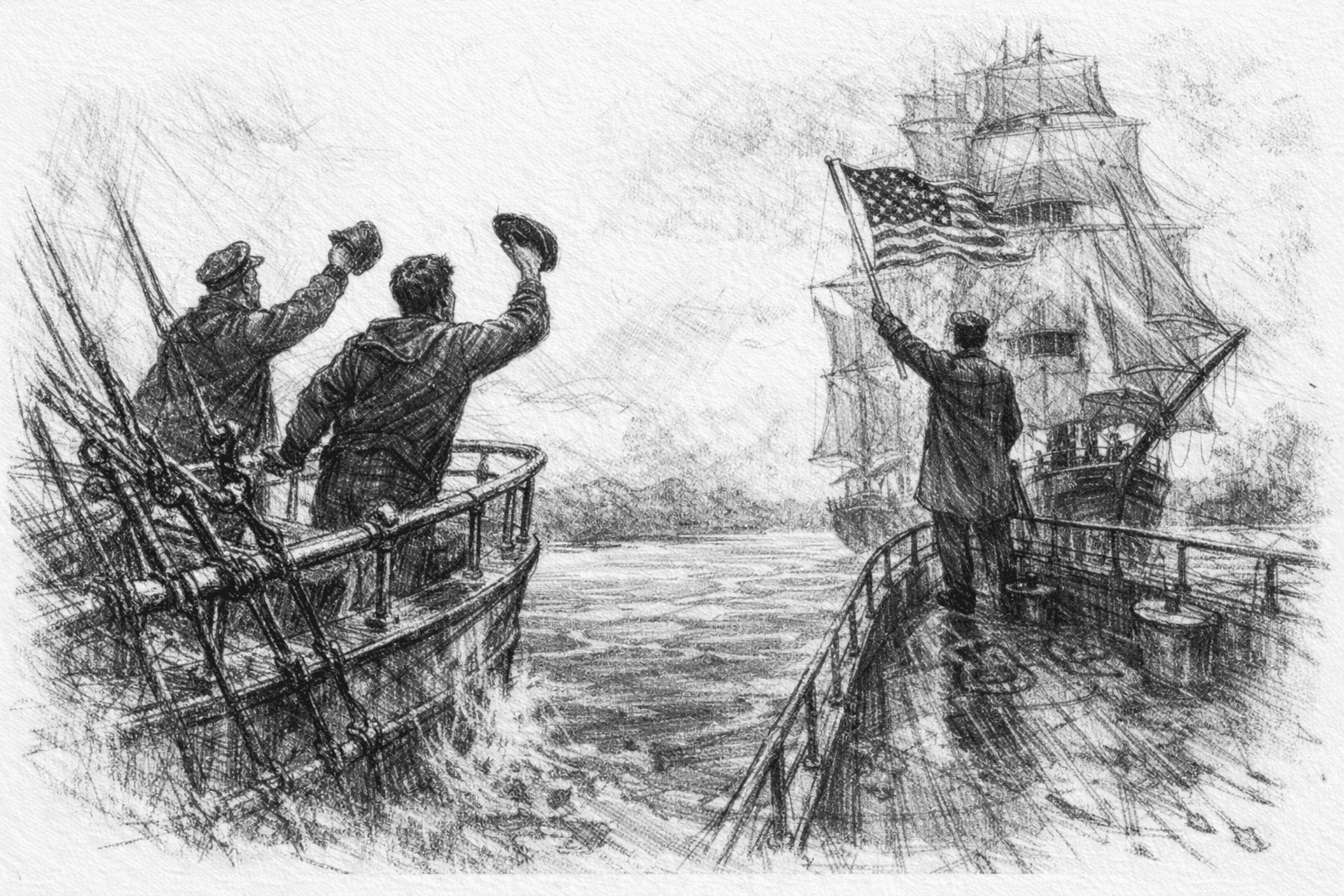
We came aboard, and the next morning a tug was secured to take the ship out to sea. On the way down the river, my comrade and I happened to be forward on our ship, laying in an anchor, at the time we passed the American, our former ship. Our captain was also there with us. As we were passing, the Dane and I saw our former captain, standing on the halfdeck of his ship. We were quite near, so we took off our caps and signaled him farewell. He knew us, and signaled back by lifting his hat. Then he went to the flag haliard and dipped the American colors 3 times in greeting. Our captain looked at him, and then at us, and asked: 'Who is that man?' 'That is the ship on which we came here,' we answered. Then he said, 'He must be quite a man. 'Well, he was so much of a man that neither our captain nor any other had ever before seen a captain signal a farewell to two common tars by the dipping of the national colors. It was only captains or other officers who used to greet each other in that manner. I had never heard that a common sailor had ever been greeted like that before.
The American captain saw the name of our ship and the flag it carried, and he must have understood we were now going home to Norway, as we had said. Now he could see, as he had said he wanted to see, that we were going home.
And, curiously enough, this occurrence made the officers and comrades on our ship look on us with a sort of reverence, so we were treated with the greatest respect and kindness. Think of a pair of youngsters who had sailed on an American ship, and had been so signally honored on their departure. These lads must be outstanding in virtues of some kind. And what with their modern, new, French clothes and smart outfits, and the money in their pockets, these young chaps were not to be scoffed at. There was certainly something comical about it too; especially when we remembered that it was not so very long ago that even the wharf rats in New York would have nothing to do with us.
Our pay was to be $30.00 per month, as it had been on the American ship. This was three times as much as paid to other seamen on this ship, and 3 times as much as ordinarily paid to seamen who were hired in Norway. We did not need to draw in advance on these wages, but we delivered what money we had in pocket when we came onboard to the captain for safekeeping till we should reach Norway.
When we came down to the mouth of the river there was no wind. The captain would not attempt to go out, and put us in hazard of drifting ashore with the current. We anchored, and waited for wind. The next day was also still, and bright sunshine. So we took it with calm resignation.
A man of the crew had been out on the jibguys to do some work which I had now been asked to complete. When I came up on the bow rail I noticed he had tied a rope to one jibguy, put the other end on the windlass. and thus hauled the one guy away from the other, to make more room for himself to work. I wanted that rope removed; so I loosened the knots and expected the jibguy to spring back to its proper position. But it did not. So I believed there was no strain on the rope. I did not notice that the rope was stuck in the old tar on the guy-tackle, so it remained taut even with the knots unbound. I went out, put one leg each side of the guys and began to work. After a while the rope pulled loose from the tar, the guy sprang back in position, throwing me off into the air, and I fell into the sea. Going quite far down, I had time, before reaching the surface, to call to mind there was a boat on the water at our stern. There was therefore no danger. I began to swim to the boat as soon as I came to the surface. But noticing I had lost my cap I swam back to get it.
In the meantime, I had been seen falling in the water, and a rope was let down for me. But I swam for the boat. First mate then ran aft and slid down into the boat by its towline, and did all he could to help me in. And the men let down a ladder for me. But as they got me up to the window in the captain's cabin, looking out from the stern, the captain opened it and told me to step in there. He asked if I had intended to take a swim. I said it was quite unexpected.
The next morning there was wind. We lifted anchor and set course for the English Channel and for Norway. I had notified my betrothed that I was now on my way home. It was now about midsummer, and the weather was unusually fine, but the breezes were very small, so we did not move rapidly. Our captain here was an elderly man with a big, black full- beard, and he was good-natured and friendly. First mate was also a man up in years, jovial and playful; and the men were all friendly and good-hearted people.
As the ship was homeward bound, she must be put in the very best appearance, and we were set to painting and polishing and putting her in fine trim. Good mariners always liked to do that. They felt proud of a fine looking ship, painted white and cleaned up all places inside.
We had watch by watch, that is; the afternoon watch was free from 12:00 noon to 7:30 P.M. Thus we had much time to spend on any little hobby we might be interested in. To make small covers for the chest-tops was a pastime with some men. These covers were painted white and were embroidered and set with ornaments and fringes. I made one of those for my chest, and it seemed to be much admired. It remained on my chest as long as I sailed, and was left in Norway when I emigrated to America.
Time passed rapidly and pleasantly until, after nearly a month we saw the Norwegian mountains on the horizon. They did not look very inviting at first. But as we came nearer, and especially when we saw woods and grassy slopes, which were now in the full flower of summer, we admired and readily agreed this was the most beautiful country in the world.
The day after arrival at Sandefjord we were mustered out. There was a Stavanger man on board. I do not remember his name. He was also going home. He had been bumming as a sailor for some time, and did not even have decent clothes to put on; and of money he had no more than enough for fare to Stavanger. Whether he had sailed and worked only for the boardinghouses or runners, or had spent his money at drinking and carousing, I do not know. But I would not have gone home in his condition, and looking like he did. He had probably been away a long time, and was glad to come back and see his relatives and friends. So, we traveled together to Stavanger. To my good friend the Dane I said farewell. He was going home to Denmark. I saw him no more.
Looking for a coast steamer, we found there would be no regular schedule boat westward, calling here, for several days. But a boat would go west from Laurvik the next day. Then we secured a man with horse and wagon to take us over to Laurvik next morning, and after having taken a walk up through the valley a little distance, we came back to town, looked up a hotel where we stayed till next morning. The man came with the wagon and we got in. Up hill we went for quite a while until we were upon a plateau of many well- improved farms. It was haying time, and good weather for it. Soon we were going down hill again, and were presently in Laurvik.
A little coast-boat was going as far as Christiansand. It was as delightful day, steaming along the coast in beaming sunshine. We touched at Kragero, Risør, Arendel, Grimstad and Lillesand. When we came into Christiansand we got on the mail-steamer from Hamburg, 'Kong Sverre.' We obtained a berth in it, and slept till next morning, when the steamer swung in around Tunganeset and in Stavangerfjord.