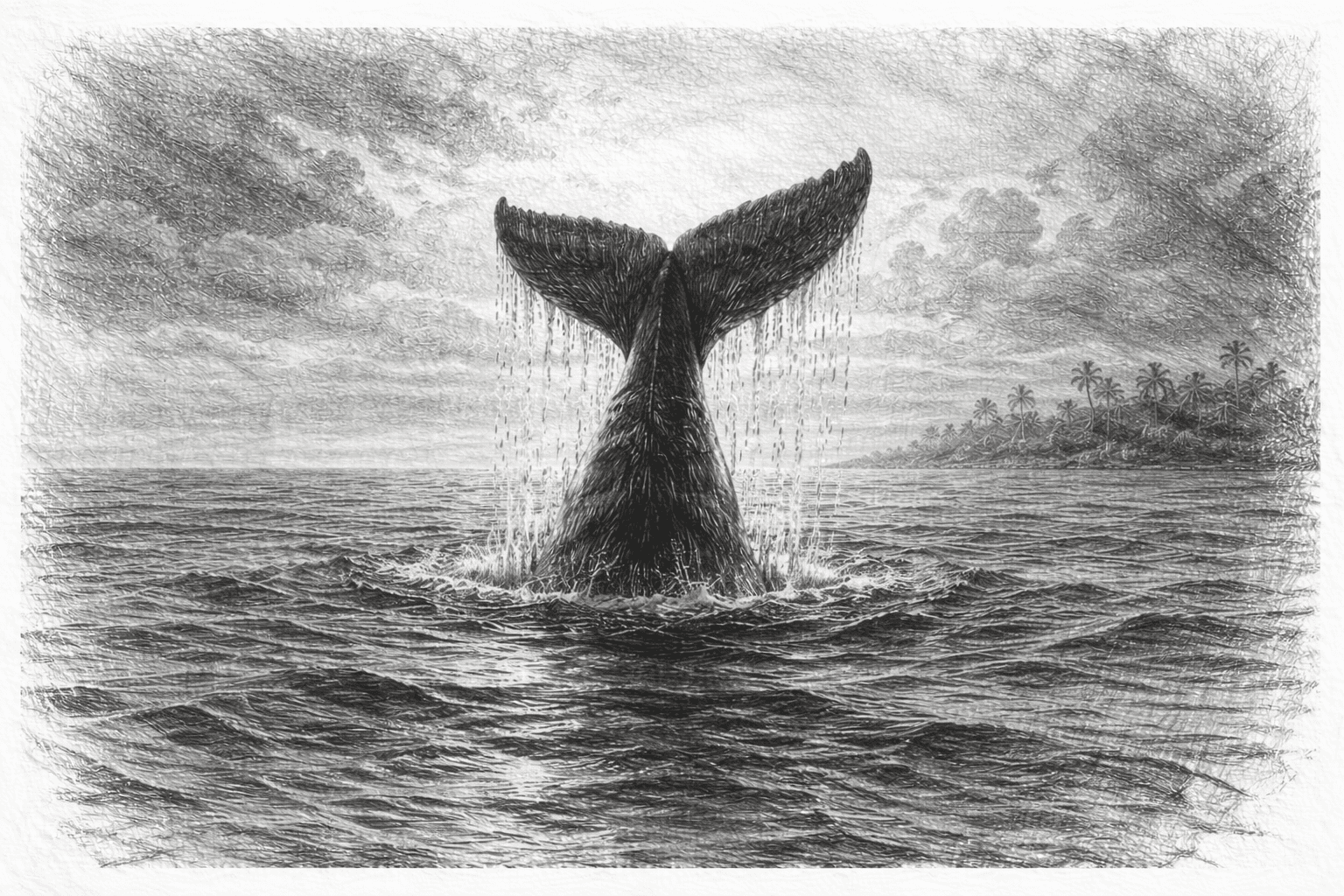

We had come into the northeast tradewind and were not far from Madagascar, as I stood at the wheel one day, I saw a sight that I have never been able to explain. In the light breeze that was blowing I admired the appearance of sea and sky and was looking this way and that, and all at once I noticed a strange object some distance out to port. This thing was about a mile away, stood vertically out of the sea, and appeared like the hinder part of a fish, its tailfin uppermost. It was like the tailfin of a salmon, but it could hardly have been any common fish, it was so monstrously large, standing not less than 15 feet out of the water, and the fin must have been 8 or 9 feet across. The color of it was black. It stood still for a moment, and then gradually sank into the sea. This could not have been a whale, as I have seen the various kinds of them, and know how they appear when they emerge. This was entirely different. To this day I have at times wondered what this thing could have been, without solution.
Finally we approaced Cape Good Hope. Expecting a western gale and high seas, we were ordered to secure the rigging by extra backstays. Violent pitching and rolling of a loaded ship is hard on the rigging. And when we finally got into that contrary gale and sea we found it was well to have done this extra bracing. It was a violent storm and turbulent waves, and we had to put her under stormsail for a while.
Here around the Cape was much life and activity; so entirely different from the lonesome, vacant Indian Ocean. Here sailed the mighty albatroses, in all diretions, unaffected by storm and wave, all day, apparently without moving their wings. These beautiful white birds, some of them as much as 12 feet in wing-stretch, sailing around us in all directions was a meorable sight. There were also cape doves, about as large as leghorn chickens, and spotted black and white, very attractive in appearance.
We fixed up hooks and lines and began to fish for birds, - the rarest fishing I have ever done. Putting a little piece of pork on the hook, we let the line out from the stern. Both line and hook lay on the surface, and when the bait was about 100 feet from the ship the cape doves took it and flew aloft with bait, hook and all. Then it was to pull them in while they opposed with all their might. When we got hold of them we took the hook out of their beak and let them loose on deck. The upper part of their beaks was bend down over the lower part. The hook took hold of the upper part, but did not go entirely through, because the outer part of it was horny hard. Therefore, as soon as the line was slack the hook fell out. We caught a great number the doves.
But we had to try the albatross too. This required heavier lines and bigger hooks. It was greater sport also. They would not take the bait until it was at least 200 feet from the ship. And when they had bit they did not fly up, as the cape doves, but set their feet down and forward in the water, therby almost submerging themselves. And that made them so heavy to pull in that we blistered out hands in the process. With a big one on the hook I struggled till I got it up under our stern, and began to think of the fine catch I had made when, as I pulled it out fo the water it contracted its body so the head was close to its back. Then it shot the head out and backward so rapidly that the hook fell out of its beat and it escaped. The hook was only caught in the hook of the beak but had not piereced it. That the bird had wits enough to throw the hook out of its beak I had not believed.
Letting out the line again, the same bird took the bait. Now I thought I should not be fooled again, and tried by best to hold the line taught when I began to lift it from the water, but it played the same trick and got away. It began to look as if this albatross was having fun with me, and was not a bit worried. I let the line out again and it took the bait for the third time. You shall not make a fool of me this time, I thought. And now, as it prepared to make the quick move and unhook itself, I also prepared and gave a good jerk on the line to take up the slack. But its move was more effective than mine, and it laughed at me again. Now I had to give up because my hands were terribly sore from the pulling I had done. It was like pulling a 100 pound potato sack.
We caught only one albatross, and we marched it around the deck several hours. It did not seem able to raise itself for flight from the deck. It did not appear to be afraid of us, but would stare at us with rather mild and kindly eyes. Its yellow beack was about 7 or 8 inches long and evenly broad all the way to the point. It stood about 4 feet up on deck, and measured 11 feet between points of wings. It was killed and a kind of embalming process was used to keep it until a taxidermist could set it up when the ship reached home. The bird fishing was limited.
The western gale did not last but a couple of days. The third day we were near the African coast immediately east of the Cape. Then all at once there was a calm, and a fine little easterly breeze filled the sails. Under this we rounded the cape close to shore, which is rocky and steep. The Cape Rock is also called Taffelberget. It is hight, and flat on top. Its position is about 32° south.
Having passed the Cape the coast line lies northerly. Now a southerly wind blew, and we avoided the usual contrary west wind. All our work in preparation for a protracted battle with a westerly gale and high seas was unnecessary, and we now had to take down all extra braces and stays.
Then we took to painting and polishing ship again. The wind was not strong, and we sailed slowly. It was now nearly three months since we left Rangoon, and no day in that time had the wind been strong or favorable enough to make more than five miles per hour. This weather was almost too fine. If it had not been for the slight rolling of the ship in the easy swell on could almost forget he was on the ocean. But we had plenty of work, so the time passed rapidly.
The ape that escaped to the rigging was thrown overboard one night when we put the ship about. The other one remained a source of amusement. We had a pig onboard and its house was on top of the main hatch. To keep the ape out of the paint we had to tie him to the pig's house. He had a long chain so he could move about freely. There was a cover on top of the pighouse which we usually took away in nice weather, and then the ape took his position there. The numberous cockroaches in the pighouse the ape caught and ate with great relish. But the pig was always watching for a chance to get hold of the age's tail, especially when it hung under the roof of the cage. He was often compelled by the pig to get out of the cage, which was not to his liking. Then he would scold and often give the pig a crack over its nose with his flat hand, complaining the while most bitterly to us that the pig interfered with his effort to get the roaches. Its emphatic language, supported with abundant gestures, we could well understand.
One day the carpenter had placed the grindstone on the corner of the main hatch, having used it to grind an axe or a knife, and he had left a little water in the trough under the stone. The door to the carpenter shop was near and stood open. While the carpenter stepped away somewhere for a moment, the monkey went into the shop and took the carpenter's pipe and came out with it in his mouth; but the pipe must have been very sour, because he grinned painfully.
The he went to the grindstone trough, dipped the pipe in the water and rolled between his hands by the stem, repeating the dipping several times, and then again put it in his mouth, as he had seen us do. Not succeeding by this process to make the pipe sweet he threw it in the trough with a loathesome grin and left it there.
Then the mate came with a gallon pot of gray paint which was to be spread on the forecastle roof, placed it on the corner of the main hatch and stirred it for a while. The monkey sat on the top of the hog-cage and watched the mate closely. From the place I was working I could see the ape planning mischief, and I thought it would be too bad if the mate should leave the paint pot there and go away.
Sure enough, the officer went aft for some purpose and left the pot. The ape, doing some rubbernecking to see the mate well out of reach, immediately jumped down aside the paint pot, grabs the brush lying aside the pot, dips it in the paint and begins to paint the hatch cover with all his might. But however deep he dipped the brush he did not seem satisfied with the amount of paint in each brushful, or he feared he could not complete his job before the mate, for whom he kept a watchful eye, should return. So he grabbed the pot and emptied its contents over the edge of the hatch cover and down over the deck. Then he threw the brush aside and began to spread the paint with his hands as far as he could before the mate returned. he worked as if it meant life or death and the paint went over a lot of surface in a hurry. But now comes the officer, and the monkey goes for the top of the hog-cage, where it puts on an extremely innocent attitude. The officer was raging with anger. But mad as he was he did not dare to do anything to the monkey, because it belonged to the captain. The scene was so comical I wanted to laugh out loud, but I had to keep an innocent face, as if I had seen none of it. The officer and the ape were both very comical, each in his own role. It was no small job for the mate to clean up the paint, and he was bitterly angry at the little imp that sat on top of the pig-cage and grinned the while.
As the reader will understand, we had endless amusement over the antics of this little creature from the forest of Burmah. It was nearly unbelievable how he could imitate what he saw us do.
In the meantime our school of navigation was holding sessions every day. One day the captain asked me if I understood English. 'A little,' I said. ''You are a Portuguese devil.' Translate that into Norwegian,' he said. 'Du er en Portugisisk djevel,' I said. 'Well, that is what you are,' he said. I expressed my pleasure at that. 'Do you know the meaning of it,' he said. I said I did not. 'That means,' he said, 'when he is good he is really too good. Here you are teaching these boys navigation for nothing, whereas you had to pay well for learning it. You are dumb. You will never get a cent from any of them for your efforts.' 'But it does not cost me anything to teach them.' 'If they would learn navigation, let them pay for it as you did,' he said. With that the conversation ended. I understood well enough that he was right. I rather doubted, also, their promise to pay me some time in the future. But it cost me nothing, and I felt like helping my comrades and good friends, so I let it go on. If they paid me int he future, then good and well. If not, then I really had lost nothing.
BUt I understood what was in the captain's mind. He looked at me as a rebellious leader among the men, and he knew by thus favoring the boys they would be my allies in a controversary with him. This he did not like. He remembered the Sunday strike as a defeat of his supremem authority aboard ship.
After a while the opportunity seemed right for the captain to test his power over the crew again. We were to paint the interior of the forecastle. We had to take out all our belongings and bedclothes to paint everywhere, inside and out. The captain thought we would be glad to get our things moved back into the forecastle again at the earliest moment, so he ordered that we were to forego our afternoon free watch and finish painting the forecastle. This order we did not like. There was no reason for haste. The voyage was proceeding very slowly and there would be plenty time to finish this painting without working during the time of our free watch. We could sleep almost anywhere, because the weather was fine and warm. We let the mate know we did not intend to follow the captain's order. He went to the captain with the message. Then comes the captain and asks if we refuse to work again. We answered we could not see there was so much haste about this painting that wehad to use our free watch to do it. He threw his cigar to the deck so the fire flew from it in all directions, and in a fit of anger brought his fist down on a table standing near by so I thought he would break it, and vowed that we should be put in durance vile, and be deprived of whatever wages we had coming. We had now twice refused to work on ship in open sea, and for such refusal we should pay dearly. When he had raved thus for a while he went away. But we did no painting during our free watch. We heard no more from him, but we wondered if he really meant to have his threat executed. We believed, however, that our refusal was justified. The captain also knew this, because we never heard anything more about it. But he was terribly sore over the fact he imagined he had suffered another defeat.
A high, rocky island was in sight forward one morning. We were told is was St. Helena. Our captain hoped we could have a chance to send a wire home that we were alive and our present location. For this purpose we steered for the island. At noon it did not appear to be more than ten miles away, but the air was very clear and it must have been much farther, because we did not reach it until about 6:00 P.M. Then it was too late to get out a wire that day, and we would have to wait until after 6:00 next morning. This island is high rock, lying in latitude 15° south. Its greatest width is north and south, and at both ends it is higher than the middle. In that middle part or saddle it was that Napoleon sat while he was a captive here. Inaccessible on all except the east side, this telegraph station and a little town is located there.
We left St. Helena before dark and set course for Ascension which lies on about 8° south, and where there also is a telegraph station.
Now it was nearly four months since we left Rangoon, and no word from us had reached home since then. So they were no anxious to hear what had become of us. After a while we reached Ascension, which is a little flat island, and here we arrived at about noon. We sailed near under the island, hoisted our national colors and the signals giving the name and home port of our ship. These signals were answered from shore by signals meaning 'we have seen you.' Then there went a telegram to Stavanger as follows: 'Semiramis, of Stavanger, passed Ascension today. All well.' That was very welcome news to the people at home. Now, at any rate, they knew we were alive, and where we were.
No marked change came in the settled calm weather with small breezes. it became monotonous. We longed for brisk winds. Even a gale might be better than this. Another thing, we had consumed nearly all our vegetables, and fresh or canned meat supply. The last was some canned halibut and some dried potatoes. Then, living only on salted meat, there was danger of scurvy. The symptoms of this sickness begin with a tired or lazy feeling, then the gums of the teeth begin to swell, the teeth become loose in the sockets; and one of the final symptoms is, when you press on your leg with a finger and then remove the pressure the impression stays. If no remedy is applied the flesh may loosen from the bones, as if in decay, while one is still living. But death is sure eventually. This sickness often becomes a visitor in ships on long voyages. One time a sailor told me he had been on a voyage to South America, and became a victim of this disease, and when he was brought ashore and to a hospital, he was in such condition that the attendants in handling him feared the flesh would part from his bones, so they rolled him in a sailcloth and took him with great care to the hospital.
Among our crew, the first one who was attacked by this sickness was Jacobson. He used to take thinkgs very easy during his free watches, lay much in bed and read, while the rest of us kept more active.
The captain, hearing scurvy was showing itself, ordered that the men be kept in activity, day and night, whether there was much or little to do. We were not told why, but there was a constant stir by the officers to keep us busy, bracing and shifting sails, at all kinds of hours, whether necessary or not. Some of the men protested. We were all tired, and they could not understand why this useless driving. But there was no use protesting now. The officers had the right of it. Nevertheless, some of the crew vowed they would give the second mate a thorough overhauling as soon as we reached port. He was, however, right, though he would sometimes go too far in his attempts to stand in favor with the captain. As the sickness increased the threats against the mate were repeated.
We were to go to Falmouth, England, for orders. At length we arrived there. We braced back at the insailing, and signaled for a tug. When it came, the captain ordered it to bring out our orders, and also to bring out a goodly supply of vegetables, fresh meat, two barrels apples, and not to forget, tobacco. In a little while the tug returned. Our orders were to proceed to Copenhagen with the cargo. As soon as the provisions were brought onboard the captain ordered the steward to open the apple-barrels, take a basket, and distribute freely among the men, - apples are among the best things one can eat to prevent scurvy. I stood aft, near Kristian, who was steering, when the steward came with the apples. Kristian grabbed an apple and took a bit, but at that the upper gums loosened from his teeth so the blood ran profusely. When I saw that I was prompted to be more careful, as my gums were quite a little swollen, though I was rather lightly affected with the sickness.
Then we braced full again and set for Copenhagen. That we were going there was good news to us. Now we had what might be called a Christmas-feast, with all kinds of good things to eat, and it was unbelievable how fast the scurvy left us and we came back to full vigor.
After about a week we reach Skagen, at the northern point of Denmark. Here we met the biggest storm of the whole voyage, except two days when near Cape Good Hope. About two hundred smaller vessels bound for Baltic ports lay here close up to the northwest shore of Skagen and awaited a change in the stiff southeast gale, so they could proceed in Øresund to Copenhagen and beyond. Captain Hamre was too proud to stop and lay waiting here among these small fry ships and Chinese junks, as he called them. He came from East India and he would show these homebodies how he could sail into Copenhagen in any gale, contrary or otherwise. Then we went to tacking, with topgallant up, though it would have been more sensible to go under reeved topsails. he had an idea he must be first of all these ships to reach Copenhagen, and then he would tell how he could sail when the west lay weather-bound. meanwhile the current was also against us, and after tacking for three full days and nights, going about once every three or four hours, we could still see the lighthouse at Skagen in the northwest. Now the wind veered to east, and soon the whole fleet of small craft came pushing up to us. Now it would be very humiliating to our proud captain if any of those little junks should make Copenhagen before we did. The wind was such that we had to closehaul our sails, and keep her as close to the wind as possible to avoid tacking. As I took the wheel for my turn, the captain came and told me to handle her helm as if it was a red-hot iron. He meant I must take advantage of every shift of wind, which I also did. Late that afternoon, as the first of all those ships, we anchored in the roads of Copenhagen. Pilot we had taken on at Elsinore.
We had anchored 3 miles from Trekroner, the lighthouse at the insailing. An easterly gale was blowing. It was not far to the leeward shore, and there were choppy seas. The captain expected his wwife to meet him in Copenhagen, and he was in great hurry to go ashore and see if she had arrived. Out boats were rather small, and our pilot warned that it was dangerous to attmept a landing in such a high running sea; but the captain meant we were able tars and could take him ashore easy enough. Should he, who had come from East India now lay here weather-bound in Øresund, at anchor, only 4 or 5 miles from shore? No, he would show the world that here were Norwegian sailors who knew their business. He ordered the second mate to selet four of the best men on board, who were to dress for shore-leave, and take him ashore. Jakobson, Thompson, the carpenter and myself were the men chosen.
The oat hung in davits abaft. Two men entered the boat, and they were to unhook the tackles when the boat reached the water. That done, the other men were to come in the boat one by one, as it came up on a billow even with the half-deck. Between the billows the boat went down 16 to 18 feet. When the four of us and also the second mate had entered the boat, the captain was to enter when the boat came up on the next high wave. But he was not quick enough. Before he got in the boat had begun to go down - at great speed. The captain fell, and came very near to going overboard. We shipped a great deal of water, and the carpenter, who was trying to hold the boat clear of the ship's side with a boat hook, broke it. Clear from the ship, the captain took the helm, seating himself pompously on the Norwegian colors on the stern seat. Soon he noticed the steering ropes hung rather loose in his hands, whereupon he looked behind him and there was the rudder floating in the water. Now the second mate had to get out an oar, and try to steer the boat. That was not so easy, but the four of us at the oars, rowing, had to paddle or hold back so as to keep running with the wind and prevent the boat from turning side to the weather and capsizing. It was hard work, and the drift and spray from toppy breakers gave us good wetting. As soon as we came inside the Trekroner light the sea was more calm, so there was now no more danger of capsizing and drowning, and as the dark of the evening came on we landed at one of the piers. Glad were we all, and the captain not the least, that we had landed safely, though we were all wet to the skin.
There could be no thought of getting back to the ship that night, so we were told to come with one of our officers to one of the best hotels in Copenhagen. On the way up the streets I had an experience of sea-legs, which I have never had since. For a while one of my legs seemed shorter than the other, or it seemed as if I walked on an incline, first leaning one way then the other. And the walk seemed to be moving or rolling under me. But it was really not so strange that I felt the ground moving under me. We had been on the mvoing waters for five months, or 152 days, the ship rocking more or less all that time. It was as if I could not walk steadily on solid ground, or believe the street was solid.
When we got to the hotel we were ushered into the dining-room, and big, find toddies were put before us, which braced us considerably, in our wet clothes. On came a great supper, which felt very satisfying to our ravenous appetites; and cigars, - a good smoke belonged always to a good dinner for a sailor. Being assigned to our separate rooms, which seemed so luxurious, I doubted that I could sleep in that fine bed with my wet underwear. But I thought the captain will pay. I went to bed ans slept like the righteous till about 9 o'clock next morning. Breakfast was fully as fine and enjoyable as the supper. While we ate, the waiters stood around and told how the captain had praised us to the officers of some other ships, who happened to be there the previous evening. He had said one might hunt a long time to find such able seamen as we were, and if it had not been for our skilful handling of his boat last evening he would not have reached shore alive. The waiters looked on us as heroes, and our heads swelled not a little, for the time being, especially since our own captain had praised us to the skies.
We returned to our ship in a small steamer, taking our own little gig in tow. Then the ship was brought into harbor. Here lay hundreds of ships of all sizes and descriptions, but even the Danes themselves admitted freely that that 'Semiramis' was the proudest and finest ship in the harbor. On the homeward voyage, as before stated, we had painted and polished her from the globes on top her masts to the waterline, and she appeared like a new ship. When she was moored to the pier and pumped dry, our time was up. We had been exactly a year on that voyage to East India.
(The last few pages of these reminiscenses were written aboard the Norwegian-American Liner 'Stavangerfjord', on the way to Norway. We are now a few miles west of the Hebrides, and it Saturday afternoon, July 9, 1938. A gale of Northwest is blowing, and the Stavangerfjord is rolling and heaving considerably, especially noticeable fore and aft. Many of the passengers are seasick; some are feeding the fishes. But some of us think this is really enjoyable sailing. My nephew, B. O. Berge, of Ottawa, Illinois, who is my traveling companion, has been taking some pictures of some of us who enjoy sailing on a stormy sea, trying to get backgrounds of foamy waves and breakers. Tomorrow afternoon we are due in Bergen, Norway.)