
It was early May as we lifted anchor, glad to get out of this bakeoven. We had perspired away a great deal of the fat of our bodies but as soon as we got out to sea we were relieved of the great heat. The weather was fine, but the wind very faint and progress slow, with changing winds clar across the Bay of Bengal. On the east side of that bay lie the countries of Burmah and Siam, the latter extending southwardd under the name of Malay Peninsula, almost to the Equator, with the city of Singapore at its south end. West of this peninsulalies the large island of Sumatra, extending from about 6° north to 7° south latitude, a distance of about 800 miles. The strait between Sumatra and the Malay Peninsula is full of small islands, rocks, shoals and sand or coral reefs, and as there is a strong southerly current running down the strait, it is a dangerous place for sailships in periods of calm. When we saw the norhtern end of the island I noticed the captain expressing fear that we mgith be carried into the strait, as the wind had very little effect in our sails.
One day we watched the crew of an English ship pulling in a monstrous shark. The wind eventaually straightened our sheets so we got out on the westside of Sumatra.
We had begun to clean up our ship while at Rangoon, and now, in this infe weather, we continued, so she would be in fine trim when returning home. The first job was to remove all rust from any iron and steel. This took a long time. Then we began to paint.
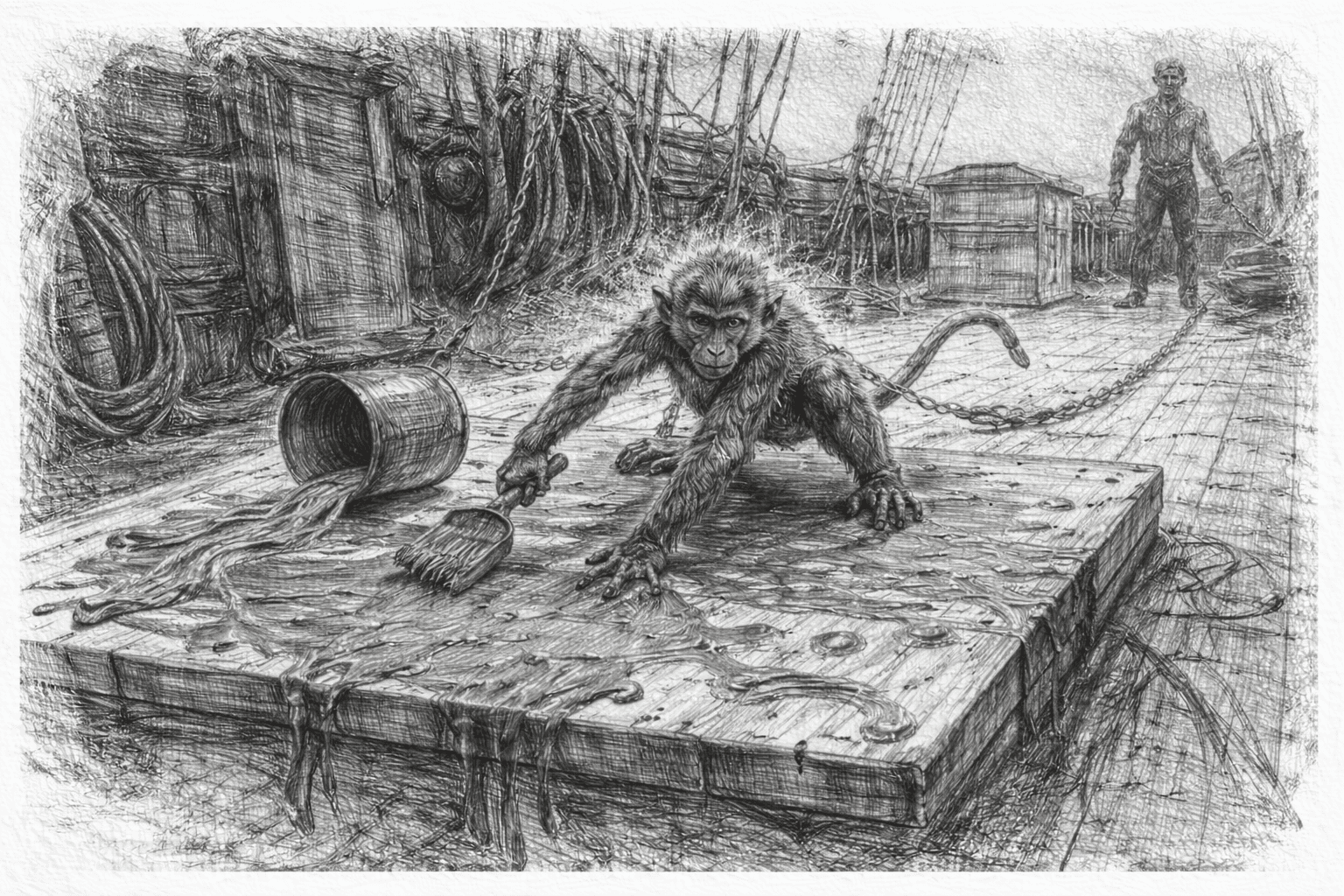
The captain had bought two small apes in Rangoon, and kept them chained to the cabin roof. One of them was quite tame, but the other wild. It strained and worked at its chain day and night until it finally succeeded in getting loose, and then it ran aloft, and by no means could it be persuaded to come down. The other we had to move forward to the forecastle roof when we began to paint around the cabin, so it should not get into the paint. There seemed to be no end to its varied apish tricks, by which we were greatly amused. But it did not enjoy life on the forecastle roof so well. It was take the sardine box in which it was suppoed with water and pound and hammer on the rusy anchor to which it was tied, in apparent effort to remove rust, as it had seen us do. With this it continued day after day. Once in a while it would stop to see what we were doing, but soon it would be at its own job again.
The method in which the apes were caught was this: Two cocoanuts were used. Small holes, big enough for an ape to insert its hand, were bored in the shell, the contents taken out and a little sugar put in. Then, out in the forest where the apes were numerous the nuts would be placed, and the man would stand a little distance away. Soon some ape could not control his curiosity, and came down from treetops to see what was in the nuts. As soon as it discovered the sugar in the nuts, in goes the hand to grab it. But it cannot get the hand out without losing the sugar, and it knows the sugar tastes very good. Soon it doscovers there is sugar in the other nut also, and in goes the other hand to get that. Having grabbed the sugar it will not let go. Now comes the man. The ape cannot take to the treetops with those two cocoanuts on its hands, and in its fear and excitement it is unable to let go of the nuts, so it is quite easily caught.
There was something happened on the outward voyage to India I have omitted so far to tell. As mentioned, the comrades in the forecastle became good friends, and as they found I could do barbering I had 3 or 4 customers every Saturday. Sven was one of them. It was, of course, all gratis service. There was a boy from Sandnes, Kristian Tronser by name, who had an accordion. I had learned to play a little on it, and no one else seemed to know how. Sometimes I would borrow the accordion and play such tunes as would come to my mine, including national airs, chorals and gospel song tunes.
It had been a custom or havit that on Sunday mornings the crew was to wash and clean all painted surfaces in their quarters, and scrub decks. This took all Sunday forenoon, and we did not think it proper to work every Sunday forenoon like that. The cleaning and scrubbing could just as well be done on some other day. After we had been out about a month we agreed that we would refuse to do this work on Sunday. Then, one Sunday morning about 5 o'clock the mate comes to the forecastle door and calls: 'Turn to.' Nobody answered, and nobody moved from his place. After a while he comes again and asks if we did not hear his order to turn to. 'It is Sunday today', answered some one. The mate went to the captain and told him the men refused to go to work. The captain comes and asks: 'Do you refuse to work?' "It is Sunday today' was the answer he got. He became very angry and vowed we should suffer for our refusal. Noboby answered him, but we remained quiet, sitting on our chests. After he had scoleded and fumed for a while he went aft. The sit-down strike was effective, however. We were never again ordered out to wash and scrub ship on Sunday morning. But later I leared the captain had not forgotten this humiliation.
One day while we were crossing the Indian ocean, Kristian was at the wheel, and the captain came over to him and asked: 'Does Vestbø play many fine humntunes for you in the forecastle?' Kristaian told me about this, and I began to suspect something coming. I had noticed the captain was not very friendly toward me. He had probably figured out that the man who played the humntunes was the leader or one of them in refusing to work on Sunday. This was entirely wrong. I was one who refused, but i was not the leader.
Another day a little later the captain approached and asked me 'You are from Finnøy, aren't you?' I said I was. He took a few steps along the half-deck, then returned and asked: 'It was there they caught their pastor in the dip-net was it not?' 'Yes,' I said and smiled. I wondered what these questions were leading to, as I noticed they were not asked with any humorous expression in his face. After another swing over the deck he came back and said: 'There must be some great chaps on Finnøy.' To that statement I did not feel I had to make reply, and I kept my mouth. When he had stood and looked at me a while, he resumed his promenade on deck without saying anything more.
Now I understood what it all meant. It was a nice hint of the fact he believed I was the elader in the Sunday strike.
There were two men in the forecastle who had taken the navigation course, and we had had considerable talk about things pertaining to the subject on the outward voyage. Some of the boys had asked me to teach them something of the course now while on our homeward voyage, as they intended to go to the school when they reached home. I had promosed them to do that, and they had supplied themselves with paper and materials while in Rangoon.
Right soon after we were out to sea we began this school, during the daytime free watch. Students were Jacobson, Thompson, Sven and Kritian, and possibly one more whose name I cannot now recall. Kristian was illiterate and, to begin with, it looked rather hopeless for him; but he had a great desire to learn and it was astonishing how well he took hold. They all had more than a little ambition. I have never seen more active and enthusiastic students. The weather was pleasant and not much work to do, so the school was in session every workday. It was hardly any trouble for me and i was in this manner enabled to go through the course all over again. This, I realized, was a great gain. The boys promised to pay me as soon as they had any money to spare, and I believe they honestly meant to compensate me, but I did not expect much if anything from them.
For a long time there was hardly wind enough to fill the sails, and we moved at snail's pace; but the days were bright and clear and we enjoyed them, and cleaned, painted and polished our ship against the homecoming.