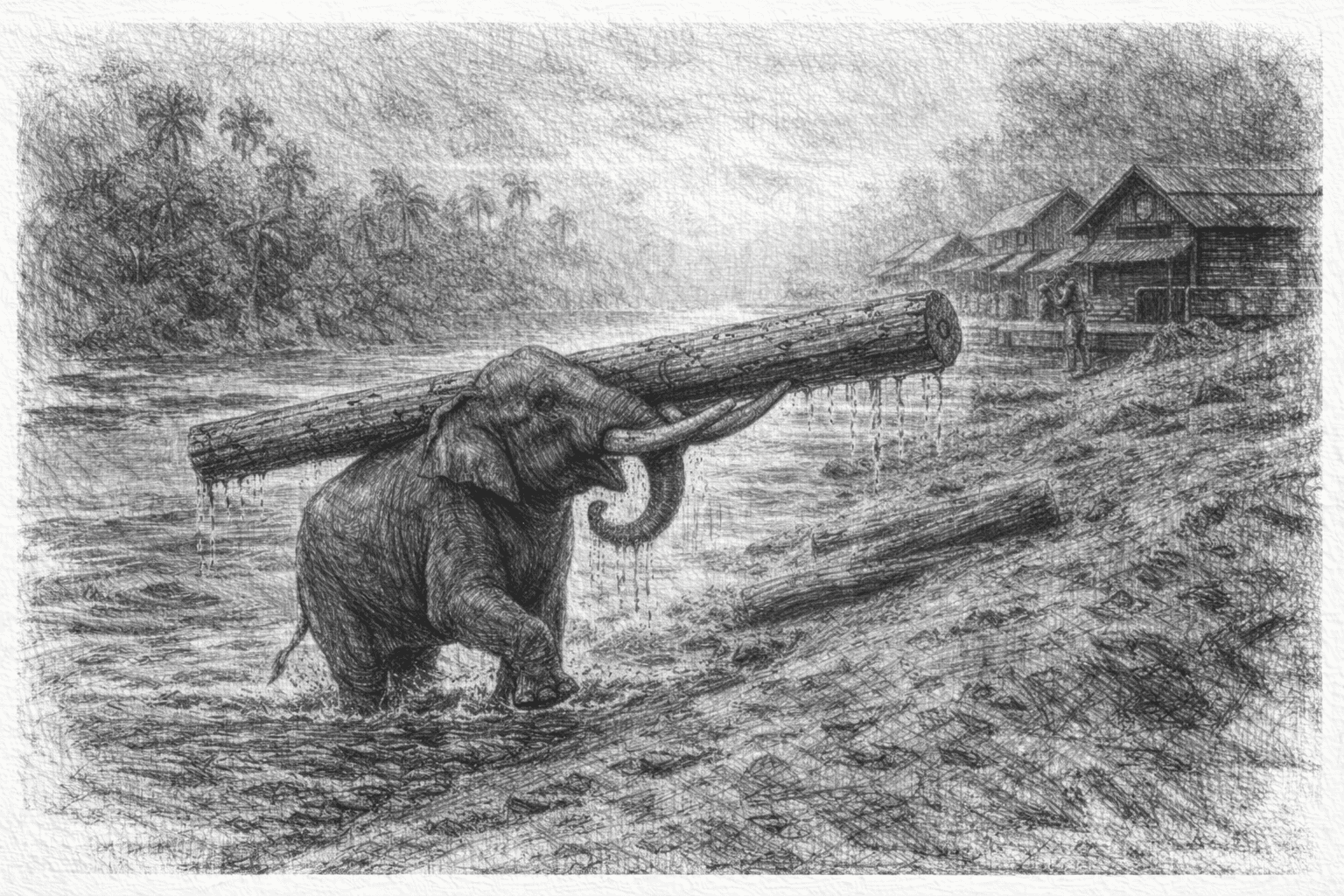

The city was located on the east side of the river while our ship lay on the west side. Up on shore in front of our ship there was a large sawmill. It was some distance up from the river, probably because the river in rainy seasons would run much higher. There were two elephants working in connection with the sawmill, one carried logs from the river to the mill, the other stacked up the planks after they were sawed. I have never seen any other animals so faithful and intelligent in their work as these elephants. The one which carried the logs from the river to the mill would come down to the water, wade out and turn his head first to one end and then to the other of a certain log, then put his tusks under the log and his proboscis over it, life it from the water, turn around and walk up to the mill with it and put it down just where it should be; then turn again, go to the river, and repeat the process. A native Indian sat on its head all the time, and only talked to the elephant now and then. It was wonderful to see how he could take these great teakwood logs exactly at their centre of weight every time (they were about 35 or 40 feet long) and carry them in a horizontal position the whole distance. It continued to do this work with clock-like precision the whole day, by exception of the hour's rest at noon. Sometimes on the way down pick up some sand by the snout and blow it over its back to scatter the flies and gnats when they sat on too thick. The other elephant set up stacks of planks or boards as well as any man could do it.
We watched these animals many times, and they were a source of admiration and wonder. The owner of them and of the mill was an Englishman. He told our captain that he had paid 500 pounds for each of them, but that they were worth much more than that to him. He had also told of an incident, when he was abset for a while, and had directed his servant to take good care of the elephants and give them plenty to eat. They were fed new-mown grass. But when the owner returned and himself resumed the care of feeding of them he became puzzled over the action of one of them. When the grass was given him he would divide it in two parts, eat the one part and let the other alone. This act was repeated several times, and the owner could not understand what it meant. Then, one day, the thought came to him that possibly the elephant had not received more than half enough feed while he had been away. He then called his servant and said the elephant had indicated it had not received but half enough feed while he had been away. The servant had to admit it was true. Then, when the elephant had been apprised of the fact that its complain had been understood, it ate all the grass fed to it and did not divide and leave part of it as before. It is almost unbelievable that an animal could thus tell of its mistreatment during its owner's absence. But the story was related as an absolute fact.
The British, who dominate the 300 millions hindoos, seem to keep good order among them. There were native policemen in the city and they seemed to have no trouble in enforcing the laws and ordinances. It is possible that many of our American cities cannot boast a population quite so obedient to law. We were here for a period of over three months, as we had to wait for the preparation of the cargo of rice we had to take back to Europe, and I was ashore a great many times, during days and evenings so I know what I am talking about. We did not hear of a single disorder during all that time, except one evening when some Norwegian and some British sailors had a fight among themselves.
There was another Norwegian ship in the harbor at the time, a 2000 tonner, from Arendal. A part of the men from that ship and some from ours were in a saloon or public house, when some British sailors also came in. Here as in other places the British were fond of bragging about their prowess in boxing and fighting. They soon began to edge up to a test of ability with the Norwegians. These did not let the challenge pass, and it became a free-for-all, in which the English were thrown out of the place and then the fight continued on the street. The British used brass-knuckles and other weapons but withal could not hold their own. Then came the native policemen and tried to establish order, but the Norwegians put both their opponents and the police on the run. It was said some Britishers on flight jumped into the river to escape the fury of the Norsemen. The boys from our ship who had taken part in the affray came aboard about midnight, bloody as butchers, but with great jubilation over the fact the English had been trimmed. Our cook had two big holes in his head. Sven had received a rap on the nose, his shirt appearing like dipped in blood and torn to rags. The others had been more furtunate, but all rejoiced that here, too, the Norwegians had conquered, as usual when Britishers had tried to beat them up, in a foreign port. Some of the reports of this fighter were that the Arendal boys and some of ours had gone beserk, wrecked the saloon and scared the life out of the Hindoos. But all of them came back ont heir ships without being arrested. There were practically no lights in the streets, so no specific charges could be made against any one. 'All pigs are black in teh dark' is an old saying. Probably all the two-legged pigs taking part int he fight also appeared black. But, from experience with English seamen I had, in other ports, I honestly believe they deserved the drubbing they received.
Rangoon was a city of about 400,000 population, of whihc many were Chinese. Many of the Chinese men were clad in roomy, long skirts or cloaks, mostly of silk; while the women wore trousers and a rather long shirt, or a shorter cape, also of silk, outside of them. The Hindoo women had a shawl draped about the body, almost like a skirt with a band around the waist. Some wore a thin cotton waist.
The boys of the street were the sme kind of mischief-mongers and rogues here as in other cities. They had some small squire-guns made of bamboo, which they filled with cold water; and when they met some older men whom they judged could not run fast enough to catch them, they would squirt the water at his back so it made him hop with surprise, and then they would take to their legs.
We all bought water-pitchers made from a gray or black clay. It was remarkable how much cooler the drinking water would be if kept in those pitchers.
Many of the buildings in the city were constructed in accordance with the oriental style, appearing as if one had been built on top of another, and then one above always smaller than the one below; all buildings having prominent eaves, turned up at the edge. The business section was most strangely interesting A whole block would be under one roof. No outside walls, but small streets, about 6 feet wide, intersected the block in both directions, thus dividing it up into small squares. Over those squares there were platfoms about 3 feet above the street level, and on these sat the merchants with all their wares around them. The different platfoms had different kinds of goods on them, and being about 12 feet each way, there was a countless number of them on the many blocks included in the business district. One could buy almost anything here, articles of everyday use, and great varieties of carvings, embroidery and other things, artistic and beatiful, of which I bought some for presents for my folks. My betrothed treasured some of them very highly, and some of them also went with us to our home in America.
One day I went ashore to buy some writing pagper. I searched the market for quite a while but was unable to find any regular letter paper. I did, however, find some very fine rice-paper, but the sheets were 30x36 inches in size. I bought some of this, thinking I could cut it up into suitable letter size. But before doing that an idead came to my mind that it might be just as well to use the large sheet without cutting; so I wrote a long epistle to my girl, filling the whole sheet both sides. Of course, I had to write in columns, becuase it was no handty to write lines a full yard long. I folded and got it into a sizable envelope, and away it went. When I eventually came home to Stavanger I found that nearly every one knew about that letter. They called it The World Post (Verdensposten). Everybody had not been permitted to read it, but the fame about its size had gone far and wide and there was much gossip about it. Olava had much fin answering questions from her friends about it.
We indulged much in bathing while at Rangoon. The water was cool and clear and good for bathing, especially when the tide came in. One day one of the boys suggested trying who could stay longest under water. From boyhood I had had some experience in swimming under water and after seeing the others doing their best I decided to outdo them. Going head first as deep as I could I swam downward until I felt I was deep enough to stay under water until I was compelled to emerge for air. I noticed the water was colder in the depth, but i did not know how deep I had gone. So I began to swim upward, heading away from the ship. It was rather strange that, even with closed eyes, one can feel the position of the body, as to whether it is horizontal or not. I felt I must soon get air, and while I was now swimming upward I was not reaching the surface. The water began to get warmer, but I was frightened at the length it took to come to the surface. I emerged as I felt nearly exhausted, and a few more seconds under water would have been fatal. But I came up nearly twice as far from the ship as the others. Nobody, however, could have induced me to try that stunt over again. None of the others tried it again. They had watched, and feared I would not come up alive. I feel sure no other Norwegian has even been so near the bottom of the Rangoon river, by swimming, and who lived to tell the story about it.
Another day our cabin boy, a hale and hearty lad from Horten, who was sone of Capt. Hjort of the Norwegian navy, suggested we should swim over to the English ship about 1/4 mile away. When we came over we cnetered on to a raft of timbers that lay alongside the ship, to rest ourselves a bit. These timbers were square-hewn and, lying close to each other, formed a smoot floor, but heavy, so their upper sides were nearly level with the water, and in places they were covered with a thick, green slime. Starting back to our ship, the cabin boy first took a run along the floor of the timber-raft, went head first in the water and began to swim. I tried to start the same way, but my foot slipped on the slime and I struck the water flat on my front. The impact of the body with the water was so hard that i lost my breath, and believed I would die before it returned. Then I swam very slowly as I felt certain of internal injury. It took a long time to reach our ship, and when I finally took hold of the rope-ladder to enter up something came into my throat to make me cough, and I spat out a clot of blood. An examinatino by a doctor revealed the fact that the internal injury was not serious, and by a little medical assistance I was soon all right. But now I had done all the swimming I cared to do in the Rangoon river.
There were many Europeans in Rangoon. Those I saw were both pale and thin. The climate appeared to be too hot for them. They wore clean, white clothing, and white parasols when they were out in the sun. The English had a somewhat large, covered flatboat steamer on which they would travel up and down the river. There were also a great many long, large canoes, used by the natives. They were dugouts of large treetrunks. They would come down the river, loaded with rice, and a whole family of natives would constitute the crew. Presumably they came from the far interior. There were also a few Chinese junks, - some of the most peculiar looking craft I have ever seen. They did not look so bad from the prow, but the stern was a sight to behold, - not only sawn straight up and down, but it was three or four stories high; first a big house on the main deck, then a smaller one on top of that, and still another on top fo that, and on the peak of all sat the steersman. They had only one mast and one sail. But that sail had several bambook yards at even intervals. There was no need of going aloft to reeve or shorten sail. When reeving was necessary the sail would be lowerd the distance of the interval between two yards, then the sail was shortened from below, and if the sail was to be tied down, it was simply lowered to the deck.
The Hindoos probably did not like to go aloft in tall riggings, and I do not blame them for that. They were always barefoot and bare-legged, and it is no fun to go aloft in that shape, that I have learned from the few times I had to run up and furl sail without having time to put anything on my legs. But at swimming they were expert.
One day a junk came sailing down the river, and a shower, with increased wind, came up. They saw a plank floating in the water, and at the moment they passed it a man jumped overboard with a rope in his hand; and before the junk had proceeded far he had the rope fastened to the plank, and himself clung to it, while the men in the junk hauled him up at great speed. The capture of the plank without reducing speed or changing course was done with ease and astonishing rapidity.
We had come to Rangoon in the latter part of January. Now it was tower mid-April, and the heat was becoming intolerable. The sun stood straight over our heads at noon, and began to go norht of zenith.
Finally our cargo was ready, and we got it in the hold as quick as possible , - 16,000 sacks of rice, each sack having an average weight of 314 pounds. Then the ship was well loaded, and there were many sacks under the half-deck. The freight on the rice was $1.00 per sack. The freight on the coal cargo we brought to Rangoon was enough to pay all the ship's expenses for the whole trip. So these $16,000 would be net profit, and that was looed on as a good gain for the year.