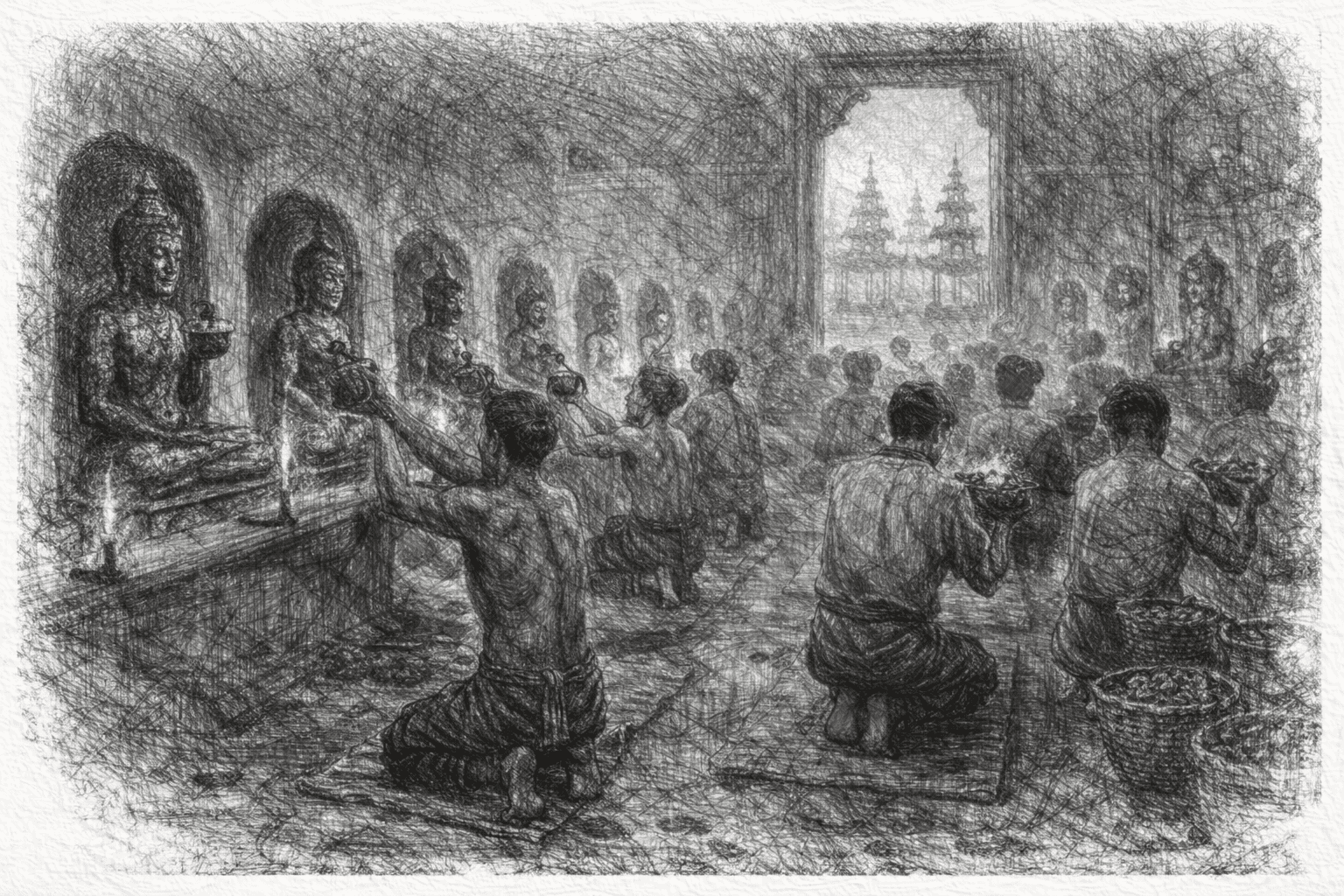

One Sunday some fo us went ashore to take a look at the pagods or temple. When we came out to a hill outside the city we passed a big white lion, made of masonry. It was 14 feet hight; how long I do not know; but it had a broad golden wreatch around its neck, open mouth and big teeth, - a great piece of art. A little beyond the lion we came to a covered stairway which led up to the temple. Along this stairway stood six smaller lions, probably placed there to impress the people with awe and reverence as they entered. These covered stairways were many, and there were landings or resting places here and there, where beggars, lame and blind, sat and asked for alms.
At the top we came to a circular structure, the walls of which were not perpendicular, but ascended by stemps around the whole building. There were probably 25 steps, made of cut stome. But from the top of the steps and even to the top of the building the walls were plain, and covered entirely with pure gold. There was only one big door of entrance. There were some small recesses in the walls round about, probably 2 to 2-1/2 feet wide and high, and 15 inches deep. They were not more than a couple feet from the floor, and in them stood whole families of copper or bronze gods.
When the natives came in they went before one or another group of gods, laid down their mats and kneeled before them, praying with much serious gesticulation, but with no audible words. Sometimes the worshipper would take fortha a little piece of gold-leaf and stick it on a god, probably in expiation of some sin. Others would offer small colored candles, put them before the gods and light them. Others again took out a rag and did some cleaning and polishing of the gods, as some of them were quite dirty and black. All these gifts and services were no doubt, meant for propitiation and appeasement of the gods. These hindoos were very serious in their worship. Nor were they ashamed to be seen and watched by the Europeans. They performed their service or offering as if no one was looking on. In this respect they were superior to some christians. It is as one reads in Jeremiah 2:10-11: 'Pass over to the isles of Chittim, and see; and send unto Kedar and consider diligently, and see if there be such a thing. Hath a nation changed their gods, which are yet no gods? But my people have changed their glory for that which doth not profit.'
There was a native policeman in the temple. When another native came in with a basket of flowers which he tried to sell to us, the policeman ordered him out and used his club on him.
Around the outside of the temple there was a number of small towers, and small bells or chimes in the tops. A small feather of brass was connected with the tongue in each chime, and the faintest movement of wind on the geathers would set the chimes to ringing in clearest silver tones. It was said that these were keeping evil spirits away. While on watch at night onboard our ship we could hear those silvery tones at irregular intervals throughout the night. There were also deeper tones from large bells in the tower, conveying strnage thoughts about the darkenss of superstition that broods over this old land and its people. It appeared that they were very busy taking care of their gods, and had little thought of the gods taking care of them. Some of the more enlightened people on earth also following that practice.
As mentioned, they were extremely slow in their work, but in the use of their mouth, when occasion required, they could be ready and quick. When, at close of work in the evening, these 70 or 80 men had to be counted, they were placed in a line along the railing.
There was a Mulatto in command of the group for this purpose, and he had no little trouble keeping them in line long enough to count them. They would blabber and talk incessantly and jump out of line apparently for the purpose of quarrel and hand-to-hand conflict. The commander often had to use a stick to bring them back into line and compel them to stand still long enough to count them. As soon as dismissed they would jump over the railing into the boats like monkeys, and from boat to boat until they were ashore. Their apathy and slow motion had entirely vanished, and they were as quick and comical as cats and apes. The only way the captain could pay them off was by number and counting. Their names they did not know how to write, and we could neither pronounce or understand them.
The heat was oppressive, night and day. An English docot came onboard every day to look after our health. It did not take many weeks, however, before sickness began to attack first one and then the other of us. We had to go to bed for 4 or 5 days, and often there were 3 or 4 of us in bed at the same time. But we all got over it, and when we had had the sickenss once it did not recur. We were forbidden to be out in the sun after 9 o'clock A.M.
For a while we were busy scraping old paint off the exterior of our ship, and I remember that at about 9 o'clock the sun had made the side of the ship so hot it would scorch our hands to touch it.
All of us had bought those light gray cork hats as we called them, shaped like a German helmet. They were so made that the air could circulate under them and over the head, but for all that our hair was wet with sweat all the time. At night the mosquitoes were so troublesome that no sleep could be had unless body and face were covered. That meant the sweat would frun from our bodies all ngiht.
In stead of the seagulls, which are common on all European and American coasts, here were some gray or black hawks, a little larger than doves. It was forbidden by law or custom to kill them so they were quite tame. Eating dinner, I often took my portion out on deck and seated myself on the watercasks at the side of the forecastle, as it was too warm inside. Then the hawks would come to visit me, sit on deck at my feet or on the rail, and even on the watercasks aside of me. Looking at me eating, they appeared so hungry that I pitied them and threw them a bite now and then. Then there would be a scrap among them until the victor had devoured the morsel. Their general behavior, however, showed they were not entirely devoid of good manners, and we were quite good friends, considering they were hawks.