
In the autumn, I spent the winter with my folks. But no sooner did the spring, 1876, open than my longing for the sea awoke, - I must away. Sixteen years old. Large and well-formed body, strong and healthy, I imagined I was a full-grown man, who could fill a man's place.
I had a good home, and my father did not like the idea of my going to sea, and he tried to prevent it, but when he saw he could not he gave in. My mother had passed away many years earlier.
Away to Stavanger. a distance of about 20 miles from my home on Finnøy. I went to seek employment on a ship. Father went with me. Now, it so happened that John Stensøy. a cousin of my father, who lived very near the city, was part owner of a new schoonership, which lay at anchor, ready to sail on its first voyage. G. K. was to be captain. John gave us his address. Father knew him, and if I remember correctly, he was married to a relative of my mother. This situation we thought was very fortunate, and if I could obtain a place here it would seem as if I was sailing on a ship belonging to our family.
Calling at the home of Captain G. K., we were received in a friendly manner and yet, the first impressions I received of the captain were not favorable. He was an elderly man with a very weather-beaten and pock-marked face, unkempt hair, thin and sprawling full beard, short but untrimmed, and a big, thick red nose, set between great bushy eyebrows. He was not very tall but broad-shouldered, heavy set, a regular seadog in appearance, quite rough in voice, with a slight hesitation or stammer when speaking. He tried to appear friendly.
Father stated our errand. The captain looked at me, asked a couple of questions which I answered to his apparent satisfaction. It appeared that he was well pleased with me, and he said he would gladly give me a place on his ship. I was to appear at the office of registry in a couple of days, to be assigned place and duty. He also invited me to have dinner with him the next day, after which we were to go aboard and inspect his new ship. Father was much pleased that I had obtained such a good place, and he returned home in good spirits. Good fortune for him he could not see what the immediate future would bring; if he could have done that, I am sure he could not have had a good night's sleep until I should have returned home.
The next day, keeping the appointment, I went to the captain's home for dinner, and found both him and his wife affable and entertaining. The wife was a quiet, refined lady, apparently entirely different from her husband, in his uncouthly appearance and deportment. This was, in my estimation, not much to wonder about. A man who has spent his life in battle with stormy seas must not be expected to be as polished as people who have worked under less strain and adverse circumstances. The ocean puts certain marks on its sons.
After dinner came the inspection of the ship, and the captain showed me round from top to bottom, forward and aft. He was in the brightest of humor concerning this solid, seaworthy new ship. His enthusiasm also infected me to some extent. Think of being of the crew of this beautiful ship, and a particular friend of the captain! Here would likely be pleasant and agreeable days. well, it is fortunate we do not know anything about the future. It is time enough to consider misfortune when it comes. The next day the crew came to the office of registry and signed up for the voyage: 1st and 2nd mate, boatswain, 3 sailors, 2 youngmen, cook or a steward, a deckhand - eleven men in all; not a big crew for this size ship, especially so, when we consider that three of them, the boatswain, one youngman and the deck hand had not sailed a voyage before.
For the sake of clearness of the following narrative I think it well to mention some characteristics of some of these men. 1st mate was of middle age, had a big, reddish full beard, was quite sour and grouchy and not very easy to get along with. 2nd mate was a young, full grown, straightforward chap, friendly and good-natured. His name was Karl Oberg. and I have heard he later resided in Portland, Oregon, where he became well known and much appreciated. He died there a few years ago. I should have looked him up there, had I known, but did not learn he was there until too late. The name of one of the sailors was Thompson. He was tall and think, quiet and reserved, difficult to become acquainted with, but one could not say he did not fill the place he was hired for. Another sailor was Elisøson. He was from Lysefjord, not very far from Stavanger. He was presumably 25 years of age, not very tall, but stocky and heavy, with red cheeks, the picture of health, friendly and very quiet, he would not offend even the ship's cat. The boatswain was from Hogganvik. he had helped build this ship. I do not remember his name. About 25 years of age, he was rather small and thin, by nature a first-class fellow, friendly, quick and courageous, and though this was his first voyage, one could readily see that he was a born sailor. he and I became very good friends, and that friendship lasted till we returned to Stavanger, where we parted, and I heard no more from him. The other youngman was also from Hogganvik, and his name was Nils. He was about as old as the boatswain, average size and weight, but somewhat slow in action, and sometimes he would stammer so it was painful to listen to him. He was not well qualified to become a seaman, but there was sympathy with him because he was good-natured and friendly. The steward or cook was from Flekkefjord, about 30 years old, average size, big, black full beard, a fine man with whom there was no difficulty to get along on reasonable basis. So much for the crew. We shall meet some of them later.
We had all be hired for the term of the voyage, that is, until the ship returned to its home port, but not for a longer period than two years. So, we went aboard with pick and pack.
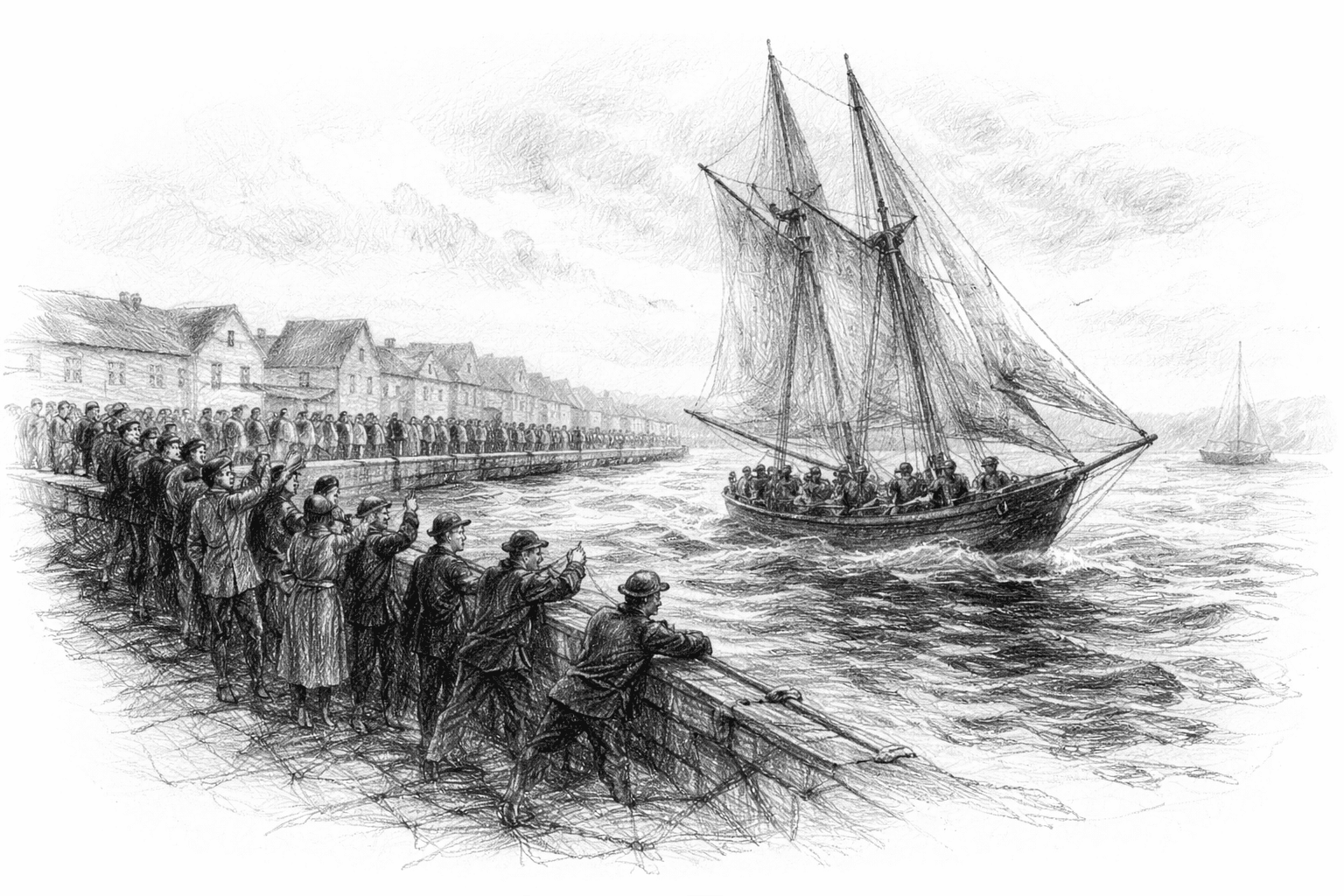
The next day, the wind being favorable, we weighed anchor and set sail, in good spirits, and with the customary chorusing (opsang). In those days, when a ship weighed anchor and set sail for departure, an opsang had to be sung, in time and rhythm with the motion of the men who operated the machinery that lifted the anchor. One of the crew would sing a verse of some popular song, and at the end of the verse the whole crew would sing a lusty refrain or chorus, perhaps something like 'Stormy Land' or 'Blow the Man Down', or 'Rio Grande', or others. 'Rio Grande' was like this:
Oh Rio, Oh Rio, Sing fare you well; My pretty young girl, we are bound for Rio Grande.
There was something remarkable about these 'opsongs', especially if the crew was large and included good singers. People would gather in large groups on docks and wharves and listen. There was something charming, captivating and magnificent in the opsang of departure of ships for distant lands. To define this feeling is not so very easy.
We stood out Stavangerfjord under proudly bulging canvas. Well out to sea, the course was set for Shields, England, where we were to take on a cargo of coal for Lisbon, Portugal, and from there we were to bring a load of salt back to Stavanger.
The crew was divided into starboard and larboard watches. I was given place on the latter, together with the second mate and captain who are always on that watch, while the first mate always belongs to the starboard watch. The boatswain was compelled to be a part of the watch on a ship with as small a crew as this. The steward had contract not to be of the watch.
The watch was set in the evening, that is, it was decided which group was to have the first watch, from 8:00 P.M. to midnight on deck. There were five watch periods, 8:00 P.M. to 12:00 midnight, 12:00 to 4:00 A.M., 4:00 to 8:00 A.M., 8:00 A.M. to 3:30 P.M., and 3:30 to 12:00 midnight. As the afternoon watch was long, the same group would never be on watch in the same periods two days in succession.
The weather was somewhat dark and stormy, yet not very bad for March. We could not expect summer weather. It was cold and wet, and the feeling among the men on board also seemed to become cold and disagreeable. The captain began in a small way to show his real colors.
The two men from Hogganvik and myself, and probably others who had imagined there would be only peace and friendship and good days on board here, soon saw the end of our illusions. Friendship vanished, and the captain began to reveal himself as a regular slave-driver. And when we noticed that the food we were given was of the poorest we had seen or heard about, it cannot be denied things began to be disagreeable. The bread consisted of great, course rye-crusts of the poorest kind, probably 4 inches in diameter and about two inches thick, very sour and, for the most part, steel-baked in the middle, that is, there was part in the middle of each crust about 1/4 inch thick that was neither raised nor baked but simply dried dough, hard as flint. When we broke the crust, this middle part would shine like broken glass. It would require soaking about 24 hours to make the crust edible, and even then, not very easily digestible. We were given no butter, but instead each one of us received a quart of a pot of olive oil (about 1/2 pint) for each week, besides some of the poorest dark molasses, and some vinegar. We were directed to make a mixture of these constituents and dip our bread in it. Of the molasses and vinegar, we used very little. But we got used to the oil and gradually came to like it. And I remember that many times when the oil was measured out to us, I took my portion, meant for one week's use, and drank it at once, then ate dry bread for the rest of the week, or rather, ate it after having soaked it for a while in my coffee. The salt meat we had was salt and dry as wood. We used to call it horsemeat and mahogany. The port, on the contrary, was so fat that we could hardly eat it. It was fully five inches thick. We were given no potatoes or other vegetables. Now and then we had peas and beans in soup, also salt fish, and a rice pudding was made occasionally. Never again in all my life at sea did I notice so poor provisions for the crew, except once, on a voyage from Hamburg to New York, about which I shall write a little later.
After about a week out we reached Shields, that dark and smoky English town, which I also had occasion to visit sometime later. In those days it was customary for the crew to do all the work taking on and putting off the cargo, except in case of coal loads. Coal was loaded on ship by cranes which lifted a whole carload at a time and dumped it into the ship. In this manner our ship was loaded in a couple of days. Some care had to be observed in placing the cargo in the ship's hold, so it would not shift when the ship labored in high sea and storm. For this purpose, the coal had to be brought out to the sides in the middle of the hold up to the deck, leaving empty spaces under deck fore and aft.
As soon as we had loaded, a tugboat was secured to pull us out to sea. The weather was heavy and gray. So was the temper of the crew. Everything seemed heavy. Even the new sails seemed hard to handle. They were wet, and the new-tarred cordage, by contact with salt water, had becomes hard as steel-cables, difficult to handle, and our hands became sore and blistered.
Coming into the open sea, we had to begin cleaning the soot and coal dust from everything. Our ship was painted white, inside and out. This washing, so far as the outside of the ship was concerned, we made too much haste to do. We could have saved ourselves the trouble, because it was not long before we became good and well washed by the turbulent sea.
The weather was, however, reasonable till we reached the English Channel. Here we met with a head wind. Every little while we had to put about and there was constant agitation and hard work. All hands had to be on deck to handle the sails when we had to put about ship, either by day or by night, and there was no excuse from duty, even on free watch.