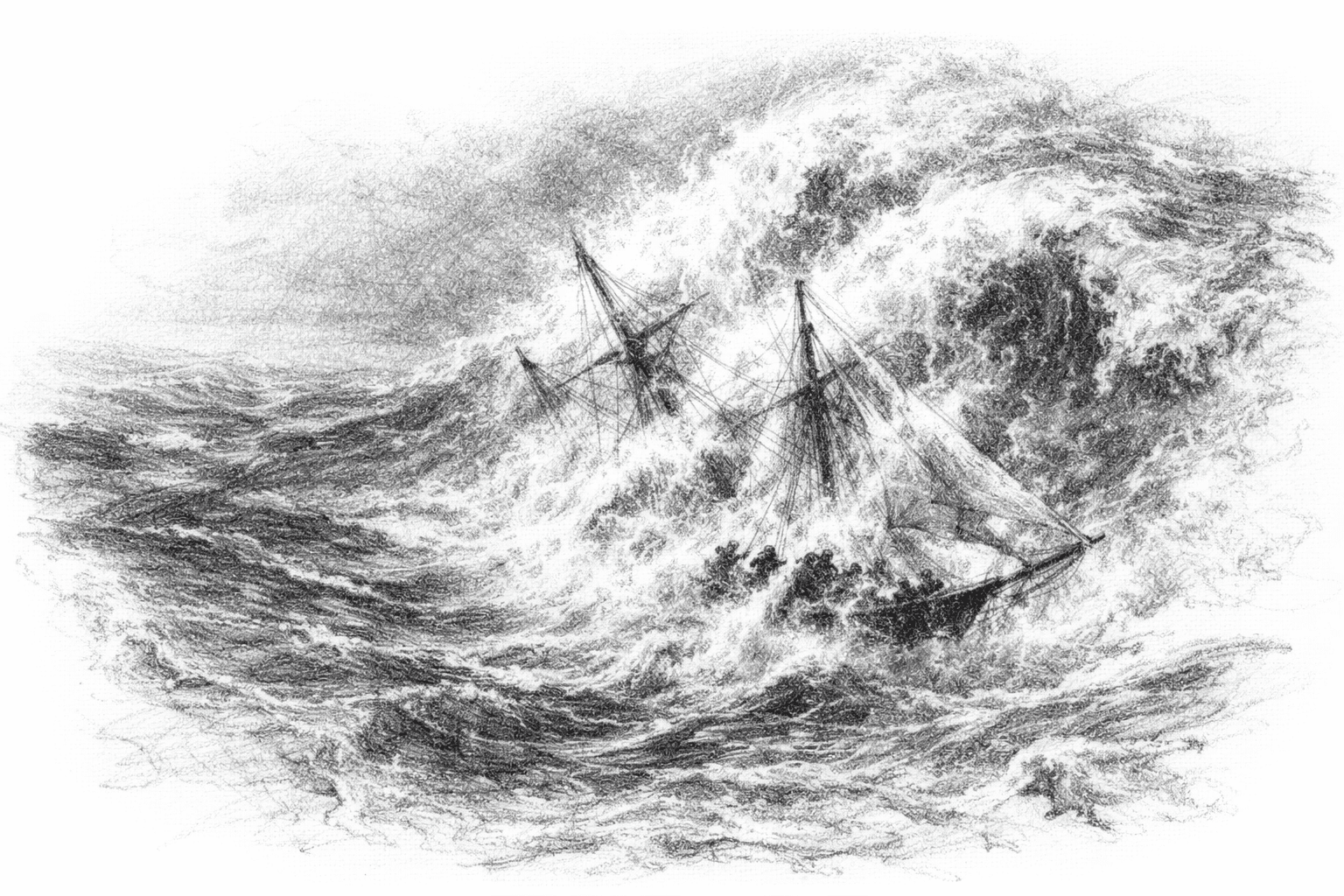

The further west we came in the Channel, the harder the gale blew, and the seas increased accordingly. Ship and sails were new, and she was a good sailer, so we felt we could force our way for a while even in the most contrary weather. But the gale became more violent. By and by we had to trim sail, and before long there was an almost constant drift of seas, not only over our bow but the whole ship and far up into the rigging. The captain took command at every about ship, and his excitement grew with the storm. He roared, yelled, and swore most fearfully, and when he thus raved, he expected the men to be so scared that they would run and carry on as if they had lost their wits. This I did not like. It was not necessary for us to jump out of our boots no matter how much he might act like a madman. I noticed some of the boys became so frightened they ran about the deck like whipped rats, and I believe many times they did not know why they were running around. But the captain seemed to like to see them act that way. He called us plebians, land crabs, and some other worse names I do not care to mention. But at the same time, he made it a point to impress us with the fact that he was a real sailor, and now he intended to teach us how to dance. He soon noticed that I was not afraid when he roared and cursed, and that ended all pleasant relations between him and myself. I had seen him stand and grin through his whiskers when the boys became frightened nearly out of their wits at his behaviour, and I promised myself that he would have to behave much worse before I would be scared.
But this situation was ridiculous. This 'Finnøybu', as he now began to call me, must be humbled, and learn to understand the majestic greatness and supreme authority of the captain. But how? I did my work as well as anyone, or perhaps better, so he really had nothing to complain about. And that was what seemed to hurt him most. He could really find no good reason to make an attack on the 'Finnøybu’ and make him really afraid of the power of the chief officer. Leaving this subject for the present, to come back to it later, the reader will see how this enmity of the captain became a life and death struggle between us.
Probably few readers now know that a schoonership is a three-masted schooner, with yards on the foremast, and schoonersails with boom and gaff on the main and mizzenmasts. The main sail on this ship was a great piece of canvas. I believe its boom must have been between 70 and 75 feet long.
As mentioned, we had come out in the western part of the Channel. Water came on deck faster than it could readily get away through the scuppers. Then, one night, as we put the ship about, Nils was stationed at the main sheet. My place was at the fore-braces. Larboard or port watch on a ship ordinarily handled the sails at the foremast. Starboard watch belonged at the main mast. The main sheet consisted of two great two-fold tackles, one from each side of the ship. When putting the ship about in a gale and rough sea quick work had to be done to slack tackle on one side and at the same time pull up on the other, so the boom would not be permitted to flap or strike to one side or the other. If it got a chance to strike one could not tell what would happen. I have seen the boom strike so hard that fire would spurt and fly from the steel tackle hooks. Nils was a little slow, and the turning was not so easy. It was dark, and the water washed over the deck, sometimes one and sometimes another direction. The boom struck twice. How it happened I could not see. However, the starboard lantern stand was broken, and the glass split from top to bottom, but it did not fall out. The captain became raving mad, and as soon as he could leave the helm, which he always handled while we made the about, he came running down the deck, struck Nils with his fist, roared and cursed like a maniac, vowing that he would teach all of us some seamanship. Nils, poor wretch, took the insult gracefully and kept still. But none of us felt very good about it. And, from this night, one tragedy after another came, blow on blow, during the next three weeks.
Up to this time we thought the weather had been bad, but we had, as the saying goes, seen nothing yet. Having reached a point sufficiently to the windward of the northwest coast of France, we set a more southerly course, to cross the Bay of Biscay, notorious for its fierce storms and violent seas. Here the weather became worse, and we were compelled to put the ship under stormsail and try to take it easy. As a consequence, we drifted considerably leeward, making it impossible to clear the northwest capes of Spain, commonly known as Finisterre, without tacking. But, after several attempts to put her about astay, we gave it up, because she had too little sail and not enough speed to turnabout against the wind. So, we had to veer around with the wind. The seas were running terribly high. I had never seen the like and had never believed the billows could be so large. It was like looking over big mountains and valleys. The ship appeared like a little chip in comparison to the enormous waves. Some of them broke and rolled in over our deck and the water dashed now this and now that way, splashing up to our hips. Good sea-boots and oilskins were of little avail to keep us dry. But the weather was cold, so we had to have them on in order to keep warm. We had to veer, around again and again, about every twelve hours.
One day I happened to be standing forward near the roundhouse. At the moment there was nothing to do. The captain stood aft on the half-deck, and he called me thus: 'Come here you Finnøybu.' I obeyed, of course. But it was almost like swimming to go along the deck. When I came near him, he said: 'Take that rope-yarn which is floating there and put it in your bunk, then you will know where to find it when you need it.' Rope or cable-yarn is a single thread of the kind used in making ropes. This piece of it was about two feet long, and it was so frayed it appeared most like a rag. Yes, I thought, I shall certainly take care of it. I understood well enough he had told me to do this only to pester me. The yarn was worth nothing. I took it and went forward, rolling it up in my hands, and when I had reached the roundhouse where the captain could not see me, I threw it overboard. Then I went down into the cable-tier, a little room at the very bow under deck, where cordage, blocks, straps, and other things were kept, cut a piece of new cable, took it with me and stuck it under my mattress in my bed. I would be able to find cable yarn when I had need of it, but not the piece I had to swim to rescue.
Then, there came a night when the wind seemed to abate a little, and when the new watch came on deck at 4:00 A.M. we received orders to get a reefed topsail. We went aloft, loosened the sail, and began to reef it. I remember Thompson was out on the yardarm starboard, which then happened to be windward, putting on the earing, which is the rope that holds the sail stretched along the yard. Eliasson lay in on the same side of the yard, about halfway to the mast, and I was about 6 feet from him and 6 feet from the mast. As the weather was cold Eliasson had on a pair of woolen half mitts. Mitts are dangerous things for a sailor to use, especially when he goes aloft, and it was very seldom I saw them used. Eliasson and I were tying up the reefs, taking the ropes one each side of the year, tying a half-knot on top of the yard, then pulling both ends up to take up possible slack, then tying the other half-knot with the loose end. I happened to be looking over his way. It was dark, but not more so than I could see what he was doing. He had made the first half know, pulled it up, then he jerked upward to take in the slack, but as he did so the rope ends slipped out of his hands, and he fell backward. I saw him, in the air as far down as to the forecourse yard. He fell in under the yard so I could not see him when he hit the deck, but I felt it. He was so heavy we could feel the rigging shake from the impact.
We were naturally somewhat overcome by the shock of the accident and called out to those on deck that a man had fallen down, and we left the sail and betook ourselves down as fast as we could. I well remember I did not trust my own hands but put my arms around the cordage as I slid down. I was pretty certain Eliasson was killed. When we came down, we found he had fallen on the anchor chain. We took him up carefully, carried him into the roundhouse and laid him down on the floor.
The captain came and ordered us to take off his oilskins and seaboots. He took hold of the boots himself, and pulled roughly, but to no effect. Eliasson had tied cable yarn around his trouser legs outside the boots, so the captain could not pull them off. Then he began to curse and said one could not expect any better than to fall down when he was bundled up like that. Then we heard Eliasson say: 'Please, captain, do not jerk my foot so hard.' That was the last we heard him say. A few minutes later he was dead. He had a hole in his forehead, and both his legs were broken. We laid his body in the carpenter's shop, to be prepared for burial later.
We were scarcely through with this before the storm began to howl worse than ever, and we had to go up and take in the topsails in a hurry.
The next four days it continued to blow. Then it abated so we could open the forward hatch sufficiently to get hold of some boards of which the carpenter could make a coffin. We put some pieces of coal in the bottom of it, wrapped the corpse in some canvas, put it in its rude casket, and nailed some boards over. Then we carried it aft, where the captain ordered us to take two pieces of rope, of which one end was tied to the outside of the railing. One man held each of the loose ends of the ropes, in the loop of which we placed the coffin, and it was thus lowered into the sea. I held one of those ropes.
When we had placed the coffin thus out on the ropes, we were commanded to hold it there while second office Karl Oberg sang a verse or two of a hymn. Thompson held the other rope. The captain was at the helm. When the singing had been done, we were ordered to lower amain. But whether one of us lowered too rapidly or the other too slowly, I could not say. However, the coffin was not going down in a horizontal position, and the captain roared out: 'See – see now, that Finnøybu, how he lowers like a (terrible execration) cow.' I looked aside at the second officer, and saw tears rolling down his cheeks, and tears were not far from my eyes either. It was exceedingly depressing and unpleasant to bury a comrade and friend at sea in that manner, and under such circumstances.
I never saw such weather and such turbulent sea in my whole life as a sailor, except on a voyage from Wilmington, North Carolina to Bristol, England, one time in winter. But on that trip the wind was with us. Now it was against us.
If the humor and spirit of the crew had been depressed before they now became more so. We had lost one of our best men, and if duties and responsibilities had weighed heavy before, they now weighed heavier.
Then, one afternoon, I was at the wheel, as we had our regular appointed hours, as well on the forward lookout as at the helm, night, and day. I saw an unusual big breaker approach us. It appeared impossible for us to avoid it. Nearing the ship, it raised us like an overhanging mountain. The top or comb of it seemed to hang several fathoms forward; balancing with the speed of the wave until it reached the side of the ship, where the whole mass of it fell like an avalanche, with a terrific crash, over the whole ship from the bow to the cabin. The aft part of the ship was forced upward by the fearful pressure amidships. The upward movement was so rapid that if I had not held fast to the helm with all my strength I should certainly have been thrown overboard. The ship seemed entirely buried, except a small part aft. I wondered if it would come up again. After a while I noticed it slowly emerging, and at the same time I saw hatch-covers and pieces of white painted boards come floating alongside. Then I understood something had gone wrong. The air pressure in the hold, caused by the great weight striking the deck, had forced the forward hatch open, broken the bulwarks from the forecastle to the fore-rigging. Both the forecastle and the bulwarks went overboard at the same time. None of the crew, however, had been injured.
We had some planks on top of the cargo, near the fore hatchway. They were brought up hurriedly. Some men sawed, others nailed, thus rapidly covering the opening, the first mate being on lookout for other breakers while we were working. It is seldom that many such breakers come in succession, even in such unusual weather, and it is not often that one strikes a ship. They have to strike just at the apex of their fury to do damage as this one did.
Nevertheless, we were to have many more tragic events, the time intervening between each I cannot well remember.
Our clothing was soaking wet night and day, and we began to feel completely saturated, heavy, and stiff, so that the mind was affected, and the experience seemed like a very bad dream. And, with the poor food, and very little sleep, it is not surprising that we felt and acted as if half intoxicated.
One morning, at daybreak, we saw a ship near us, not far to leeward. That was also a schoonership, about the same size as ours. It was also steering southward, about a half mile away from us, and we had no fear of a collision. One thing we noticed; between the ships there were always two billows, and when both ships were in the valley between the billows, we could not see the tops of the masts on the other ship. Our mast-tops were about 150 feet over the water. I believe those on the other ship were about the same. How far below the billow-crests the mast-tops went I cannot say, but there elapsed a few moments from the time they disappeared till they appeared again. And let me say, the seas were not only high, but the valleys between them were broad and spacious.
Our whole crew observed, with some wondering, the relative positions of the ships. It remained the same all day, and when darkness fell, the stranger was still two billows to the leeward.
The following morning the strange ship had disappeared, just as mysteriously as it had come into sight.
We veered round and stood northward again. There was nothing for us to do but to stand by, as we called it, and ride out the storm.
In the meantime, we drifted farther and farther into the bay. The next day we stood south again.
The following night, about midnight the mad on the forward lookout called: 'A lantern to leeward.' Our course was southward on starboard tack and, according to maritime law, we were to hold our course. The approaching ship would have to pass us to leeward. But her starboard lantern was steadily in sight as she approached us. Soon we could see the ship thru the darkness and were surprised to notice it was the same ship we had seen two days ago. Now we were on the same billows and were nearing each other quite rapidly.
All our men were called on deck in a hurry. The captain jumped up on the forecastle roof holding a metal trumpet which he put to his mouth and boomed out: 'Ship ahoy.' Answer came back instantly: 'Starboard with your helm.' We understood the situation at once and ordered the man at our helm to put it starboard, which meant the same as to go about. The difficulty was that the strange ship did not obey its helm, so it could not fall off to lee, and therefore, the last and only thing we could try to do, to avoid a collision, was to go about. But, having tried to do that, and failed so many times, we had no hope it would succeed now.
The ships came nearer. Collision appeared inevitable. Everyone, except the man at the wheel, stood on the forecastle ready to jump aboard the strange ship when the proper moment arrived. Our ship was loaded with coal, and a collision in this kind of sea would send it to the bottom at once. The lifeboats would be no help. It was hoped and guessed the other ship had a lighter cargo.
All at once we noticed both ships turning up against the wind, but still coming nearer to each other. These were exciting moments. Could it be avoided, or, had our last hour arrived? The distance between the ships was now desperately short, and each turned windward so slowly. Eventually, however, both ships had their bows straight to the wind, and they were so close together I believe I could have jumped from ours over into the other ship. The situation was terrifying. Would the ships go about astay, or would they fall back? No words were uttered or heard; only the howling and whining of the storm in the rigging of the ships, and the roar and din of the waves.
Only those who have lived thru such moments can understand what this means. Minutes seem as long as hours, and one's breath comes only by spasms.
Then there came a big sea rolling along and struck the bows of the ships with great force; the mass of water that came driving in between the ships parted them, and each was made to go about its own way. If this was not a miracle, I have never seen a miracle. We tried later to tack or go about against the wind but failed. Only this one time it succeeded. The strange ship disappeared in the dark and we never saw it again. But we did not soon forget it.
We had three big watercasks securely fastened to the deck outside the forecastle, each of them containing about three barrels fresh water. By this time, we had used about all their contents, and began to think about a new supply. There was a big iron tank in the hold, standing aside the pumps, and reaching from bottom up under deck, filled with fresh water. It had a manhole in the top, with a lid on it, fastened with bolts. And in the deck, right over the manhole, there was also an opening with a hatch cover on it.
One day when there was a lull in the storm, we opened the manhole, and everyone with buckets, hurried to take water from the iron tank and fill the water-casks. But, to our great dismay, we found the water was mixed with seawater. It was a shock which, on top of all the other adversities, caused extreme fear and consternation.
Were we now, in addition to all other suffering, also to suffer from thirst? Well, there was nothing to do but be calm. The manhole and the hatch had been carefully closed, still, with all the seawater on deck for days and weeks, in some way it had leaked into the tank.
We tried to use the water for coffee and tea but could not drink it. Peas cooked in it were so hard and salty we could not eat them. We gnawed at some bread or what else we could get hold of that was not so salty, then we would go to the water cask, take some of the water, drink as rapidly as we could, thereby trying to avoid the extremely salty taste. But no matter how much we drank of that water it did not quench the thirst. Our greatest desire was to reach land and obtain fresh water.
After some days, the gale once more diminished, and the direction of the wind became northerly. Then we began gradually to set more sail, and to work ourselves out of the Bay of Biscay, and eventually passed Cape Finisterre. We had not been three weeks crossing this body of water and had had enough of it. Glad we were when we finally reached our destination and could cast anchor in Lisbon.
The first thing we did was to get fresh water. We had been, as I remember, 12 days without it. Whoever has had similar experience is more able to appreciate good water.