
Lisbon lies on the north side of a river, of which I do not remember the name, probably 8 or 10 miles from its mouth. At the mouth of the river, and to the north side, was a large fort and all ships passing it had to hoist their national colors. The city is built on ground evenly inclining from a rather high ridge toward the river. It was a large, well-built, and well lighted city. Most of the buildings were painted white or light yellow. One day some of our crew were ashore, and we ventured to go upon the ridge to get a better view of the city. There we saw something that seemed to us quite wonderful. There were buildings constructed of white glazed brick, with a few bricks of other colors in corners and other places, for ornamental effect. Whether these were government buildings or what I do not know.
The streets were wide, paved with marble, on inch square, also of varied colors. In one place there was a great plaza, where the paving was decorated with large inlaid stars and other figures, all made out of these small, shining pieces of marble. It was the finest paving I have ever seen. And these buildings were the most beautiful, of their kind, that I have seen at any time.
The transportation in the city was mostly by mules or asses, as I now remember, - it is now 60 years ago, - and it was almost unbelievable what large burdens these small beasts could carry. Great, big baskets or hampers on each side, filled with vegetables, fruits of all kinds, and a variety of household necessities, they carried steadily all day. Never in my life have I seen animals more meek and gentle and patient. I remember seeing one oxcart with an ox pulling it. The driver walked aside the ox, carrying a big driver's pike. He urged the animal on by talking to it unceasingly, and he would occasionally touch its flank with his pike, with no apparent effect on the movement of the rig, or the feelings of the animal. But we must get aboard the ship again.
Lighters were employed to discharge our cargo. They came alongside the ship, and we transferred the coal to them from the hold by means of a hand-winch, with a big crank on each side. From this windlass there went a rope up thru a block hung directly over the main hatch, and from there down in the hold, where it was fastened by a hook to large baskets, which were filled with coal and thus hoisted up by hand. Some of the crew were in the hold, filling the baskets, others on deck, hoisting and emptying the coal into the lighter. It took time to discharge our load of coal in this manner – at least two weeks.
The captain spent most of his time ashore and was not so seldom drunk when he came onboard. He was not so very friendly, particularly toward Mils and myself.
One forenoon we were ordered to row him ashore. When he stepped out of the boat he said: 'Wait here till I return.' He went, and we waited and waited. Noon came and passed, and he did not return. We had no money with us, and we were hungry. Along in the afternoon we agreed to row over to the ship and get our dinner, and we did so. I knew we had no right to do this, but the captain also knew we had no money, and we needed to eat. We rowed ashore again, but no captain came. Evening drew on and the air became cold. We had very little clothing on, so we were chilly. There we sat in the boat, listening to the big clock in the city, striking the hours.
At ten o'clock in the evening we agreed on rowing aboard and leaving him, reasoning that he could not expect us to sit and wait, suffering cold and hunger, first all day and then all night. We came to the ship and were in the act of hoisting our boat up by the davits, first mate and others of the crew helping, when we heard a voice out of the darkness on the river: 'Faina, aho-o-o-y.' Faina was the ship's name. 'Halo-o-oo', answered that mate. That was the captain who had now gotten a ferryman to take him onboard. 'Have the boys come on board', he called. 'Yes, they came just now,' said the mate. 'I shall teach them to come, just now, I shall,' he yelled back.
Now I knew we could expect most anything. By what he said, I understood he was intoxicated. Sneaking around the cabin, I went aloft in the mizzen-rigging as far as below the top-platform. I expected he might use violence, but I made up my mine he should not reach me. And I was sure he could not reach me unless I came on deck. I could go from mast to mast on the stays, and I knew he could not follow me there.
As soon as the captain had come to the top of the accommodation ladder he roared: 'Where are they?' 'Here am I,' answered Nils. I had never believed Nils to be so thoughtless. The captain grabbed a piece of large rope, wherewith he struck Nils repeatedly until he fell unconscious on the half deck, crying and howling most miserably, and when he fell the captain began to kick him in the sides and head till I believe he had killed him. I stood in the mizzentop, directly above, so I had a good view of what happened, and I was boiling with anger.
I was about to go down and try my hand on the captain, but I knew it was dangerous for a seaman to begin a fight with a captain or other officer on board. Before a maritime court in those days, it was nearly always the officers who would win out, and other members of the crew would be punished regardless of the facts and rights on their side. Another thing was that if I went down and fought the captain, he could call the mates to assist him, and they were bound to do that, and in the end, I would get the worst of it. Having fairly good knowledge of how the maritime law operated in matters of this kind, I thought it best to avoid offending, even though it was hard to do.
Finally, he had finished with Nils, and asked: 'Where is that Finnøybu?' There appeared to be nobody who knew. He is here, I said to myself; and now you may try to catch me if you can. He went over the whole ship, trying to find me, while I watched him all the time. When he could not find me, he went into the cabin. Now, I thought, you will try to deceive the Finnøybu, but we are going to be two about that. When he went to the cabin, he believed I would come out of my hiding place, go to the forecastle, and to bed.
There was a skylight in the middle of the cabin roof, and from my place in the top I could see directly thru it down into the cabin. As I had imagined, the captain walked back and forth in the cabin without any signs of retiring; and, after a while, he came quickly out of there and proceeded forward on tiptoe to the forecastle, tore the door open and looked in, but when he saw I was not there he asked the others: 'Has he come?' When they said no, he uttered, in a voice indicating slight fear, 'It can't be possible that he has jumped overboard?' I saw and heard all that took place, and thought: 'No, you believe you are a great somebody, but to frighten the Finnøybu to jump overboard, you are too small.'
He went aft again into the cabin and started to undress. Now I understood he had dismissed the thought of getting hold of me that night; so, I went quietly down and forward to my quarters and went to bed. But as a precaution I took my big marlinspike and laid it beside me in bed. This I had planned to use if the captain had come to attack me. A marlinspike is a steel spike about 14 inches long and 1 and ¼ inch thick, sharp in one end. This was a very dangerous weapon. But I was sure no officer had the right, under law, to attack a man while in his bed, at a time when he had the right to be there. So, if he had come, and attempted to touch me, I was determined to defend myself with the marlinspike. He did not come, which was well for all concerned.
The next day I stood and helped to unload coal. I looked for trouble whenever the captain should come on deck. After a while he came, walking along the half deck, down the stairs to the main deck, and came forward quietly, passing close to me. I pretended not to see him, but I followed his every move very closely, every nerve and muscle ready to act if anything happened. He squinted at me, with fire in his eyes, his face much like that of a mad bull, while he passed me slowly. Then, he turned around and passed me again in the same manner. I continued to work, and pretended not to notice him at all, making appear I was coldly indifferent and feared nothing.
This action on my part was probably rather surprising to him. And, to my great wonder, he finally went up the stairs to the half deck without saying a word. Still, I knew he would not let me off so easily as that.
Without anything unusual happening our coal cargo had been discharged, and we had cleaned out the hold by Saturday night. There had appeared to be some desire of haste with the unloading, the reason wherefor I did not know. The next morning, which was Sunday before Palm Sunday, three or four of us asked the first mate if we could go ashore, which he granted, however, with the definite reservation we were to be back by noon.
While ashore, we met some other Norwegian seamen, which I believe were from Arendal. According to custom among Norwegian sailors, when they met with boys of their own nationality, in foreign ports, they were met as comrades, and we invited them on board to have dinner, such as it happened to be.
At about noon, when we came out to our ship, there were, surprisingly enough, lighters with salt lying alongside, four on one side and two on the other, and a little army of Portuguese busy putting the salt aboard our ship, leaving it on deck, just over the rail. We came aboard and went to dinner; then lit our pipes and seat and looked out at the open forecastle door at the Portuguese that were putting salt on the deck; and we talked about our experiences on the voyage hither.
The hold was empty, and the weight of the salt on deck, on one side only, made the ship list considerably.
It is said, love is inventive. But hatred and evil can also be inventive, sometimes. We discovered all this had been planned, as we shall see.
Meantime, it was not yet one o'clock. We were entitled to at least an hour's rest at noon. Then we saw the captain coming forward. He had on a pair of brown breeches, very wide above, especially baggy in rear, a blue flannel shirt, and a very broad white woolen bandage round his waist, a red knit cap like a night cap, or pinnhue as we called them at home, and on his feet, he had a pair of clogs, -wooden soles and leather uppers. This was his exterior. But we soon noticed he also had something inside. One of the visiting boys sized him up and said: 'I have never before seen any human being that looked so much like Old Nick.'
The captain evidently feared the ship would capsize. He called to the Portuguese to stop throwing the salt on the deck. They appeared not to hear or understand what he meant and continued to follow what we understood was a previous order of the captain. Then he became furiously angry, ran over into the salt-pile, took large salt-lumps wherewith he began to bombard the Portuguese with all his might. He sank to his knees in the salt, swore and cursed, in Norwegian, that he would teach them to stop putting salt on the deck.
Then the Portuguese awoke, grabbed some long boathooks, and stormed the deck. When the captain saw them coming, he took to his legs back to the cabin door as fast as he could make it, and the boathooks right at his heels. The Portuguese, frenzied with rage, cried out and shouted as they pursued. What they said I could not understand, but there seemed to be a great deal of r and s sounds in their language.
The captain reached the cabin, got inside, and managed to close the door. If he had not done so I believe the pursuers would have pierced him with the boathooks.
Then the mate came, and said we had to come and shift the salt, as the ship was about to capsize. We did not know whether or not we could refuse work under such circumstances, and concluded we better obey orders. We were given salt shovels, each about 6 feet in length, shovel and handle both of one piece of wood, and went to work, first to shovel the salt into the hold, and later to level it out. We continued till 12:00 o'clock at night before we were thru.
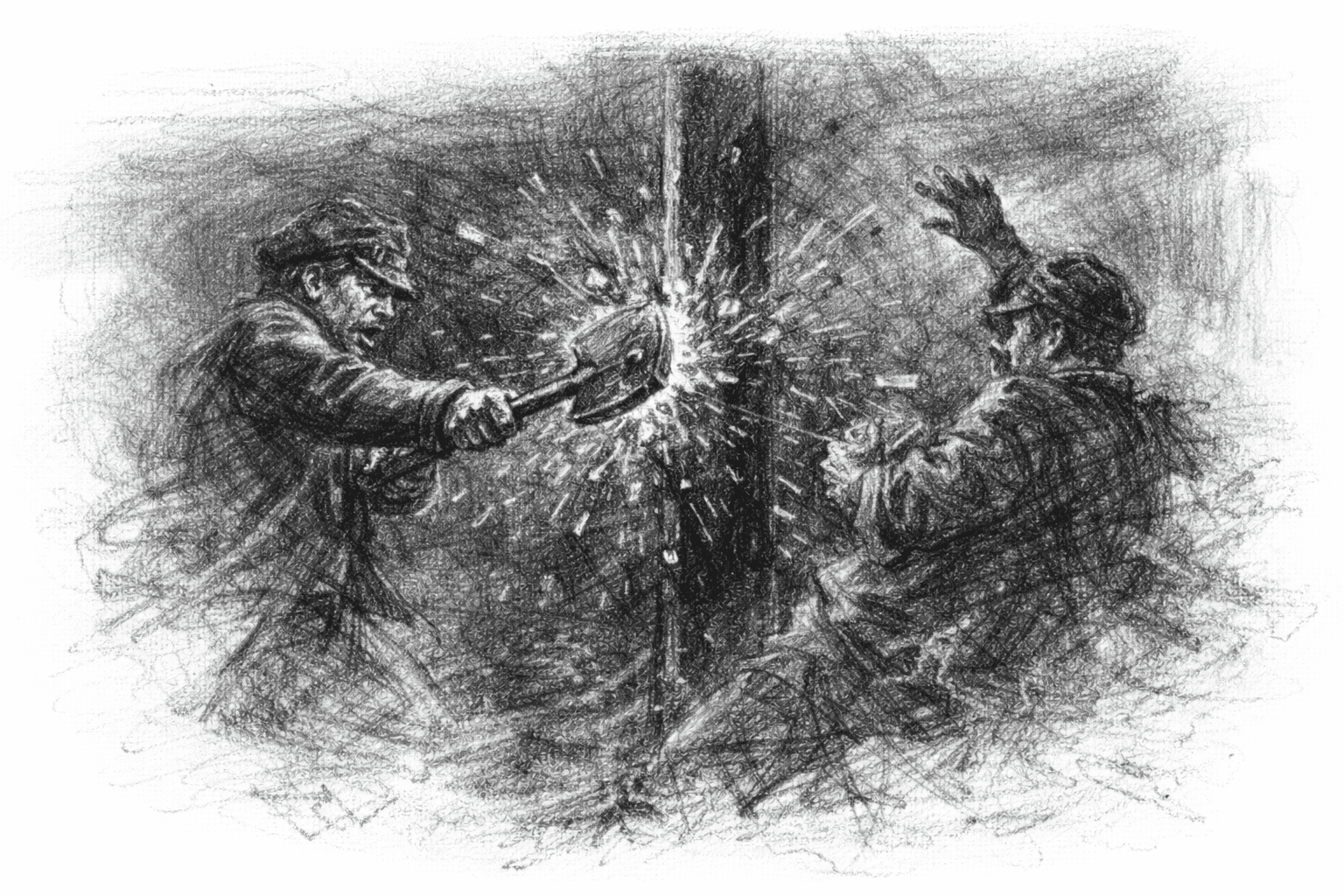
A little before 12:00, midnight, I was alone in the hold. I believe the other men had been called up, but I had not been called. There was a small lantern down there to furnish lighting and, while I was scooping, I saw the captain coming down the main hatch and began to approach me. It appeared he was intoxicated. He was mumbling something to himself about pardon. I felt offended, thinking he was approaching me with drunken blabber. When he came a little nearer, I said: 'A slave-ship this, where I have to work Sunday and Monday, day and night.' I stood near an iron post amidships, that stood on the middle deck and supported the main deck. Before I realized what he was about he had seized a salt-shovel, and he swung it with all his might against my head. Fortunately, I saw it just before the shovel was about to hit me and ducked. The shovel hit the iron post, broke, and two feet of it was severed from the other end which the captain held in his hand. As soon as I arose again, he ran for the main hatch and got on deck as rapidly as he could.
I began to wonder if he really was as drunk as he pretended to be. My conclusion was that he had planned to kill me. But he was unfortunate to break his rapier, and therefore had to run to save his own life.
Coming on deck I found all the men in the forecastle. I asked why I had not been summoned from the hold, but nobody could give me answer. In the meantime, I noted everything in memory on the captain's debit account.
The rest of the week the lighters with salt did not come nearly as rapidly.
One day the captain took Mils and the deckhand to row him ashore. He had bought, or in some way secured, several cases of oranges, and some kegs of port wine, at the ship chandler, which they were to bring onboard. While they were carrying these things down to the boat, Nils accidentally dropped a keg from his shoulder, one of its ends was broken against the paving, and they had to set it on the other end, so the wine would not run out. When they came aboard the broken keg was brought to the forecastle, with word that we could help ourselves. The cracked end was then taken out, a tin cup was placed aside the keg on deck outside the forecastle door. The cup was used steadily for a while, not least by the First mate, who finally took and filled a large bowl or pot with wine and carried it aft to the pilot house where he could have it all to himself. After a while, the deck hand was seen lying stretched full length beside the keg, dead drunk.
Then the captain came on board, not so little intoxicated. He came forward and saw the boy lying there and told him to get up and get to work. When the boy did not move the captain kicked him in the side, at the same time swearing lustily. At that Thompson became impatient and said: 'There is no need kicking him, you are well aware he is dead drunk.' So, the captain walked away, growling out threats as to how he would teach everybody to behave.
The rest of us did not drink so much that we could not handle ourselves and our work. We took the boy into the roundhouse and put him in bed for the rest of the day and night.
But that night, after we had retired, the mate came into the forecastle and accused the steward of not keeping the mate's cabin clean enough. After quarreling a while, he went back to the pilot house, took a cup of wine, and came back, began to abuse the steward with offensive epithets, such as Flekkefjaering, and demanded that he get up and make some tea. The steward answered that this was night and if he wanted tea, he would have to make it himself. In this manner the mate continued between the pilot house and the forecastle till about midnight, when he came forward with a big, brazen teapot, on which there was a pouring spout reaching from its bottom up along one side, and the handle on the other side. He filled the teapot with water from a big kettle standing in the middle of the floor, while the quarrel with the steward continued, the latter urging the mate to betake himself aft, so we could get some rest.
The steward had stuck his head out of his bunk while he said this, and at that moment the mate swung the teapot at the head of the other, holding it by the handle. The contents of the pot flew over walls and bunks in every direction, but the steward had pulled his head back in time to avoid being hit.
Then Thompson, who was boatswain, and an old sailor, protested that this would have to be enough, we had to get some sleep, and it would be best for the mate to leave of his own accord, if he did not wish to be thrown out. Thompson and the mate knew we were all agreed so the latter decided to leave.
The next morning, we discovered the pouring spout of the teapot jammed slantwise into the roof beam above the steward's bunk. It was driven in so tight that we had difficulty to pull it out. If it had hit the steward's head, it would surely have killed him.