
With a full cargo of resin well stowed in the hold, we were towed out to Cape Fear, and set sail for Bristol, England. Not more than one day out, a gale arose from the west, and soon we had to furl, pull in and tie down every sail. Running before the storm with bare rigging, the sea rising higher and higher, we were eventually compelled to hold directly with the course of the mountainous waves. Two men had to be at the helm, day and night, to prevent the ship from cutting to either side.
Now there was opportunity to observe her seaworthiness. The well built stern lifted like a balloon on the billows. Many times, during my turns at the wheel, I saw the mighty waves tower up in overwhelming threat, as if they would bury us, yet the worst we would get was a splash or a small dash of spray from the comb.
An ordinary vessel would never have done scudding like this. Ordinary ships will take big breakers in over the stern, and that is the most dangerous thing that can happen when scudding in heavy seas. For that reason it was customary with ordinary ships to heave to, run out a drift anchor and let the prow cleave the waves.
Three score years have flown; still I see it all: The mountain high waves, of which I have never seen the like, except once in the Bay of Biscay, heretofore mentioned; the ship lies across the valley, deep down between two of these rolling mountains. Then it begins to rise, stern higher than prow. In that position it naturally beings to run forward. As it rises, and with the increased steepness of the wave, the ship is made to stand almost on its nose. The speed increases; soon it is driving ahead so violently that it trembles. This vibration and great strain is probably most keenly felt at the helm.
Immediately behind the stern is the towering breaker, with an overhanging comb, more heavy and threatening at every moment. This crest or comb of the wave is itself heavy and large enough to sink the ship if its full force comes on deck.
Now there is a race between the ship and the crest of the wave. The water is thrown from the ship's prow to each side in avalanches of foam and spray. Finally the crest reaches the ship, but its speed and the constant rise of its stern to the elevation of the wave have gradually broken its power, and, as it actually comes in contact with the ship's stern it subsides.
Now the ship begins to slacken speed, and comes to a horizontal position. For a while it rides on the billow's top, set squarely across the ridge of it, amid the roar and din of angry breakers, and one feels as if the vessel is on wheels and going on ties not well leveled. The gale howls and shrieks in the rigging like a thousand wild, supernatural voices. It is an awful, grand and fearsome scene.
The ship now begins to settle, prow pointing skyward, and speed is retarded until, the through between two billows it lies almost still.
The next wave rises, and the race is on again. You may talk about sport. This is sport that makes one hold his breath a good share of the time.
About half-way across the Atlantic, there was one day a lull in the storm, the waves seemed a little smaller but still plenty big. We set a little sail, hoping the worst was over. When, at noon, another man and myself were at the wheel, the captain said: 'I believe one of you can steer today while the other goes forward to eat his dinner.'
We agreed that I was to go first. Walking forward on the storm deck, I noticed the 2nd mate and the carpenter busy at some work near the mizzen mast.
In the forecastle my bunk and sailorchest was on starboard side. According to custom every man sat on his own chest. There were no chairs and no benches. I got hold of my soup-bowl, filled it with bean-soup, and seated myself on the chest. Other members of the crew sat each on his chest with his soupbowl on both sides of the room.
Suddenly the ship took a violent list to larboard. Together with all the others on starboard side I went almost on the head over to larboard with soupbowls and all. There was a great confusion. Beansoup squirted and flew in every direction, and we did not know what was coming next. Anything might happen. Would the ship capsize, turn to the wind, or what? However, in a few moments it began to straighten up and come on right keel again, to our great relief.
Later we learned that the steersman had been watching the officer and man who were at work on deck, forgetting to watch the waves and his own job. The ship began to veer and cut to starboard and could not be stopped. It came to the top of the wave with its side to the weather, and one may easily understand how it was thrown over by the crest of the wave. It could have gone worse than it did. The top of the wave struck across the storm deck, took the mate and the carpenter along, dashed them to the deck with its weight and carried them toward larboard railing. One grabbed a rope as he passed the mizzenmast, and clung to it, the other was carried to the railing, where he happened to get one leg on each side of a stanchion and was thus saved from going overboard. It was a wonder both of them were not washed away.
Immediately two men were ordered to take the hem again, and thus it continued till we reached England.
The lull in the storm did not last long. It blew up again, if anything worse than before. After our close-reeved lower topsails (stumperne) had been torn from the yards and lost, we were again coasting before the storm with bare rigging. Topsails broke with reports like cannonshots, and we had some rare fun going aloft to fasten the rags that were left.
Finally, nearing England, one morning at daybreak, it was thought best to heave to and stand by. The air was brownish gray, so laden with the spray and haze that scarcely anything was visible a mile away. To stand in to the windward coast in such weather would be extremely dangerous. Waiting for clear weather, we would try to ride out the storm.
Nineteen days out from Wilmington, we had used scarcely any sails, so above related, all the way. As far as I know, such a voyage is very unusual. The distance is about 3500 miles. To cover it in 19 days, with almost no sails set, is probably a record.
We lay thus to the wind two days. The prow of the ship seemed to be fully as able as the stern to meet the tremendous seas.
Then, one morning about four o'clock, the whole crew was called aft to consult on procedure. In certain dangerous circumstances the insurance companies who carried the risks on the ships demanded that officers and crew should consult on what to do next.
The captain told us that, according to the dead reckoning, we were about 30 miles off shore, but, as the sun had not been in sight for many days, it was not certain that the dead reckoning was anywhere near correct. On the coast we approached there was no harbor; only cliffs and rocks. It was thought we were somewhere off the Cornwall coast, not so very far from the mouth of the Bristol Channel. Now the captain wanted to know what we thought was best to do, lay by longer, or try to make port or harbor. Very tired from the strenuous voyage, and having all been awake the last two nights and days, we thought it better to try and reach port. It was better to sail in with hope of finding harbor than to drift the 30 miles and be thrown on the rocks to certain destruction.
'Well', said the captain, 'go and set up some of the stoutest sails we have; then we shall try to make harbor.' The ship was turned aside and bore away till the wind was at our stern and slightly larboard. Then we set sail till she lay with railing awash, and began to shoot forward on a race for life. Neither sails nor ship could be spared. Its sailing ability and power to hold its own against wind and wave must be tested to the uttermost.
After we had fairly started on this race it became my turn to stand watch forward. In such weather we had to keep constant and careful watch forward, day and night. I shall never forget the peculiar feeling I had then. It was as if the ship was alive and fully realized our situation, taking leaps and jumps, now and then, as if in breathless haste. Its speed was amazing. There was something grand about this dash for cover that is hard to explain.
At about one o'clock in the afternoon we sighted land. It proved to be a little island out in the mouth of the Bristol Channel on which there was a pilot station for all ships bound for Cardiff or Bristol.
We could not see land before we were about a mile away from it. It was remarkable how correct the captain's dead reckoning proved to be. He was a navigator among the few, which was also proven at other times. We steered in lee of the island, where the sea was less violent. A pilot boat came out, and we took the pilot on board.
Here let me say a word about the English pilot boats. They were quite large, - much larger than those on the Norwegian coast. But they lay low on the water. They had a small rowboat standing across the deck; and when the pilot was about to go aboard a ship, he and two men to row stepped into the boat while it stood on deck. The ship wanting pilot braced aback, so it lay almost still. Then the pilot boat is taken away, two men on each side of the rowboat stand ready, and when the pilot boat is close up to the ship's side, they shove the rowboat out on the water and toward the ship with full force, then the men at the oars take hold, and one, two, three – they are at the ship's side, and the pilot enters up the rope ladder and on board. The rowboat shoves off a little distance, then waits till the pilot boat comes up to it. The four men stand ready, take hold of the fore part of the rowboat and pull it up on the pilot boat while the two oarsmen are seated in it. Then the pilot boat is ready for the next ship. I must say I admired the English pilot boats; and those pilots certainly knew their business.
As soon as the pilot came on board he said to the captain: 'Have you some tobacco for the boys in the boat?'
'Yes, I certainly have that.' The captain ran down into the cabin, brought up a couple of plugs, which were thrown down to the boys in the rowboat, as he said to us: 'That man, (meaning the pilot) is worth a plug of tobacco.'
Then the pilot to the captain: 'You are lucky. I am the last pilot out here. No pilot has been able to come out the last fourteen days, so, if another ship should come I don't know what's to be done. I have now been a pilot here for thirty years, but such weather as this I have never seen before. There are ships lying at Cardiff and Bristol that have been weatherbound for two months and cannot get out. And see all the big steamboats lying here under the island. They have two anchors out and they have steam up day and night, ready to use in case the anchors should give way. They have laid here a long time; even they do not dare to go out. And now, what do you think, do we dare to tackle the Bristol Channel in such weather?'
The captain answered that, if possible, he should wish to go in as soon as it could safely be done. 'All right,' and with that the old pilot threw himself on his knees on the deck, and audibly to all of us, prayed to god that He must help us and protect us in this daring venture. Then he arose and told us to set sail. We gave her all she could carry and stood up the Channel at leaps and bounds.
The Bristol Channel is not so very wide, but the air was so tempest-laden that we could see only a short distance. After a while a large tug came alongside, and ran so close that they called to us and wanted to know if they should pull us in. 'How much do you want for doing that?' the captain asked. 'One hundred pounds' was the answer. 'No', said the captain, 'that's entirely too much.' 'Well, the weather is fearfully bad, and there are not many tugs out, so you better let us take you in.' Then there was a long dickering about the pay, while they kept alongside. Not coming to agreement they pulled away and were soon out of sight in the fog. After a little they came back, and offered to pull us in for less, - I think the amount was 60 pounds. That was accepted. They threw us a hawser and took us in to dock. They were well paid, we thought, for a few hours' work.
Toward evening we came up to the mouth of Avon River, on which Bristol is situated. It was ebb tide. We had to heave to again and wait three hours. Then the tide took us up the river, and we had no more of the heavy seas. But the storm was raging as bad as ever, and now it was so dark we could not distinguish earth from sea or sky or river.
We did notice that the river was crooked and winding, the wind coming now from this and now from that side. The tug was big and strong, and that was certainly necessary. It often had to go right close to the bank on one side to keep the ship from going ashore on the other. Soon we noticed high cliffs on both sides of the river. The wind stood in between the rocks with undiminished fury.
It was quite a distance up to Bristol, but finally we were there and came into a basin, from which we were lifted up and into a dock. We were assigned a place at the upper end of it. There were wharves and piers built of stone all around. By the force of the wind we were pressed hard against this pier, so the tug could not move us from the spot by the half speed allowed to be used here. Then we put hawsers up to the other side of the pier to keep the ship clear.
On a new manila hawser from the after part of our ship, I was ordered to slack off as the ship moved forward, but always keep it clear from the dock. This was easier said than done. The ship soon moved forward with great speed. Then there came a kink in the hawser and it jammed in the timber head and could not be released. The hawser broke with a bang; the ends flew into the air; the ship went broadside against the stone wharf with a fearful crack and vibration of hull and rigging; and then we lay tight to the pier again.
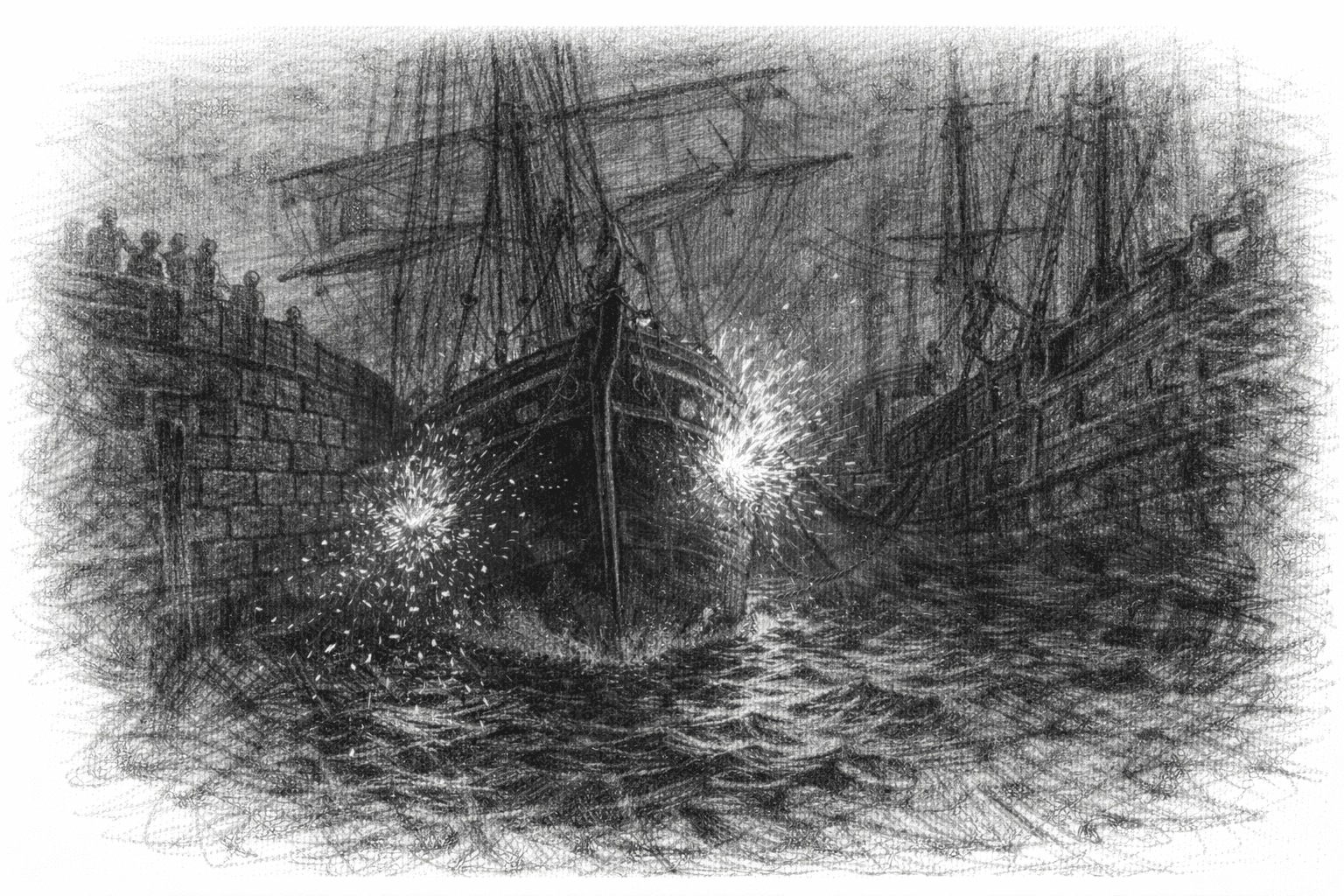
Now, there was nothing else to do and the pilot signaled 'full speed ahead' to the tug. And off we started with a frightful crashing, the chainbolt heads on the outside of the ship scraping against the dock wall, and as the speed increased sparks and fire flew from the contact, showing a flare of light over the railing.
The darkness was broken only here and there by some small gas lanterns, not sufficient to give us a view of our surroundings. The gale had increased again.
All crews on ships around us were up and at it, mooring their vessels more securely. All commands had to be given by extreme vocal efforts in order to be heard. With the storm howling and shrieking in the rigging of the many ships, there was a noise and brawl and uproar as if all evil spirits had been let loose, and I expected every moment that our ship should be crushed and sunk under our feet; and that, too, right here in the dock.
Then, before we knew what next, our ship ran into a smaller one, and took away its bowsprit. Immediately our pilot came with a great big axe, on which the edge was about 15 inches. He cuts off every thing that holds us, and we move on.
In a little while we collide, head on, with a big steamer, and our fore-rigging becomes engaged in his anchor hanging high in his bow. Again our pilot gets busy and cuts two or three shrouds of our forebrace. We proceed. Sometimes we see our yards coming in contact and fastening in the yards of other ships. The pilot comes and cuts the braces, so the yards can swing loose.
Having cleared ourselves of still another collision we finally reached our mooring place. Men stood on the wharf ready to take our hawsers, put them on the pile heads, and we lashed her to the pier with almost all the cordage we had on board.
We were on the west side of the dock, where the wind blew off the pier. As soon as we were moored we went to the pumps, being almost certain that the ship had been injured and was leaking, - probably half full of water. To our great surprise, after a few strokes of the pumps they were free. A ship that could stand such sailing and such abuse without opening a joint must have been very well built.
It was now about midnight, and all were ordered to bed except the one man watch on deck. We were glad, indeed, after three days and two sleepless nights, being thoroughly exhausted.
When, at 8 o'clock the next morning we were awakened, I went out on deck to look around. The storm had subsided. Looking aloft I saw a sight never to be forgotten. The whole rigging appeared a wreck. Yards stood in every direction and swung loose in every way. All braces had been broken or cut. Some of the forebraces hung loose, and the whole rigging appeared to be only loose ends of ropes, some longer, some shorter, hanging and swaying in all directions.
It was unbelievable we could suffer such abominable destruction after coming into dock.
I looked down the starboard outside. Some of the chainbolts were bent aside, others torn off, and the heads of a few worn off by scraping against the stone pier. Chainplates were bent and twisted. The ship had had a horrible treatment. There would be work for a long time to put things in order again.
However, we were glad to be in harbor. Had we been out at sea that last hurricane night, I believe we would have had real trouble. But it was certainly an unusual manner of landing, the like of which I never saw, either before or since.