
The wind was favorable and it did not take long to pass thru the English Channel into the North Sea. Here the winds were variable, skies clouded, and we had to do some tacking. When this had been going on for about a week, I asked the 2nd mate one evening if we could not soon expect to see the Norwegian coast. 'I do not know,' he said. 'By the reckoning in the charthouse we are now thirty miles up in the Norwegian mountains. It is not easy to tell just where we are. The captain works on the charts and does the reckoning.' Thirty miles up in the mountains! And yet we could not see hide or skull of them! That was navigation which could give most anybody something to think about. One thing good about it was that we were really behind the reckoning. If we had been ahead of it the mountains might have found us while we thought we were yet far out to sea. That would have been a serious matter, especially in dark nights and rough sea. The captain was evidently as good navigator as he was seaman.
Along in the night we sighted a lighthouse; I believe it was Obrestadbrekken, on Jaederen. The wind had now become favorable, and the next day we swung in around Tungeneset and stood in the fjord to Stavanger under a nice aft breeze. Glad we were. Now we were soon at home, and free. Think of it – FREE.
But the captain had not forgotten us yet. As he had been accustomed to drive us, so he would continue to the last minute. We received orders from him that all sails were to be unbent, rolled up and stuck in the sail-room under the fore-deck before we could be released. And not only that, but we were also forbidden to cut a single seizing. We were to untie and save them. 'Yes,' I said, and went into the carpenter shop and asked the carpenter to loan me a good knife. He had a good sheath knife which he let me use.
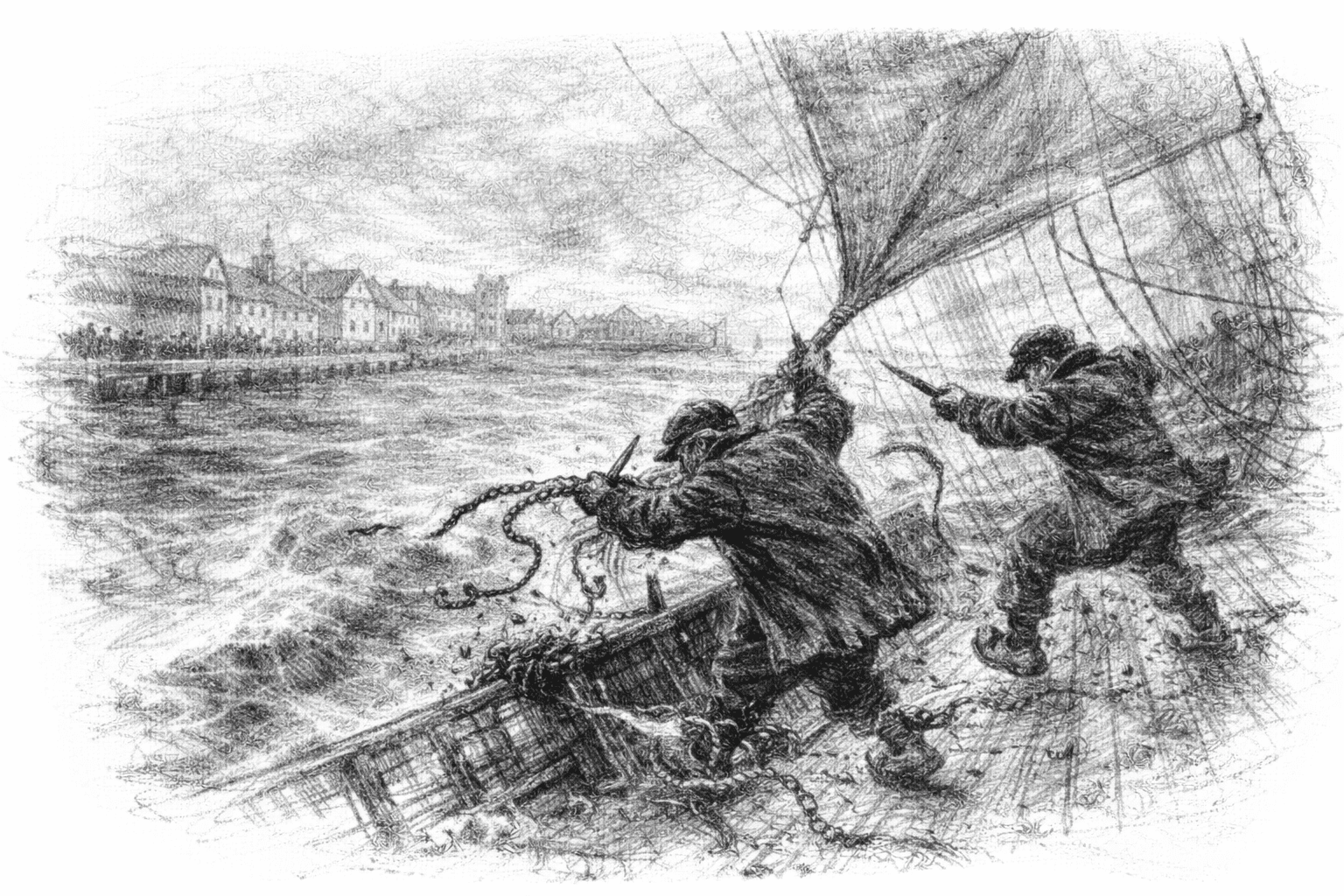
It fell to the carpenter and me to unbend the sails on the foremast, as we were on the larboard watch. We laid our plans and sharpened our knives; then we went up and began on the royal. We had agreed that I was to unbend beginning at the yardarms, and he would handle the middle part of the sail. It was also agreed not to untie any of the seizings, but cut them all, and get thru before the anchor should fall. Cut and slash; - one – two – three, the sail was loose, and we called down, 'Lower away.' Then down to the topgallant yard, with similar operation.
I took some of the seizing, rolled it up after it was cut away and tossed it down on the deck. I noticed it fell right before the nose of the 1st mate. He took it up, looked at it, then looked up to see me and said: 'It was the Finnøybu who did that. Don't do that again.' I did not answer, cut the seizings as before, but took and threw them out over the ship side, not wishing to have them fall before the nose of the 1st mate again. When we came down to the upper topsail we found the seizing so thick it was easy to untie, and took no more time than cutting, so we untied from that place down.
The sails on this or any ordinary ship, either before or since, had never come down as fast as they did on that day. We were determined to show both captain and mates we could unbend sails in a hurry, and we worked at full speed. The seizing that had been cut lay all over the deck but, remarkably enough, we never heard another word about it.
When the anchor fell, in the harbor of Stavanger, every sail was in the sailroom. We cleared up the cordage on deck, and pumped the ship dry, which is the last duty of a crew after having reached the home port. Then the office makes formal announcement that the voyage is ended. This is only a formality, it being understood that when the ship is in port, anchor in bottom, sails unbent and packed away, and pumps dry, the crew is free whether anything is said or not.