
Then, one afternoon of fair wind and weather, the first mate came to me with orders to get a bucket of tar and proceed to tar all the fore-rigging, and see to it that there were 'No holidays.'
'No, I thought, there is evidently no thought of holidays aboard this ship, either figuratively or actually.' I knew quite well that this order was from the captain, that I was to tar the rigging alone, and that this was to be punishment for the Finnøybu, who seemed to be difficult to handle.
There was nothing for me to do buy obey. I found a tar bucket and some oakum and went aloft. It was not the most cleanly and agreeable job. The oakum had to be dipped in the tar and thus smear it on the rigging by hand, in and out, between ropes and cables, over and underneath, so the hand soon became covered with tar clear up to the elbow, not to mention my clothing, on which tar-drops fell here and there.
I had come as far down as the upper topsail yard and began to think it must be about 3:30 o'clock, when my free watch was to begin. I looked down to see if anybody else of my watch was on deck. But I saw none. The captain had been walking around all the time to see if I kept busy. At once the thought came to me that it was his intention I should be kept at work during my free watch. I made myself errand on deck to get more tar, though I had a fairly good supply.
Going into the forecastle, I found all the comrades of my watch resting in their beds. I asked why I had not been called. 'Well,' they said, 'the captain told us to leave you at your work.' 'Oh, yes,' I said, 'now I am to be deprived of my watch below (free watch) and be punished with convict labor.' I said no more but went forward to the tar barrel.
Tired of being persecuted in every manner by the captain and being compelled to avoid him and pretend to take it good naturedly, from now I would try to play even.
I knew the captain was part owner of the ship, and it was for that reason, with the idea of greater personal profit, he did not give his men decent food or other means of comfort but tried to use them like slaves.
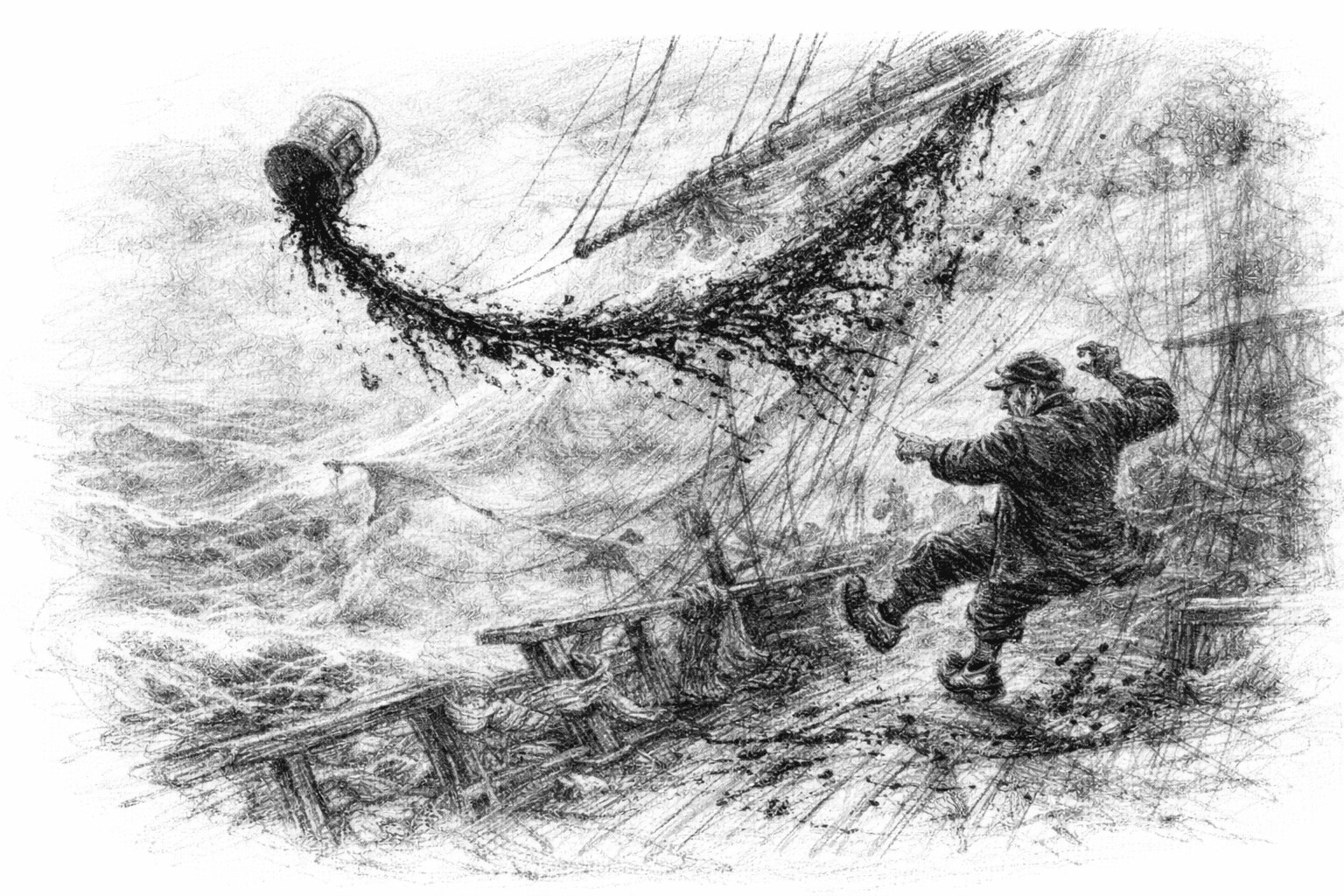
A gallon pail was used for a tar pot. Now I filled it to the brim and went aloft. The captain watched me, as before. I had reached down to the lower topsail yard with my work; and now I went out on the yard arm and pretended to start tarring the topping lift – (the rope running from yard arm to the mast and by which the yard hangs in place) and the foot rope, (a rope stretched from the yard arm to the middle of the yard, and which was used to stand on when one had to work on the yard). Having come about halfway out on the yard, I looked to see if the captain was watching; and there he was, in the same costume he had on when he bombarded the Portuguese with salt, - wooden shoes, pin cap, etc. With a sudden kick on the footrope, as if I had stumbled, my arms went forward over the yard, as if about to grab hold of it. I saw to it that the tarpot flew up and overturned, spilling the tar over sails, rail, and deck.
Never in my life have I seen an acter play more realistically than the captain did when he saw what happened. He howled and cursed, struck the air with his arms, and clogged the wildest kind of dance in his wooden shoes till I thought they would certainly split, and the red pin cap flew a constant whirl around his head. I stood entirely still and looked at him. He was more comical than an ape. He yelled and roared most wildly, but I could hear no words except oaths; and I decided not to move from the spot until I was told what to do.
At last, I understood him to mean I was to come down. 'So, you had to call me, I thought. And I will now show you I am not afraid of you.' I went down and right over to the half deck and asked in a loud voice and pretended arrogance: 'What do you want?' 'If you don't wipe up all the tar, both rapidly and thoroughly, I shall take it out of you with a good trouncing.' 'Ai-ai,' I said in the same loud and spiteful voice and walked away.
Down in the cable tier I found an armful of oakum and began to sweep up the tar. As the handfuls of oakum were filled with it, I threw them overboard before the eyes of the captain. I knew it hurt his stingy soul that I used so much oakum. But it had to be done that way. Now he could come, if he dared, then we would see who could deliver the best flogging. This was my free watch, and he had no right to keep me at work against my will, without proof of guilt, and without judgment according to law.
Most of the tar on the white railing and deck having been wiped up, while he stared at me like a fiend ready to eat me alive, I cleaned my hands, went to the roundhouse, and laid down to rest, but with the marlinspike at my side. The captain could come if he liked. He should find me ready for him.
Remarkably enough, from that day forward he never tried to either use violence against me or to give me any work intended as extra or meant as punishment. Only now and then, when I passed him, I could notice him making a wry face at me. He probably gave up all hope of reforming the Finnøybu. And, strange to relate, I was not required to complete the tarring of the rigging. There were some large tar-spots on the sails, and he was probably afraid there might be more. Yet, tar did not injure the sails in the least; it only made them stronger, though it did not improve their appearance.