
Next morning, on board the 'Cito', we weighed anchor and set course for Hamburg, Germany. The ship was loaded with resin, and had an additional deck load of 100 barrels. Being thus heavily loaded the deck was only about four feet over the water line, and did not appear to be in the very best condition for crossing the Atlantic in the wintertime. She had been on the way once before and had to return to this port to repair a leak. Now she had laid here three months for such repairs as was needed to make her seaworthy. A new set of heavy cotton sails had also been made for her, so now she was thought to be in very good shape.
The crew consisted of 13 men. The captain was a big, stout, brave-looking man. The mates were apparently agreeable men, and so were the comrades in the forecastle. I remember very little about each one in particular, except one, young, quiet lad, who was on his first voyage across the Atlantic; and one other, a tall man, about 30 years old, from Hamar. who was remarkably congenial.
We had favorable wind, and all went well until Christmas Eve. We had then come out into the Gulfstream, and there came up a storm from northeast. This was directly contrary to the current, and a very choppy sea arose, which threw and jerked the ship with great violence.
All sails had been made fast that evening. The wind veered around to the west. At eight o'clock, on trying the pumps, we worked for some time, and they did not come free. She had sprung leak again. We had an iron measuring rod about 6 feet long which we could let down aside the pumps, in a small pipe, and ascertain how much water was in the ship.
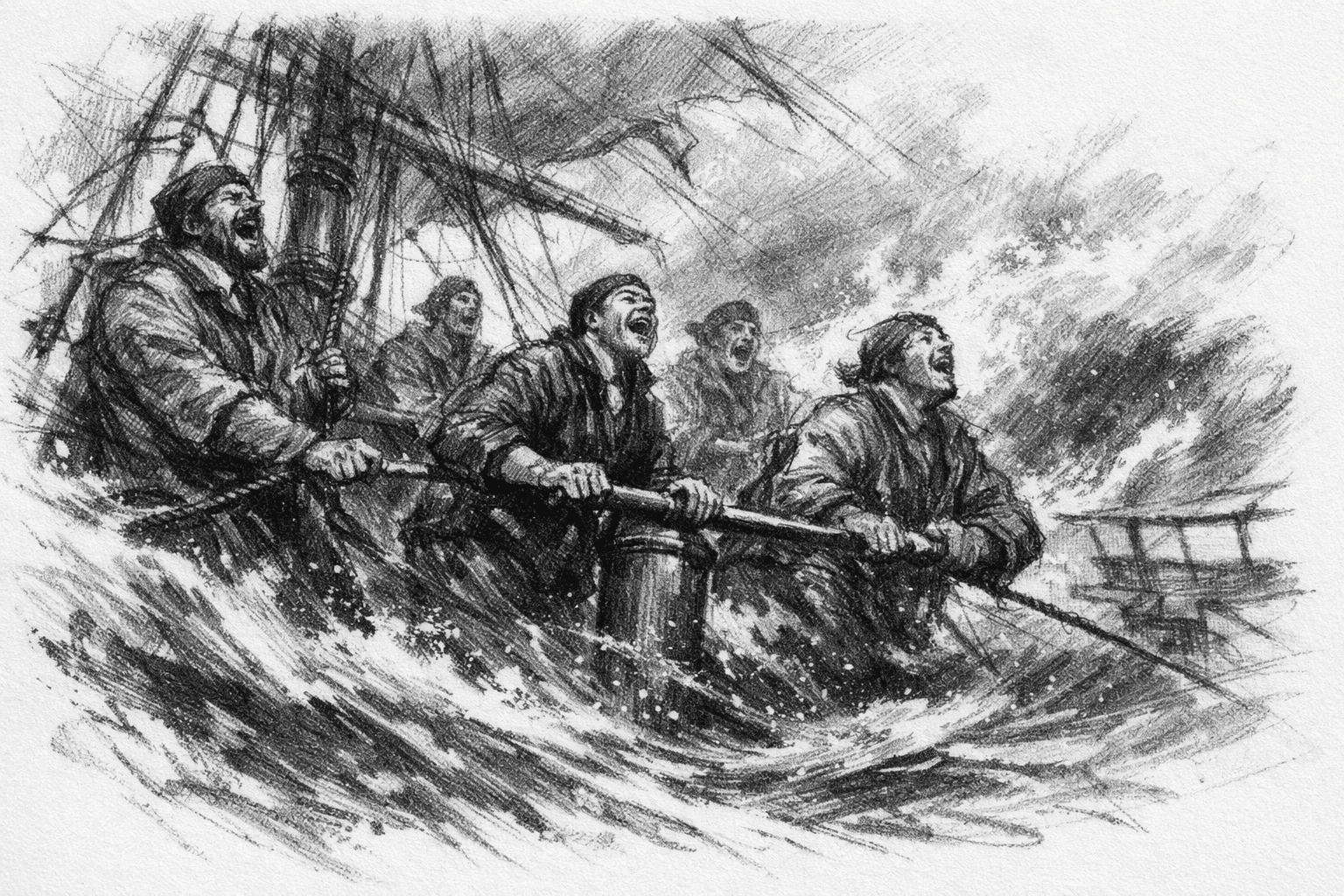
But now the seas were washing over the deck almost constantly, so the pipe was full of water, and we could not find out anything about the amount of water in the hold. The only thing we could do was to keep on pumping until air would come from the pumps. Hour after hour we pumped, but no air would come, and we began to doubt about getting the water out of her. The seas rolled in over us worse and worse till we stood up to our waists in water, and now and then a breaker would go over our heads.
The pumps were located at the main mast. Every stroke of each pump would bring about 3 to 4 gallons. These were called 'Balance Pumps', with large steel handles and cross bars on each end. Pieces of rope were fastened to the bars, permitting a larger crew for the pumping. It was very difficult to work at those ropes, because one had nothing steady to hold on to when waves washed over. My place happened to be at one of those ropes, because it appeared that I had the ability to maintain myself as well as anyone in this position.
But the weather became so bad we finally had to put ropes around our bodies and tie ourselves to the ship, so as not to be washed overboard. Many times when the ship seemed to be buried under the seas and appeared as if it could not emerge, we kept the pumps going, on top or under the water. When all the men were at the pumps we probably pumped out 300 to 400 gallons per minute.
At midnight we had become somewhat discouraged. 'Then came the captain, and he, too, began to help at the pumps, the other officers having taken hold earlier, and he said: 'Don't give up, men. Sing a chorus or two, that will help. 'Well, we thought we might as well sing, it might not do any harm. So we sang quite lustily. Sometimes big billows would roll over and drown our voices.
That singing, on that Christmas night, I shall never forget. There was something dismally weird and unnatural about it, like singing our own funeral dirge. And in the darkness of the night I seemed to hear our ghostly echoes from the great seas that rolled along. But, remarkably enough, it seemed to help in the work of pumping.
About 9 o'clock next morning after about 13½ hours pumping, the ship keeled over temporarily on a big wave, whereby the water in her hold was thrown over into her side, and air came in the pumps. This lifted our spirits considerably, as we then understood she was not ready to sink. What a dark Christmas Night this had been!
One half the crew was now released to go and eat and get two hours' rest, while the other half continued to pump, after they had had something to eat. From 12:00 to 2:00 P.M., everybody was at the pumps again. Then the other watch had two hours' rest.
In this manner we continued for six weeks, until we came to Hamburg. Two hours rest and six hours at the pumps, day and night; or six hours rest and eighteen hours pumping every day; the pumps going constantly, except when we were compelled to shift sail, reeve or set sail.
This ship had been built in the United States, of some sort of soft wood. When it came into heavy seas it would twist and bend sometimes so much that we could clearly see one end twisting one way and the other the opposite. This motion worked the oakum out of the outside planking, and then she would leak. It was one of those ships which are ordinarily called 'Floating Coffins', which should never have been permitted to sail the seas. The crew had to carry them on their arms from port to port, or leave them in sinking condition, or founder and go to the bottom with them.
I sailed in two other ships also which were so rotten and miserable that they should never have been permitted to cross the North Sea, much less the Atlantic Ocean. Many of those rotten ships became the coffins of their crews.
As before mentioned, 'Cito' lay low on the water, as a watersoaked log; could not lift on the billows, but simply permitted them to roll over her, and was something like a submarine. Neither could we make her speed up. 7 to 8 miles per hour was all we could force her, under favorable wind and all her sail pressure. We even tried to set up a heavy helping stay on the main mast, so we could put up the greatest possible spread of canvas, without danger of sailing the rig overboard. But nothing would help. It was the same snail's pace.
If we could only have come back to America again, it would not have been so bad. But the winds were westerly, and heavy seas; and if we could not make much progress scudding, it would surely be worse if we should try to buck the weather. There was nothing to do but hold on our course, though the prospects were everything but bright.
Now I understood why the two men were so ready to desert and let us have their places. They knew the ship and knew what it meant to pump day and night for weeks to keep her afloat across the Atlantic. We got all we bargained for.
At first we attempted to change clothing once in a while, and be dry now and then; but it was not long until we had no more dry clothing. For drying purposes we had to put our clothing some distance up in the rigging, out of the wash and spray of the sea. But dry clothing did not stay dry. As soon as we came on deck we were soaked again. And soon we became so careless and so accustomed to be wet that we forgot to change, and went to bed in wet clothing. For a while we took off the outer garments; but if we became warm in bed, and then had to get out, and put on the cold, wet clothes, we began to shiver and our teeth clattered fearfully before we got our clothes on; so we gave it up, and rolled into with everything on.
For a long time we took off our oilskins during the rest hours, but, as it was seldom we could warm during the two hours off duty, we went to bed with them on. There was no stove in the forecastle by which we could warm ourselves.
Soon our bedclothes became so wet we could wring the water out of them. It may seem incredible that we could live in this manner for weeks and weeks, without sickness or death, but it is the actual fact. And I shudder at the thought of it. If it had not been seawater, we had all died in a short time, of fever or other sickness. We had good food and good appetite, and that was necessary to maintain strength for pumping. Sometimes we got some sleep in the two hours rest period, but often we did not sleep a wink, which is no wonder, since we were both wet and cold. And not only so, but oftentimes there would come big breakers, striking against the forecastle wall with thunderous noise, as if something was breaking and one might expect forecastle and inmates would be washed away.
There was a boat, turned keel up and lashed to the forecastle roof. Before we reached the English Channel it was splintered, and only its stern was intact.
Some days there was not so much water on deck, and our clothes had a chance to dry on the upper part of the body, but it was not often and it did not last long. Nearly all the time we had to lash ourselves to the position at the pumps, and stand to our hips in water, and now and then an avalanche would drive over our heads.
It was noticed that our forebraces had become slack, and we had to tighten them, so the yards would not break. To give as many as possible a chance to get hold of the brace I jumped upon the railing and tried to take hold away up. Then came a big sea, and someone cried: 'Lookout for the breaker.' I took hold as high as I could reach on the brace, then lifted myself, and thereby succeeded in keeping my face over the water as the breaker went over. The others bent down in the lee of the railing, took hold of anything solid until the sea went over, and then came up.
We were about half way across the ocean when the steward found that the fresh water had leaked out of one of the tanks which contained our water supply. He told the captain, who then examined the contents of the other tank and found there would be water enough for 3 days if each man used only a pint of water each day.
Now it began to appear that we might die of thirst in a few days unless a miracle happened. The effect of the report of shortage of water made us all so thirsty we could drink any kind of water, even though it were brine.
We had seen no ships so far, and it was not probable that we would see any during the next three days. The weather was typically winter-stormy and depressing. Were we to drown or die of thirst? It appeared we must meet it, by one method or the other.
Sometimes we could empty the ship of water by pumping, so there was a slight release, other times we could keep on pumping for days and nights together without coming free.
As near as I can remember it was the second afternoon after we had been put on water rations, when a black cloud appeared in the west. Such were not uncommon; but if there came a rainstorm, it was usually followed by a gale, so the driving spray of the seas made it impossible to gather any fresh water. But we had to be ready, if there should be an opportunity to gather some rainwater.
We washed the cabin roof and the halfdeck. There was a big moulding around the edge of the cabin roof, which held the water and brought it to a downspout. So also, on the half deck. We were ready with buckets in hand. A gale was blowing, and we feared it would blow harder when the shower would come. But the almost unbelievable happened. As it began to rain the wind died down and it became almost still. The rain fell faster than we could gather and carry away to our empty watertank. We filled it and then we filled some empty barrels that were available and every container that could be spared.
It was hard to believe our own eyes. We had filled our fresh water tanks in mid- Atlantic, and in winter. It is something I have never heard of before or since. If it had been in Equatorial waters it would not have been so strange. As soon as the shower was over it began to blow as before. But now we had water enough.
I do not remember how many days later it was when we had another unfavorable experience. As said before, we had 100 barrels resin on deck. Some short planks had been placed on deck on which the barrels had been set on end, and solidly stowed against the riser to the aft half deck. To hold the barrels solid against the halfdeck a long heavy spar, reaching from side to side of the ship, had been placed in front of the barrels. The spar was fastened by chains to big iron rings in the half deck.
It all appeared solid enough. But we learned it was not. The severe heaving of the ship and the power of the breakers going over made the barrels roll and slide, now this way and now that. This movement caused a barrel here and there to be smashed. Thus given a little more room to slide, more barrels were broken. We tried to wedge them together and stop the sliding but we could never be sure they would stay solid. There were also three cords of wood piled and lashed on top of the barrels.
One night, on my free two hour watch, I had just turned in and gone to sleep, when some one tore open the forecastle door and roared: 'Every man out. Now we are going to the bottom.' I heard a fearful noise, together with the wash of the waves over the deck, and it was easy enough to believe we were sinking. The man, no doubt, believed it himself. But it was a rough and thoughtless manner in which to wake us from sleep.
We were on deck immediately. Here was the whole deck load of barrels and wood sailing around the main deck in utter confusion.
The mate cried out: 'throw overboard everything as fast as you can get hold of it.' But this was not all play. We were in danger of getting our legs broken by the rapidly rolling barrels, not to mention being knocked over by the various moving objects, wood and planks in the water, going now to one side, now to the other, and thus going on our heads in water, which we did again and again.
Taking my place at the railing, every barrel that came within my reach I put overboard, as if there was little or nothing in it. Fear seemed to add strength. A barrel of resin weighed 200 pounds or more, but they seemed to me like empty barrels. I handled a great number of them. It did not take long before the deck was cleared.
And then we had to feel around the edges of hatches and other places, and collars around the masts, to ascertain if there were any holes. We feared the barrels had knocked holes through which water could get into the hold. It was enough that the ship had a leaky bottom. We found no large holes or breaks, the tarpaulins were solid on hatches, but there was a crack in the collar around one of the masts. We filled it with oakum and nailed some sailcloth over it.
We were all more or less permeated with the constant soaking received from the stormy seas, tired and drowsy, caused by the endless pumping.
The young lad, and the man from Hamar, before mentioned, seemed most affected by the severe ordeal. They appeared not to be able to take hold and protect themselves from the waves that rolled over so freely. Sometimes they would be washed from side to side by the rushing water, unable to hold fast to any object, and seemingly without strength. Many times I would take and lift them up and move them to a place where they could hold to something, and then tell them to hold on, or they might be washed overboard. They said they would do so, but soon I would see them tossed around in the water again. I pitied them; they were so worn out and appeared as if walking in sleep, caring little whether they lived or died.
This waterlogged feeling is almost like seasickness. If one gives in to it, it gets worse. It can be overcome, at least to some extent by resistance. Anybody who has experienced this feeling will agree with me, that men were not created to be fishes, and live in the sea, even if they could hold their heads over water.
We had on a great press of sail, to make her speed up, and the sails were new and strong, so we let them stand as long as we believed the rigging would hold up. One night the gale was too strong for the main upper topsail. The bolt that held the yard to the mast broke, or its head was pulled off, and the yard began to swing from side to side, so we thought the whole main mast would come down. We found some chains which, by hazarding life and limb, we were able to put around the yard and the mast, and made it stand solid again.
One afternoon, I was off duty and in bed to get some much needed sleep, a man came to the door, tore it open and called out that we were foundering, 'Every one out. We are going to the bottom.' We had had our minds so long on this idea that it did not seem to be news any more. What seemed more surprising to me was that we had not gone to the bottom long ago. But we came out of our bunks in a hurry, and from the after deck we heard the mate calling. It was to swim rather that walk aft. When we got there we saw the cabin and the provision room half full of water. There were two windows on each side of the cabin, reaching from deck to its roof. A big sea had broken both windows on one side and nearly filled the cabin with water.
I stepped down the stairway to look, and there were the captain's bedclothes and other things, sailing this way and that, together with flour and bread-barrels and other things that would float.
We were ordered to get hold of flour and bread-barrels as soon as possible, and get them on deck before they became entirely water soaked. We had, not so long ago, been in danger of death from thirst. Now it appeared we would soon be in danger of starvation, with all our provisions spoiled by seawater. We opened the barrels as soon as we could do so safely, and found, to our great relief, that the water had not gone entirely through them. We hurried to take out from the middle what was dry. And there was so big a supply that we had enough provisions of such as had not been spoiled.
The water soon leaked out of the cabin and provision room, so we now had that much extra water to pump out. It might well be said that, on this voyage we were trying to pump the Atlantic dry.
The ship was still afloat. But what would happen next? It seems as if this ship was doomed to go down, sooner or later. There was very little hope that we should see land again. The cook's galley was ahead of the forecastle. It had a sliding door on each side, so that if the wind was from one side and compelled closing of that one, the other door could be opened. One morning there came a violent sea over the bow, broken in the windward door and went out the lee door, cleared the galley of all cooking utensils, washing everything overboard. The stove was so securely fastened that it did not go. But what was now to be used for cooking our food? The coffeepot was, luckily, in the forecastle at the time. And, from that day, all we could cook was coffee.
The men seemed not to care anymore about anything and were going about like half-drunk. But to go thus, looking death in the face night and day for many days and weeks, became too much for me. I knew there was a God who could exert his power on the wind and wave, and that He could save us and bring us into port if He would. One night when I was relieved from watch I went forward beyond the anchor windlass, where nobody could see me, and there I went on my knees in prayer to Him who can save from all harm, and called to Him for mercy and salvation. This I then repeated, night after night, but I said nothing to any one about it. I thought the other men appeared hardened and dull, and if they had known what I did they had probably scoffed and ridiculed me. It was not so seldom I heard them call on their god, Satan, so I concluded it was better not to say anything to them.
From all appearances it could hardly be believed there was another one on board who thought of God, or prayed to Him. But I firmly believe God heard my prayer, and that the promise contained in verses 23 - 32 of the 107th Psalm was fulfilled.
Eventually we came into the English Channel. The sea did not run so high, and we were less flooded with water on the deck. But here it was colder than out on the Atlantic.
It was now the first part of February. A cold northwest gale blew, and I remember I suffered much from the cold, particularly when at the helm, where I could not move around to get warm.
Our seaboots had loosened in the seams, and I put oakum in the holes to prevent the cold wind from freezing my feet, but it helped very little.
The captain had often encouraged us by saying that when we reached Hamburg we would all leave the ship as soon as the anchor was in bottom. We could now have gone into some nearer port for repairs, but if we had done so then we would have been compelled to stay with the ship until repaired and brought to her destination before we could be discharged. It could have been 3 to 4 months more. We had carried her on our arms over the Atlantic, in turbulent seas, so we ought to be able to carry her now for another week, in more quiet waters, and then be mustered out. There were harbors to be found now, on either side, if we should be unable to keep her afloat. The wind was favorable and we kept her going until, after another week, we reached Hamburg, seven weeks after leaving Wilmington, and after having pumped almost constantly for six weeks, day and night.