
The carpenter and others of our crew knew where we were, and came to visit us sometimes In the evenings. They told us that at 4:00 o'clock in the morning after we had left the ship both mates came into the forecastle, and when they saw we were not there they cursed roundly and regretted exceedingly they had not kept a more strict watch. Now it was too late. The birds were gone.
It was dangerous for a boardinghouse to keep deserters. Under the law the landlord was subject to a fine of $200.00. For that reason we were shown into an old brick building, to the rear, with only one window, high up on the wall. There we spent the first two days. It was something like a jail, but very near and handy to the boarding house. If the officers of our ship or police officers should find us here it could not be said we were in the boarding house. There were chairs and a table in this jail, and a spacious cement floor to walk on, so we could amuse ourselves in any way we saw fit. We ate breakfast and supper in the boarding house. The dinner was brought to us in the jail.
But, since nobody came to look for us during the first two days, after that time we stayed at the boarding house all the time.
There was, however, a protection for the boardinghouses. If the captain would hunt us up, he had to engage a policeman to go with him. Then, when they came to the suspected house, they had to give the proprietor notice of their business, and the captain had to put up a $200. bond with the proprietor, as a guarantee, before entering and searching the house. If they did not find the men they looked for the captain would lode the $200.00. If the culprits were found in the house he would get his $200. back, and the proprietor also had to pay a fine of a similar amount.
It was not so easy for the captain to make a search, as long as he was not absolutely sure where we were; and he also knew that every house had many secret hiding places; so, he feared losing his money instead of catching his boys.
But he knew our comrades visited us. I wrote a letter to the mates, and sent in aboard with one of the men one evening. In the letter I thanked them for all kindness and good comradeship in the past, wished them a prosperous voyage; and said to the second mate, who had often bragged about his ability as a detective, that he might now make use of some of that ability, and try to find us.
One evening they brought me a letter from the captain. It was a very nice letter, wherein he voiced his regret over what had happened, and said if we would come back there should not be one word said about our desertion, that he would try to make everything as agreeable as possible for us, that were good boys and he liked us, and for these reasons he asked us to return.
I knew he meant everything he had written. I had now been with him 17 months, and I felt bad about leaving him, especially since he made such condescending and kindly request to us to come back. But I knew, on the other hand, that the captain would usually be asleep nights, and that then the mates would undoubtedly make life very miserable for me. Having deserted, I concluded I would stick it out, and see what happened.
The people who owned this boardinghouse were Irish. I believe the name was O'Brien. At any rate, I will let that be their name. The man was not a good business man, and he boozed too much, but did not make a great deal of disturbance. The wife was, however, an able housekeeper capable in business matters, and she had the management of the house. They had a boy who was a fine young man. He worked in a store in the city and was living at home. They also had two nice little girls, Mary Ellen, 13 years old, and Margit, 9 years old. I mention their names because their kindness became of great importance to me before I left their home. The religious faith of the family was catholic. This woman and her daughters became like mother and sisters to me, by reason of later events.
Besides Thomas, and myself, there were also two other Norwegian sailor boys in the house. One was 16 years old, and was out on his first voyage; the other, somewhat older, but still a very young lad. There were also five middle aged Irishmen boarders. They worked in the cotton mills. So, with the Swedish cook, we were quite a big family. The five Irish boarders were hard drinkers, and did not look very good. One of them really looked as if he had eaten one man and was ready to eat another any time, we used to say.
The lower story of the house was one large room, which was used for living room and dining room, and there was a small stove in the middle of it now during the winter time.
One Sunday forenoon the five Irishmen had brought with them to the house an Irish tailor, and they sat around the stove which was red-hot, and began to drink whiskey from a bottle which they passed around. Some of us sailor boys stood around outside the circle. The 16 year old lad had on a heavy, knit, blue Scotch cap, with ribbons hanging down the back. The tailor saw the cap, liked it and asked the boy how much he would take for it. 'Two dollars', the boy answered. The tailor thought that was too much, and offered $1.50. 'No,' the boy said, 'I want $2.00.' Then I said to the boy in the Norwegian language that it would be better for him if he had nothing to do with these drunken Irishmen. But he thought he was able to handle his own affairs, and would take no advice from me, even if he could hardly talk any English.
At last the tailor said he would give two dollars for the cap, and took up four half dollar coins.
The tailor sat on one side of the stove and the boy stood on the other side, and between them sat the three other Irishmen. The tailor delivered the money to the man nearest him, and he in turn to the next, then he again to the third, who was the man above mentioned of the savage appearance. When he was delivering the coins to the boy who sold his cap he let one of them fall into his coat sleeve, then he stuck that hand down in his coat pocket and let the coin fall into it.
When the boy received the three fifty cent pieces he said, 'No, I want two dollars,' and he delivered the three coins back to the tailor the same way they came. Then the tailor claimed he had given the boy two dollars, which was all he asked, and now there was only $1.50 returned to him.
Then there arose a great uproar among the Irishmen, who seemed to come to agreement that the boy had stolen the missing 50 cent piece. The boy could not speak for himself, and it appeared perilous for him when these drunken men circled around him. He protested that he had not taken the fifty cent piece. 'Who took it then,' they all yelled at him.
To help the boy, I thought I must answer for him. So I said, 'That man there has the fifty cent piece,' pointing at the man. 'Did I take it?' he roared. 'Yes,' I said, 'and I will tell you where you put it.' And, pointing at his coat I said, 'you have the money in that right side coat pocket; I saw you put it there.' Then he had to turn out the fifty cent piece. But the eyes he put on me spoke as plainly as words that I had now put myself in a very dangerous position, like some inexperienced boy.
A little while later this man was dickering with the same boy to buy his big pocket knife. I called the boy aside and told him if he had never been whipped before I would give him a sound thrashing if he dared sell his knife to that man. I had a suspicion it was on me that ugly, drunken wretch would use the knife. The boy did not sell the knife.
I felt uneasy and went out in a little rear shanty, used for a cook house. A big cookstove stood on one side of the room, and on it stood an old-fashioned iron kettle full of boiling water. At the side of the stove was a chair whereon I took seat. I did not want to be in that room with the drunken men.
Not very long after I came out into the shanty I heard a fearful commotion in the room I had left, and soon the ugly looking man came running out into the cook house, and said: 'It was I who took the fifty cents?' At that he lifted his fist and was about to strike me in the face, but before he reached me I raised off the chair and set my foot against his stomach so he landed against a table on the other side of the room.
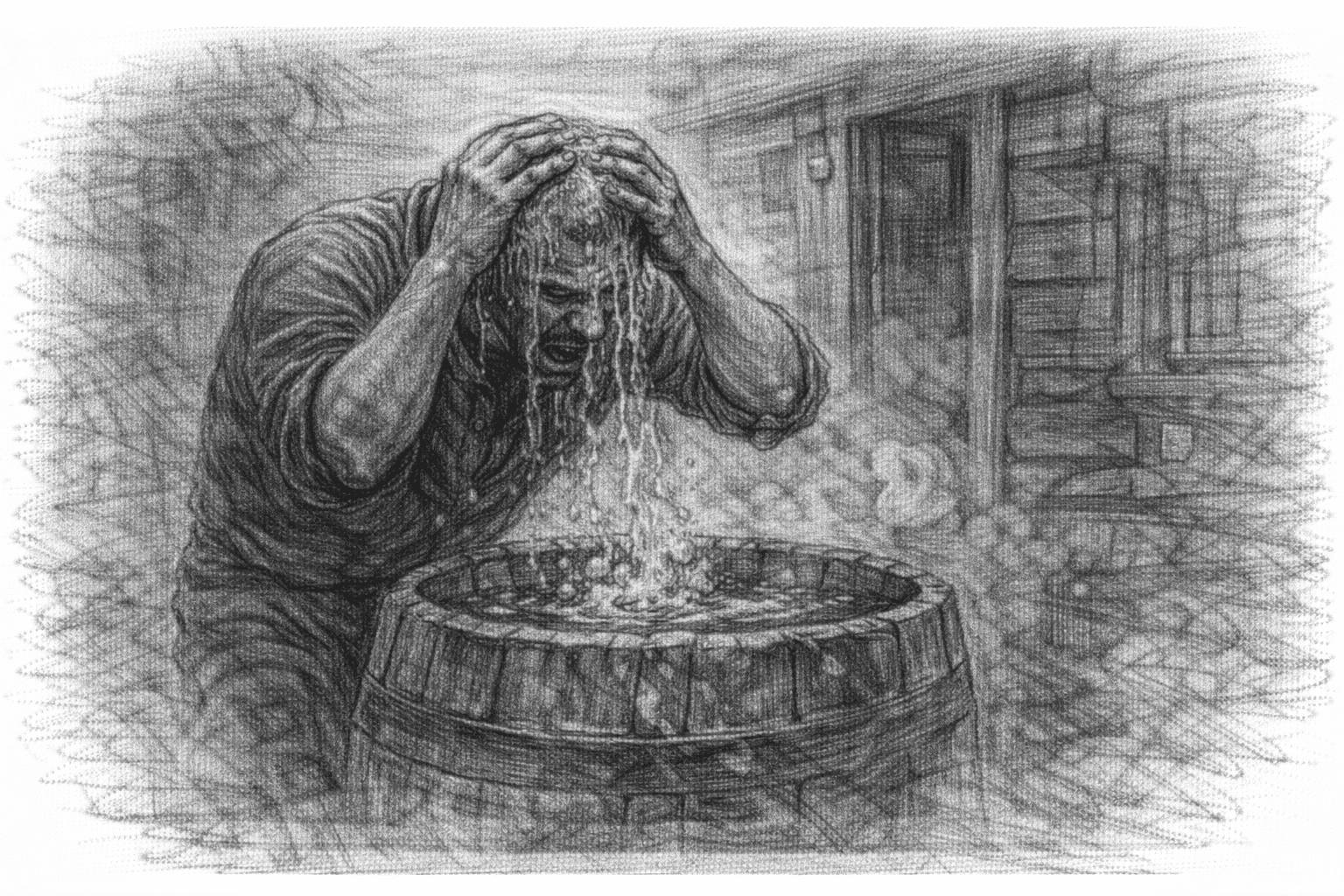
He appeared to be somewhat stunned and stood still for a while, not trying to approach me. Thoughtlessly I sat down on the chair again, while he moved near the stove. Then, with a hurried move, he grabbed the kettle of boiling water and emptied its contents over my head.
Raising both hands to my head to press the water out of my hair, I jumped up, and make my way out to a waterbarrel that stood outside the door, applying some cold water to my head and face, as soon as possible. My scalp and skin on the forehead was scalded, and with the pressure of my hands and downward movement some of the skin rolled down to my eyebrows. The pain was extreme.
The Irishman dropped the kettle as soon as he had emptied its contents over my head, and ran out in the back yard.
In the meantime the people in the house had seen the steam coming out of the cook house, and immediately there was an effort made by them to get hold of the man who had injured me. Two policemen also happened at that time to be coming up the street. The Irishman was soon surrounded and put in jail. I learned later that, before he came out to quarrel with me there had been a fight in the main room, upset the stove so the fire was spread over the floor, and it was then this man had come out to attack me.
Nearly fainting with the pain of my injury, I knew not what to do, but soon Mrs. O'Brien came with a cloth full of white lard and applied it to my forehead from eyes to top of head.
Then she made ready a room upstairs where I was put to bed, and after the excitement and shock of the occurrence had subsided somewhat I went to sleep. When I awoke there was no pain from the bum except when I touched the spot.
After a couple of days Mrs. O'Brien took off the bandage of whitelard, and then she put some ill smelling oil or salve on the burned spot. This salve was to prevent the scab on the forehead from drying up and cracking thereby leaving a bad mark.
The two little girls had much sympathy with me, and came up quite often to console me. They said the four other drunken men had said it was a big shame to treat me this way.
The third day after this happened Mrs. O'Brien told me there was to be a trial that day to determine the punishment of the culprit, and that the judge had told her if I would come and testify against him he would be given not less than three years in the penitentiary.
She also told me the ship I had deserted was still in harbor. And she wanted to know if I would get up and give my testimony. I thought it over and concluded it would not help my condition no matter how much he was punished. And if the captain of my ship should find me he would take me along, and I would be compelled to make the rest of the voyage without pay. That was what deserters could expect if they were caught. So I answered I would not go and testify against him, - let him go as far as I was concerned. He will do me no more harm than he has done.
I do not know exactly what kind of judgment was entered against him, but I think he was to pay a fine and was then released. Later he came up to see me, examined my head and then said: 'O, that will be all right in a little while.' Then he hurried down stairs. There were 3 or 4 other sailor lads in the room at the time, so he probably thought it was best for him to leave as soon as he could. That same night he ran away from the boarding house, and we saw him no more. He may have had a bad conscience, and also feared revenge.
It was good fortune I did not lose my hair. Pressing the water out of it as soon as I did was probably what saved it. The skin on back of both my hands came off, and a scab was formed on my face and forehead clear to the crown. In the course of 8 days new skin had formed on all the burned parts. During those days I had been confined to the house for the most part with a big, unsightly bandage on my head.
It was now December. There was ice on the streets in the morning some days. I developed, somehow, a very bad cold, and was compelled to go to bed again with what was called a case of country fever. Being very sick, I lost consciousness for some time. Here again Mrs. O'Brien's ability as a doctor was demonstrated. She brought a large tub up into my room, and put water in it. I wondered what it meant. Then she came with a glass of water, wherein she put a quantity of epsom salts, and then a big pitcher of lukewarm water, and told me to drink what was in the glass first, then take from the pitcher and drink all I could swallow.
I was willing to do whatever she said, having boundless faith in her medical advice. The purpose of the tub was soon revealed, as I had use for it before I had drunk half of the contents of the pitcher. And such cleaning out as that I had never had before.
Thomas sat at my bedside during the nights when I was unconscious. He had to keep my covers on, and smooth them out, as it seemed to be cause for more vomiting if I saw wrinkles in the bedcovers.
The sickness took my strength, and when I began to recover, Mrs. O'Brien made various soups and other easily digestible foods, which the little girls brought to me. They were so glad when they could do something for me that it seemed quite touching. And as soon as they were through with their work, and had their mother's permission, they would come running to my room, days or evenings. They were not noisy but rather quiet and reserved, though they would talk and laugh in a most agreeable manner, showing such good manners and deportment as I have seldom seen. They were real ladies, or, to me they were more like good angels.
When I began to improve they would often beg for a few cents from their mother, with which they would buy candy for Willie, as they called me.
It was somewhat difficult for them to pronounce my name, Olaus, so they wanted to know if I did not have some other name. Then I said Vullum, they changed that to Willie. They liked that name. They talked and laughed about many of their experiences, and vied with each other to get me to laugh with them.
I have written quite extensively about these little girls because they set a mark in my heart which has never been obliterated, and I believe their kind visits contributed very much to my early recovery. When I was well enough to get up and come to the dining room for meals, they wanted to wait on me. It did not appear they thought so much about the other boys. They told me the other boys were rather rough and uncouth so they could not like them so well.
One evening at supper Margit asked me if I did not want another cup of tea. I said I had not emptied my cup yet. 'O, that makes no difference,' she said, 'let me pour another cup for you.' So she brought the cup back filled. When I was through, I went to my room. And when they had washed the dishes they came running up, Mary Ellen first and Margit right after, trying to hold the first back, while she said, 'Don't tell him. Don't tell him.' Mary Ellen only laughed and said to me: 'Now I will tell you something.' 'No, don't tell him,' said the other. Meanwhile the first one said, laughingly: 'Now I know why Willie is so sweet, he uses so much sugar in his tea.' And then they both laughed heartily. When Margit had poured the second cup of tea for me at the table, she had drunk what was left in the first cup before pouring in the second. I used sugar in the tea, and that which was left probably contained the most of the sugar.
So, now they had the explanation of it all. They knew before that I liked candy, but that had not struck them so funny as this tea experiment. With their straight forward openheartedness they were really stealing my heart, even though they did not realize it.
This Irish catholic family has been a treasured memory with me all my life. They could not have been better if they had been my own mother and sisters. All the pain I had had during those weeks was forgotten when I thought of the gentle and loving care I had, and that from an entirely unknown family of Irish catholics. They knew I was a Lutheran.
My ship, 'Hjemmet', had now departed, and I had to think about employment on another ship. Thomas had hired and had already started on another voyage.
I must have laid on my left side all the time while unconscious, as I found my left leg paralized when I came to walk on it, and I had to be very careful in its use. The kneejoint seemed to be much affected, and I did not dare to hire until it was better.
Two boys from the bark 'Cito' of Mandal, Norway, came in one evening. Their ship was about ready to sail; but they were thinking of deserting, so they could hire out at better pay. They wanted to know the current wages of seamen sailing from this port. We told $30. per month, which was true. But I did what I could to get them to desert.
The fact was that 'Cito' was the only ship in port here at present, and it was uncertain when there would be another on which I might find a place. I did not have a cent when I left my ship, and now I had been at this boarding place 21 days, for which I was owing at the rate of $1. per day. One month's pay was all I could expect to be advanced, if I found employment. Mrs. O'Brien ought to be paid something extra for her special care, and I needed some money for purchase o a few personal effects.
It was said at the beginning of these reminiscences that I would write the narrative of events just as they happened, regardless of what reflections there might be on my own actions. And thus I shall continue to write. Now, if I could help those two boys desert I might find a place on their ship.
The Swedish cook helped them come ashore one dark midnight hour. I knew the captain of their ship would be coming ashore the next morning to report the desertion of his men to the police. So I was up early and, as the captain stepped ashore, I was there to meet him and offer my service before he could hire anybody else. He was a big, tall man. I stopped him and asked, hurriedly, if he needed any men. He looked at me sharply and said: 'It wasn't you who took my men off the ship last night, was it?' I did not say no, but answered by asking if he had lost any of his men. 'Yes' he said, 'two men deserted last night, and I wonder if you did not help them get away.' But he needed two men at once, he said, as he was ready to sail, and I could go with him up to the consular office, and see what arrangements could be made.
In the meantime a comrade from the boarding house came and said he also wanted to hire. The result was, both of us were hired. $30. were paid in advance, to each of us.
Now, principally for my own advantage, I had acted as boarding house runner. Boardinghouse runners were, in those days, especially in the larger seaport cities, the worst kind of gangsters. They would virtually steal men from the ships by foul or fair means. They had a certain wage paid them for each man they brought to the boarding house. But the boarding house boss took this money back out of the boarders. And he would, in turn, sell his boarders, in certain cases, to the highest bidder. If the boarder would not voluntarily hire to a certain ship, then he would be 'shanghayed' (made drunk and doped), and brought aboard unconscious.
This boarding house where I stopped did not have any runners, and the boarders there were at liberty to hire to whom they would. But I had to pay dearly for my activity as a runner, as the reader will see later.
When I returned to the boarding house and told that I had hired and would sail the next day, the little girls were much grieved. It was a week before Christmas. Mary Ellen said she had hoped I would remain there during Christmas, when they had a festival at their church, to which they would invite me. At that time she had intended to present me with a book mark which she had made, and now showed me. She had embroidered it with blue silk thread and an inscription: 'to Willie. Welcome. Mary Ellen:'
Mary Ellen was, indeed, a very fine girl, of face, form and poise; and she was very intelligent for her young years. When she understood I had to depart, she wanted to present her gift now. It was a beautiful piece of work, and I kept it as a memento many many years after I came to reside in the United States.
Then I asked Mrs. O'Brien what I owed her. She answered; $1. day is the regular price, and you may give me $2. extra for medicine and care, that is $23. Total.' I was surprised again. $2. Extra for medicine and care! That was practically nothing. After I had paid her I went out to a store and bought a pretty little sewing case, at $2. for Mary Ellen, and a smaller present for Margit.
With what remainder of cash I now had I bought some small personal needs for the voyage. The little girls were much pleased with the gifts, thanked me heartily, and ran to show the mother. But I understood it hurt them to say goodbye, and I had similar feelings. But I had to follow my career on the sea, and them I also had a girl at home who expected me to return to her some day; and I had received letter from her while staying here, and had also written to her.
My experiences here at Wilmington this time were some of the most romantic of my life.