
We came into harbor in company with an English bark. Our anchors were dropped at the same time. It was a custom that as soon as the anchor was in bottom, we must go aloft and make fast all sails that hung loose. We knew the English were fond of showing their superior seamanship by quick work in striking sails. But the Norwegians were also making efforts to show what they could do.
Then the captain said to us: 'Show yourselves now, boys, and don't let John Bull beat you.' Aloft we went. We noticed the English hurried all they could. But, as had been the result so often, John Bull was too slow in his movements to beat the Vikings. We were through and back on deck long before them. The captain praised us generously, saying he felt justly proud of such crew.
We discharged the ballast, and made ready to take on resin.
One afternoon, near evening, we were sent up along the dock, in one of the life boats, to another Norwegian ship. Our captain had secured some cordwood they had to spare. This wood could used for props and wedges in stowing the resin barrels, so they would not move and be broken if the ship should come into heavy seas.
The second mate, carpenter and myself were sent to fetch the wood. When we came over to the other ship I was ordered to stand in our boat and receive the wood and pack it down. The carpenter was to hand it down to me. The mate, meanwhile, busied himself in conversation with some of the officers of the other ship.
Our boat nearly loaded, and it was six o'clock, at which time we always quit work when in port. When no stop was made, I asked the mate if we were not to stop working, as it was after six o'clock. 'I will decide when we are to stop. You have nothing to do or say about that,' he said, in a spiteful and arrogant manner. He was, as before mentioned, very proud of his title and position, and now he must show his authority, before these other officers. My anger kindled at such caustic answer, and I said: 'Well, if you want more wood in the boat now you will have to come down and receive it yourself.' 'Do you refuse to work?' he asked. 'I only said if you want more wood in the boat now you will have to come down and take it yourself,' I said. 'Go in the boat,' he said to the carpenter; and to me: 'You can come ashore and walk down the pier to our ship. You have refused to work, and you will not be permitted to row.'
Both ships were at the same pier. 'O, I think there is room for me in the boat, and I have not refused to row onboard,' I said, and began to put out an oar. 'You shall not row; you have refused to work,' he said, and with that he came running and tried to take the oar out of my hands. I jerked rather hard at the oar, and he lost his hold and fell on his back in the bottom of the boat.
When he got up he did not attempt to take the oar from me, but said: 'I have heretofore been easy on you, and sent others, when the royal or any other small sails were to be handled, because I looked on you as a good man. But wait till we get to sea again. I shall no more be so easy on you. I shall send you aloft as soon as anything is to be done.' 'Listen, mate,' I said, 'you know I have never been afraid to go aloft, and you know I can run as fast as anybody. You also know that, usually, I have been the first man to the top, and the first back on deck when the work was done; and, even if it was on the topgallant yard, I used to swing into a back-stay, and come down, hand over hand, to the deck in less than ten seconds. I am not the least bit afraid of going aloft and do anything that has to be done, and that I can do as well and as rapidly as anybody, if not better. But is it not a bit too early to begin to talk about this now, as we are not ready to leave Wilmington yet?' 'Probably you think of deserting', he said. 'I said nothing about that. I only said, we are not yet out of Wilmington.' 'Well, you try to desert. I shall find you and bring you on board again in less than 24 hours.' 'It is probably not necessary to talk about this, either,' I said, 'I am here yet.'
Now we were at the side of our ship, and the first mate asked us: 'Have you a load?' 'Ask this chief here,' said second mate, and pointed at me. At that he stepped on board and I heard no more of what he said to the other mate.
It was plain that both mates had become my open and bitter enemies, without any wrongdoing on my part, except this, that I wanted to be treated like a man, and not like a dog. There was no need of working overtime. Twelve hours work per day was enough for a pay of $8.00 per month, together with the board and lodging we had.
I knew that as soon as we came out to sea now, it would be a dog's life for me. These two officers would try to torture me whenever they could do so, humble me and impress me with their authority and power of command, and I doubted not that we would have fights that might become serious.
Then I took a piece of paper and wrote a complaint to the Norwegian Consul in Wilmington, demanding to be mustered out of service. When this complaint had been written I read it to my comrades in the forecastle. They said it was proper, truthful and timely, and they were all willing to be my witnesses in event of a hearing.
The next day I asked the mate for leave to go an errand ashore. He granted me leave, and I went up to the consul and filed my complaint. He read it, and asked: 'Have you any complaint against the captain?' 'No,' I said, 'the captain is a fine man, and I like him well.' 'Well,' he said, 'I cannot muster you off on account of your complaint against the mates. The captain is the man to take care of the mates, and if you have no complaint against him I cannot do anything for you; but I can write the captain a letter, which you may take to him, then we shall see what can be done.
I received the letter, took it with me onboard where the captain read it that evening.
He must have had a conference on the matter with the mates, because the next morning when I saw them they were like mad hornets.
Now I was to be punished with the hardest and worst work they could find for me to do. They could give a man something to do only for punishment and torment. The only thing to show that it was necessary ship labor.
Being then ordered to take a big cableyarn mat off the forestay, which was there for the purpose of preventing too hard wear on the forecourse against the stay. I looked for a boatswain stool to use for this work. The forestay is a steel cable, the lower end of which is fastened to the ship's bow and the upper end is fastened under the foretop, and stands at an angle of about 45°.
The mate denied me the use of a boatswain stool. It was doubtful whether he could have stood his ground in so doing, but I decided I would show him I could do this work without it, though probably no other man on board could do it. The mat was sewed on the stay with cable yarn, and the seam was on the upper side of the stay. The order was not to cut the yarn, but loosen it and take it off.
It would require considerable time to do this, especially in the awkward and diffcult position one had to hold while doing the work. I went up, and began in the upper end. The mat was about 20 feet long, and I sat on it as I moved downward.
The mate was promenading the front part of the storm deck, and watching me. When I was through I went over and told him. 'Now you may tar the stay,' he said. I went ahead, and finding it not very difficult, that was also done, and I told him. Then he ordered me to put mat on again, without the use of a stool. 'Aye-Aye,' I said, and went away. I had on a pair of English moleskin trousers. Moleskin was a heavy cotton cloth. They were already quite well daubed with tar, so it would not hurt them if they got some more.
I went to it, but found that this was, no doubt, a piece of work the mate had thought would become impossible for me to perform. It was at the risk of my life I determined to do the work, even though I was refused the use of a stool.
The stay, with the newly applied tar, was so slippery that one could not hold his place while working. I had determined he was to have no satisfaction out of his plan of torture.
Getting hold of a haliard hanging loose at the mast, I twisted it around one limb, thus securing support, and mastering the situation. I began to sew on the mat, while I sang and whistled and sometimes called to the boys on the deck and joked with them, as if I enjoyed my work. I knew this angered the mate, and he showed it as he walked back and forth, chewing at his whiskers which he twisted up into his mouth from time to time.
Continuing thus, I pretended I had a fine time of it until the work was done. That I could do this work without complaining seemed to vex the mate to desperation.
Now he could think of nothing worse for me to do than to send me up the foremast to tar all the permanent rigging, from the top down. But he refused me the use of a stool.
This was easy, in comparison with the tarring of the forestay. All the rest of the day I was busy at this work; but in the meantime I had determined to desert the ship that night. No longer would I tolerate this unfair treatment.
Evening came, but the mate did not call me down. I knew it was after six o'clock, but no call came for me to quit. It was customary that I should be called and I had not thought of quitting before the call came, but now it was getting dark. The mate was down there watching me, and knew I could not see to do any work, but no call came. I did no more work, but it occurred to me I could put some marks somewhere, as a memorial, so I dipped my hand in the tarpot, went out on the topsail yard and, with spread-out fingers I put several marks of the hand on the sail, then I went down in the top and stood there until he called me.
When I came down I walked over to him and asked if I could have shore leave, and to my astonishment he granted it.
Then I went up to a boarding house where a Swedish boy was cook, told him I was about to desert, and asked if he would come with a boat to the bow of our ship at midnight. He promised to do it. I went aboard again.
Now, Thomas had also decided to desert, and it seemed good to have the company of such a good and brave comrade. We knew the mates feared we were about to go and, as we later learned, they had decided one of them was to be on watch till midnight and the other the rest of the night. Now it remained to be seen who could outwit the other. We thought one of the mates would come into the forecastle sometime during the evening to see if any preparation was being made for the desertion. Therefore we had left everything undisturbed, taken our clothes off, and gone to bed; and the covers on our beds were turned aside slightly, so it could be seen at a glance that we had turned in to sleep.
But I had previously asked the steward, who slept in the cabin, and who was one of my good friends, to keep awake and see when the mate went to bed and then call me.
About eleven o'clock the mate came into the forecastle, lit his pipe and looked around, and he saw Thomas and myself undressed and in bed. He must have concluded we had determined not to go that night, but that he would be up early the next morning, if so should be that we would try to leave at daybreak. So he went to the cabin and to bed.
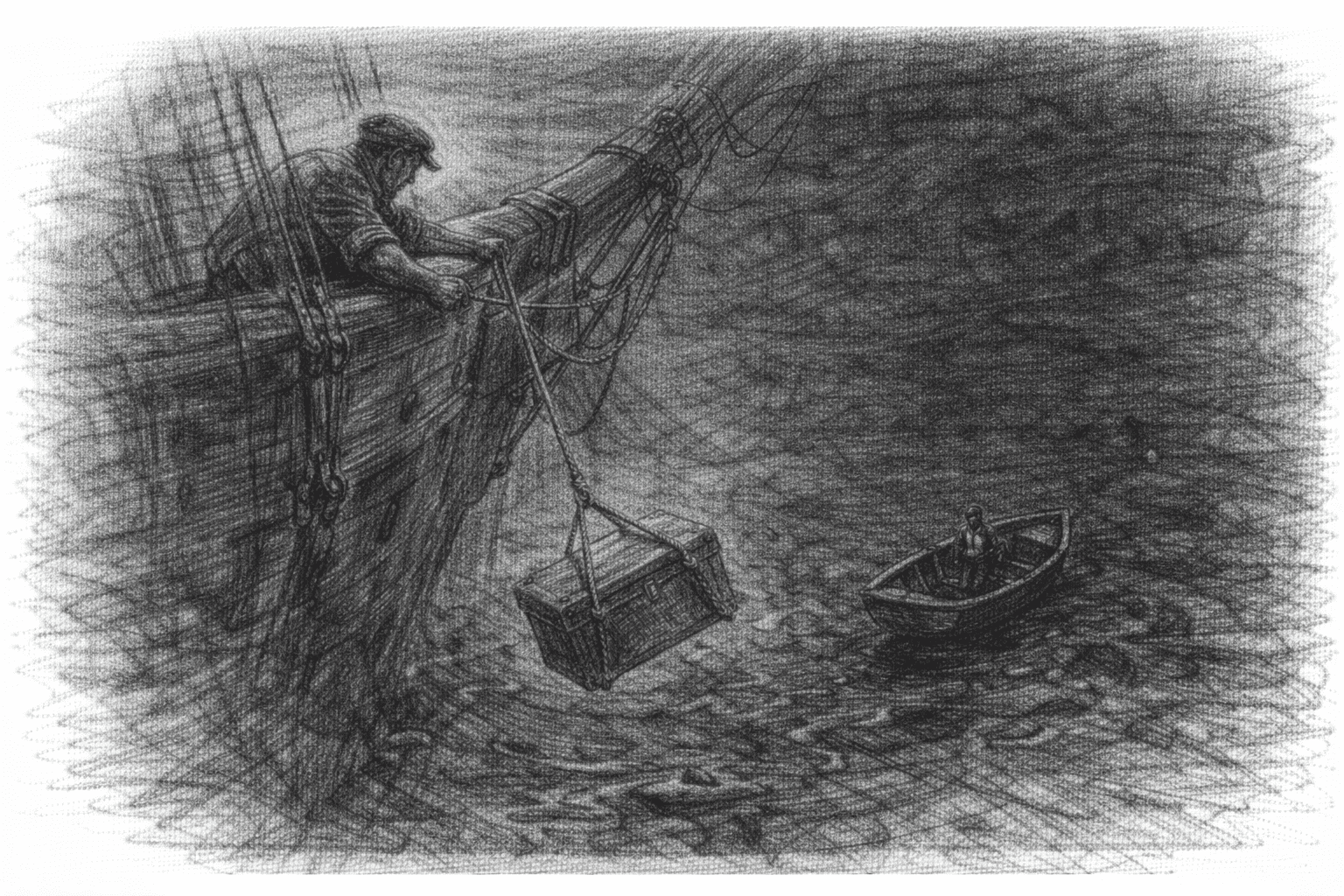
At about 11:30 PM the steward came and called me. I was really asleep. He said the mate was now in bed. Out on deck I went and there I saw a head sticking up over the gunwale. It was the Swedish cook, and he had the boat ready at our bow. I went back and awakened Thomas, telling him to be quick, as everything was now in order and the coast was clear.
He was sleepy and not quite sure of whether he wanted to go or stay. 'You do what seems best to you', I said. 'But I am going'. Soon he began to gather up his belongings.
We got our chests up on the forward deck, and were letting them down in the boat. But there was a lighter lying in the way, so we had to put our belongings first on it, and take them from there into the boat.
Everything went quietly until we had to take my chest, which was heavy. I did not tie the rope on it as securely as I should have done. It fell on the lighter with a thunderous report. I was afraid one of the mates would hear it and be on our neck in a minute. But they must have slept soundly. We had got our things in the boat and were about to move away when someone came running along the deck. He had some big hard seaboots on, and on the planks of the wharf they made a great noise.
We thought it was the officer and that now we were caught, until we learned, to our consolation that it was one of our own boys who had been sleeping when we went out but now came to bid us good-bye. It was comical, but he nearly scared the life out of us.
Then we rowed out on the river where it was dark and we could not be seen from the wharf, and we came to a landing at the end of a dark street, took our things up and got them into the boarding house, and were in bed by one o'clock.