
We received orders to take in ballast and go to Wilmington again, for another load of Resin.
It was now toward autumn. The captain believed we could gain time by going southward and getting into the tradewind.
We went out and the wind was favorable. Down the Channel we passed in a few hours. Coming out into the Atlantic we met a gale from northwest. In that we lay southward at great speed toward the belt of the tradewind.
The captain was in splendid spirits and mentioned that this would probably be the most rapid voyage westward he had ever made. But when we reached the tradewind it was so small and faint that it hardly made us move, and ended in a dead calm.
Storm and bad weather often wearies a sailor, but nothing is so tiresome and depressing as a long continued calm. It was like sitting in a prison, with no way of escape, rolling with the slight swell, the sails flapping from side to side, night and day; it makes one wish it would blow so every sail would bulge and every spar bend in the gale.
We drifted into an area where the water was covered with a kind of green seaweed, delicately branched, and with small yellow berries, the size of peas, growing on it. As far as we could see in all directions the sea was covered with this yellowish green vegetation. And here and there we could see the backs of turtles, out of water, basking in the sun.
There was nobody in our ship who cared much for turtle meat or soup, so we did not bother to set out a boat and try to get turtles.
The protracted calm had a deadening effect on the singing habit of our captain. We lay becalmed for a week or more; and there was no singing on the promenade deck. Then one afternoon, while he was walking up and down the deck, and I was at the wheel, he said to me: 'I have heard that when a sailor desires a favorable wind to take him out of a calm he must scratch at the mast with his finger nails, and whistle. I have had no faith in it, but now I think we better try it.' Then he went to the mizzen mast, scratched it, whistled long and loud to the quarter from which he wanted the wind to blow, and said: 'Now, we shall probably get some wind.' And then we laughed.
There was no sign of wind then. But towards evening that same day we had all we could do to furl and tie down sails until nearly every one had been taken in. The gale that blew was so strong that we had great difficulty and terribly hard work to shorten sail. But there was no complaint, because we had at least been relieved of this monotony and hopelessness of the long calm.
When I was at the helm again the following night, the captain mentioned his act of whistling for the wind, saying: 'I have never done that before, and I shall never do it again. The powers in nature are not to be mocked. One may get more than he can endure.'
Storms can be violent enough in these waters, but are usually not lasting. We soon found out it was necessary to set sails again, and before long we had all our canvas stretched.
One afternoon, while I was engaged at some work in the mizzen-rigging, the first mate comes up on the storm deck and, looking up he noticed the mizzen topsail sheet to be slack, and called to the carpenter, who was also there, to help tighten the sheet. The sheet was a chain and did not run very easy. They pulled and pulled, but did not gain an inch. Then the mate said to me: 'Come here you bear, and give us a pull.' As before said, I did not like to be called bear, as it seemed to be used by him for a nickname. And he and I were not the best of friends.
I had to obey orders. But now I thought of playing a little game of getting even with the mate. The carpenter and I were, as before said, the best of friends. When I joined them I gave the carpenter a gentle hint, which he understood, and we pulled with all our might. The mate was not expecting the result, as we were, when the three foot slack was taken up, and he dropped, seat first, on deck. We did not dare to laugh at his mishap.
He raised himself quietly, and, with pretended meekness, said: 'I noticed it was the bear that came.' So he fastened the sheet, indicating he did not want any more assistance from the bear.
The trade wind, though mild, continued. The second mate, in order to please the captain, who was in haste to reach our destination, kept us busy on deck during the night watches with many efforts supposed to speed the voyage. This was all well enough, but to keep up shifting, bracing and squaring sails all the time, when there was no change in the wind, only to please the captain and gain his favor, and without any actual gain in speed, we thought was useless. The carpenter and I uttered our objections to this, but the mate was conceited, and let us understand he was in command.
One night this became very wearisome. There was a constant disturbance. I protested several times, without result.
The main topgallant brace had to be hauled very close. We sang out, and pulled, making the brace as tight as a fiddlestring, and I mentioned something about a wish we could pull these braces to pieces. 'Yes,' said the mate. 'I can well Imagine you would like to do that, but, luckily, you can't.' Then I made signal to the carpenter, and whispered, 'Pull', and as we did so the brace broke. 'That was good,' I said. 'You think so,' said the mate, and then he sent the carpenter up to splice the brace. He did not trust that I would do it well enough.
When the carpenter came down, I said, 'I wish we could break it again.' Then we pulled hard, and sure enough, it broke and we flopped on deck. 'that was well done,' I said again. The mate said nothing, but sent the carpenter up to splice it again. Then he sent us away and tightened the brace himself.
From that time there was no more disturbance at night, unless it was really necessary. But the brace must really have been rotten, otherwise we could not have broken it. The result was a piece of good luck for us, as it resulted in a little more rest and peace during our off-watch hours at night.
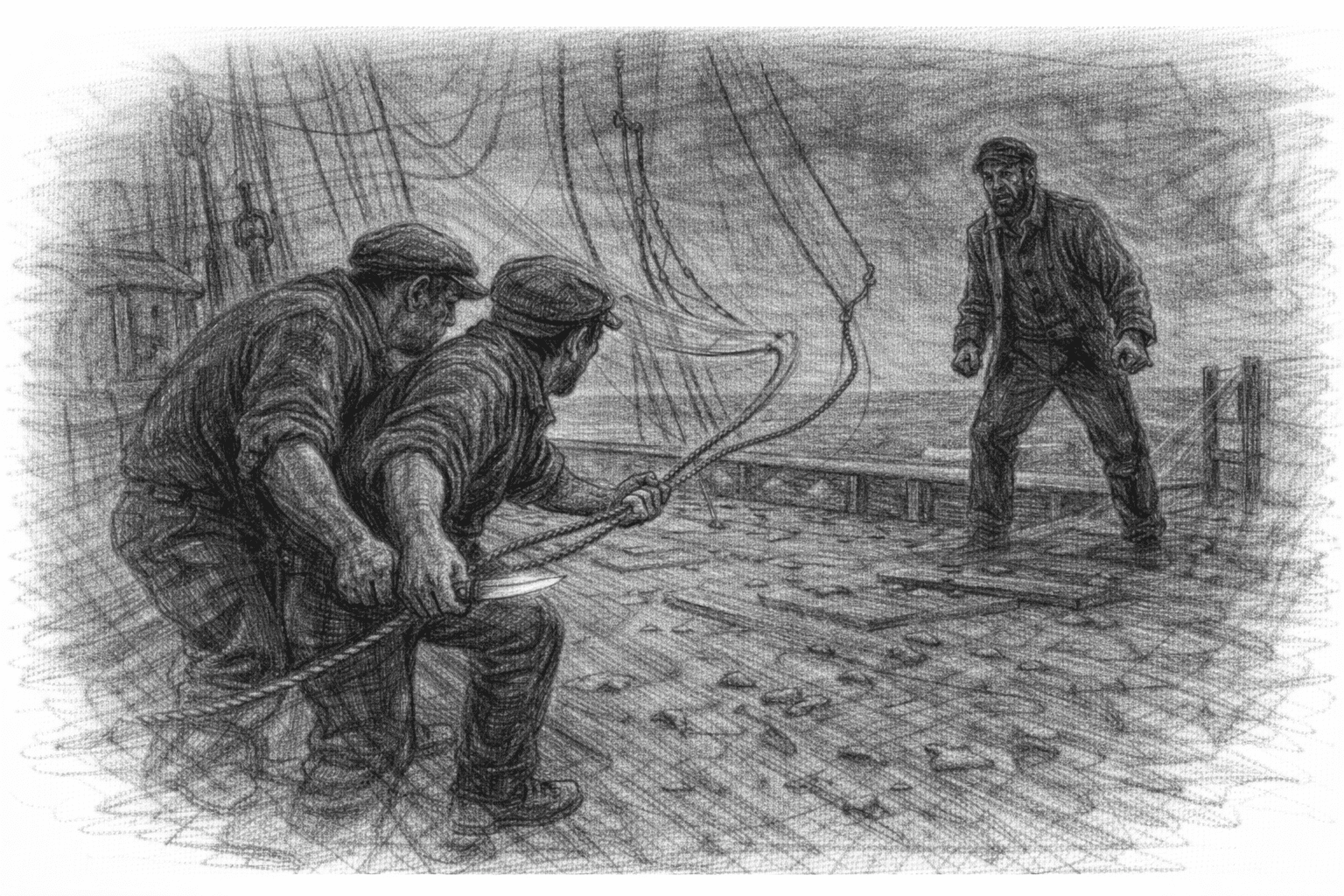
For one reason or another the first mate was almost constantly out of sorts. He bawled us out and swore at us no matter what we did. He had no good reason to do so, and we decided we would not tolerate it. When he scolded we talked back. Then he lost control of himself. Once during such fit of anger he struck Thomas in the face so the blood flowed from the wound. Thomas did not dare to strike back, as the mate was bigger and stronger than he was. I was angry but did not know what to do. If I tackled him, I could not say it was in self-defense as long as he had not attacked me personally. And to make attack on an officer would be to my disadvantage if it came before a maritime court. So all there was to do for me was to swallow my rage for the present, but it was not easy to do so under such circumstances. I knew he would have struck me too if he had dared. If he had done that then the two of us would have handled him easily, and given him all the punishment he deserved.
Finally we reached Wilmington, N.C. Here we were acquainted since our sojourn, about a year ago. But I had no idea that here was to begin a most interesting chapter in my experiences as a sailor.