
Now, for the first time, I was about to cross the great Atlantic Ocean. It was now autumn, and the weather was not always fine, so we had a great deal of exercise, to reef, furl and set sail, and tacking; but, as before mentioned, we had a very good ship and the weather was not worse than we could easily manage everything.
In the meantime, I must mention that Olava was not forgotten. I had, of course, written her from Archangel, received letter from her, and written to her from Cardiff. And, in passing, I may mention I did not think it would do to write to her on common paper, so I had bought the best in Cardiff. The person who sold it understood what it was for, and showed me some very dainty and elegant paper, lace-edged with colored silk fringes, and with floral design in delicate colors around edges of paper and envelopes. But I learned they also had elegant stationery in Stavanger. We had a great collection after we came to reside in the United States and many years later, but they gradually vanished or were lost. I would give a great deal for them now. These letters I read then, over and over, and my thought was often there at home with her, while bodily I was in this 'Hjemmet' home away out on the Atlantic Ocean.
It took us about three weeks to cross the Atlantic. Then, one day, we saw land.
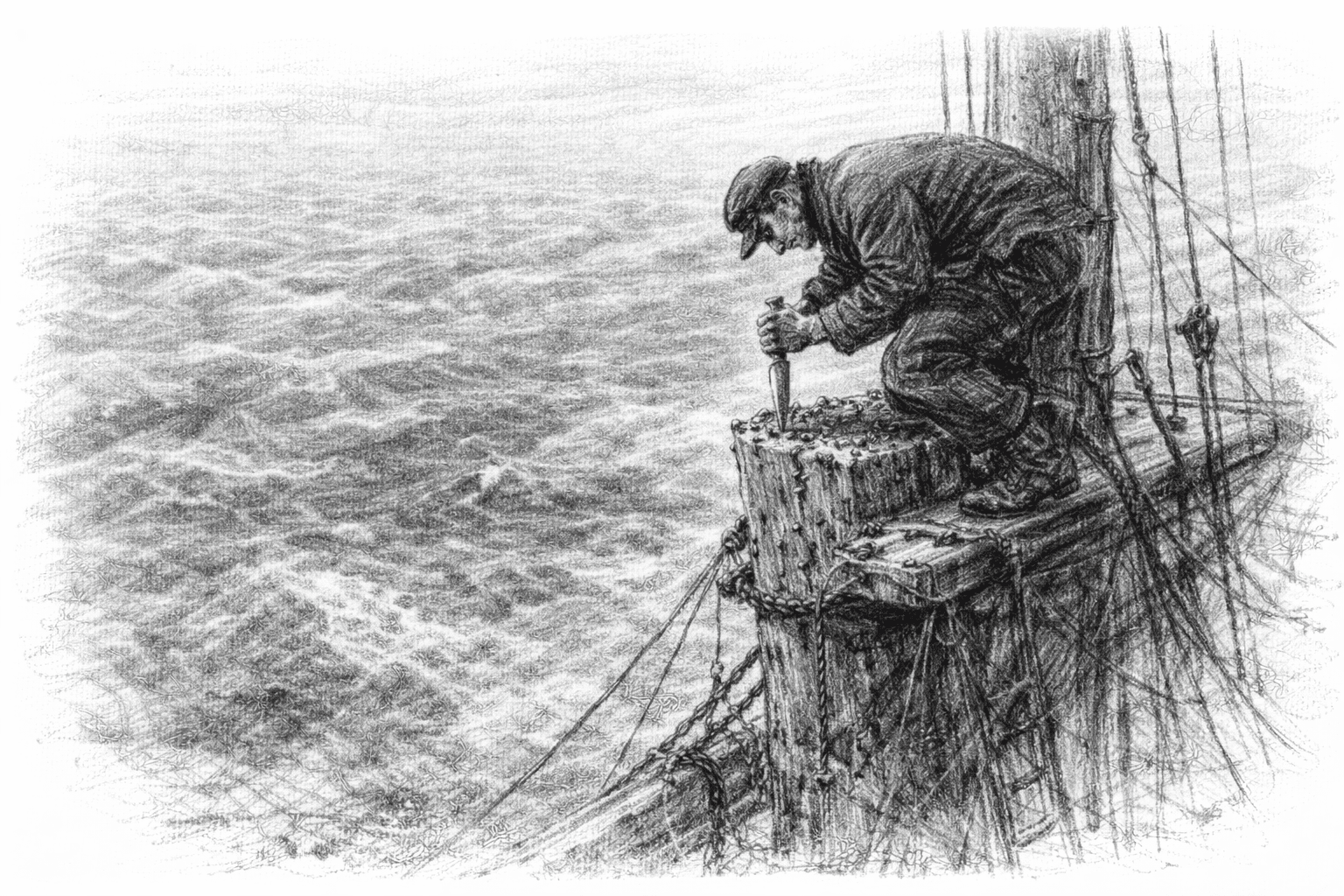
The mate came to me with the Norwegian flag and ordered me to go up and fasten it to our foretop. The flag on the foretop was among other things as sign that we wanted a pilot. I took the flag tied it round my neck, took some rope yarn and a strop or sling, and went aloft. When I came up to the cordage gear, at the very top, I found there were still ten or twelve feet up to the little globe on top of the mast. From where I stood, on top of the cordage, I reached up as far as I could and fastened the stop, then, straightening up, I could reach up to the little sphere on the top. And I began to fasten the yarn for the top corner of the flag right under the sphere.
The ship side-reeled considerably. I noticed that the top was not exactly following the motion of the ship, but seemed to be very unsteady. It was not easy to stand and work up there, holding on to the naked mast, and I had to use both hands to put the flag in place. But the wiggling of the top made me nervous. There was something wrong about it, and I must find out what it would be. I went down to the cordage head again without fastening the flag. Here I took out my jack-knife and tried to stick the point of it into the mast, and found that I could sink it clear to the handle in several places.
It frightened me when I understood how I had risked my life on the rotten mast-top. I went down and told the officer I could not put the flag up under the sphere because the top was not safe to climb. So he said: 'Go up and place the flag as far up as you can without danger to yourself; that will do well enough.' And I did as I was told.
When we came into harbor the foregallant top was taken down, so the carpenter could make a new one before we had to go to sea again. When the old mast was taken down and lay on deck, I took it in one end and lifted and it fell down, broken by its own weight. It was a wonder it had not gone overboard with me when I tried to put the flag at the top of it.
We got pilot on board, and stood in to the mouth of Cape Fear River, on which Wilmington, N. C., is located. It was low ebb, and we had to anchor up and wait for high water before proceeding to the docks.
Here we saw some low skerries and, upon question, the pilot told us they were oyster-banks. We set out a boat, took two large ballast baskets, and rowed over to the banks. We found they were a solid mass of oystershells, mostly empty, but enough live oysters on top to fill our baskets in short time. When we reached the ship with them we had a feast.
As soon as there was sufficient depth of water we brought the ship up to the wharf, which was made of planks. And there was a horse-power crane, by means of which we discharged our ballast in a comparatively short time.
Wilmington, N. C., was at that time not so much of a town, but was prettily situated on a little incline from North toward the river. There was much cotton grown in the vicinity, and considerable export of it, and also resin and turpentine. The population was mostly Irish and Negro. The wharf was extensive. Many ships could be moored there at the same time, discharging or loading cargoes.
When we had unloaded the ballast the ship had to be moved to another place, where the resin was stored. While this was being done, I had a comical mishap.