
Shipping-master Helland was a well known character in Stavanger. He did nothing else than go around and pick up crews for the ships. One could recognize him far away, by his long neck. I met him, and asked if he could find me a place on a good ship. 'Yes,' he said, 'there is a place on a very fine bark, by name 'Hjemmet', belonging to Heling company, ship-owners, where a crew is to be engaged for two years.'
Captain Tollefson, of this ship, was a likeable man, originally from Sand, but now residing in Stavanger. If I cared to engage, Helland would recommend me to the captain. Nothing seemed more to my liking, and I took place on this ship. In it I could be away and at home at the same time, as its name meant 'Home.'
The ship was to sail in about two weeks, which I was glad to know. As soon as I had hired I went home to Finnøy to get my belongings, and be ready to leave at any time. While thus waiting for the day of departure there was little to do but to visit Olava and have enjoyable hours in her company. She came to town in a rowboat every day. She liked to handle a rowboat. I found out she knew all about how to sail in it as well as row. We tried to sail a race one time, and she won.
There was another boy from my neighborhood, or rather from Stjernerøy, who had done farm work at Finnøy for some time. His name was Thomas, and he was a wild chap. He was also hired as a man on the same ship. Thomas had also found a girl, or, may be she had found him. She was a schoolmate of mine from Finnøy. There were also three or four other young people from Finnøy staying in Stavanger at this time, attending an important religious conference. Many people from various parts of the adjoining countryside attended these meetings, which were held in Bethania Hall, a room which held about 3500 people. There were many good speakers. We went to hear them frequently. Olava belonged to Hetland parish, where Lars Oftedal at that time was chaplain and old Sagen was pastor or provost.
As young people, we often gathered for special social hours. I remember at that time having some photographs made, of which I gave on to Olava, and she also gave me one of herself. Yet, no word had been mentioned of love, but we understood each other perfectly well.
Time came when the crew had to be mustered in, and we went on board, and on a fine day about the end of July we weighed anchor under a lusty chorus, while relative and friends looked on from the piers. There were many good singers on board this ship, including the captain. The handkerchiefs waved from shore, as long as our ship was in sight. The feelings, as I remember, were rather sad, especially when I thought of 'the girl I left behind.'
But we were busy, putting everything in sailing order, so the thoughts of parting with home and friends were gradually dismissed. Soon we passed Skudesnes, and set a northerly course, toward the midnight sun. We were to pass the north Cape and our destination was Archangel, Russia, where we were to load lumber, for Cardiff, England.
The crew was divided into starboard and larboard watch, and I became part of larboard watch with the captain and second mate, who always were on that watch.
As before mentioned, I found the captain to be a fine man, of middle age, friendly and agreeable, and a very good singer, who often stimulated good humor and gladness by his splendid voice. Second mate's name was Pallesen. He was also generally good-natured. There were two things about him I did not like: He was too conscious of his dignity, and constantly trying to gain favor with the captain. He was probably 30 years of age. First mate was a middle aged man, with a heavy, brown full beard. He was mostly agreeable, but quite capricious, hasty and not very careful in preserving harmony in the crew. The carpenter was from Tau, near Stavanger. He had just been married, and his wife took the parting very hard. I believe his name was Bertel, about 25, good-natured and attractive. Great friendship developed between us, about in the same manner as with the carpenter on my last voyage. He was also on larboard watch. Then there was a seaman, Theodor Halversen, son of Captain Halversen of old 'Harald Haarfagre', that sailed so many voyages to Pensacola for pitchpine. Theodor was 17-18 years old, somewhat wild, but hale fellow, well-met. The boatswain was the only elderly man in the forecastle, probably over 45 years old, somewhat stooped, very thin, with a wrinkled face, somewhat jolly of disposition, except when he was called out at night and in nasty weather. At such times he could grumble fearfully at the dog's life of a sailor. Also at breakfast, and possibly at after-dinner coffee, when the half hour seemed too short for his tale of woe. While the rest of us could east and then take a little smoke, he would complain that there was not even time given a man to eat in peace. I believe he ate as much as three ordinary men. He was an excellent starter of song and chorusing when there was pulling to do on sheets, braces and halyards. He could 'sing up' to be heard all over the harbor, even if quite large.
The steward was an old man who was married to a woman much younger. He could not obtain a job at home, and I believe the captain had hired him to give him a job, but had to send him home. The steward had quarters aft with the officers, and was not on either watch.
Other members of the crew I do not distinctly remember, but we were nine in the forecastle, all young fellows, except the boatswain. I must mention also a young man from Jelsa, but I do not recall his name. He was a first-class comrade. He later became a student. He was one of my best friends.
This ship was in many respects an extraordinary craft. I never saw another like it. Not very large, but built of oak throughout, ribs and sheathing, very strong. It had been built in Bremerhaven, Germany, for passenger trade on Australia, before the days of steamships. It had upper or hurricane deck from aft to the hatch before the main mast. This upper deck was 7 feet over the main deck, making the appearance of the after part rather clumsy; but forward its lines were beautiful. A little distance from the stern the storm-deck had been lowered 3 or 4 feet, so the pilot house did not extend above it. Everything on board was made for convenience and easy handling. There were patented blocks and tackle, so that, for instance, in tacking the yards would come around with very little pulling. And for seaworthiness I never was in another ship so able as this. Even in the worst kind of storm, when we had to heave to and ride it out, she seemed like a gull on the sea. Similarly, with steering, she minded the helm quicker and better than any other ship I ever steered.
And with a crew of fine fellows, good comradeship, good fare, an agreeable captain, and mates – not bad, what more could we wish? This ship named 'Hjemmet' was as good a home as we could wish under the circumstances. The ship was also a good sailer that would not lag behind any other. The weather, with sunshine and favoring westerly breeze, was tip-top.
The days lengthened as we advanced northward. Soon we reached the latitude where the sun did not go down, but followed the northern horizon eastwardly during the night time, rose less high at noon and a littler higher at midnight as we advanced northward. We set our course far out to sea for safety, in event of coming storm. There is nothing more dangerous for a ship in storm than to be too near land where there is no harbor and a rocky coast. Thus, we saw little of the coast of Norway; only once in a while a mountaintop became visible far to the east. That Norway has a long coast one may find out by sailing from one end of it to the other. How long it took I do not remember, but finally we shifted course, more easterly, came in sight of land and saw the North Cape. We passed it quite near, possibly 5 or 6 miles away, so we could observe its rugged contour very well in the clear sunshine.
Ever since my childhood I had heard much about the North Cape, so I was curious enough about it. It is a big promontory. rising perpendicularly out of the ocean. The top of it was nearly level, leaning slightly toward the north. There was no building or structure of any kind that we could see on the top of the rock.
It was rather queer experience to go to bed while the sun was up and always find it up whenever we were called out or came on deck. It was either in the west or north; east or south.
Soon we lost sight of land again, came into the White Sea, and shifted our course to southeast. Here I saw a sight which even the sailors do not often sea.
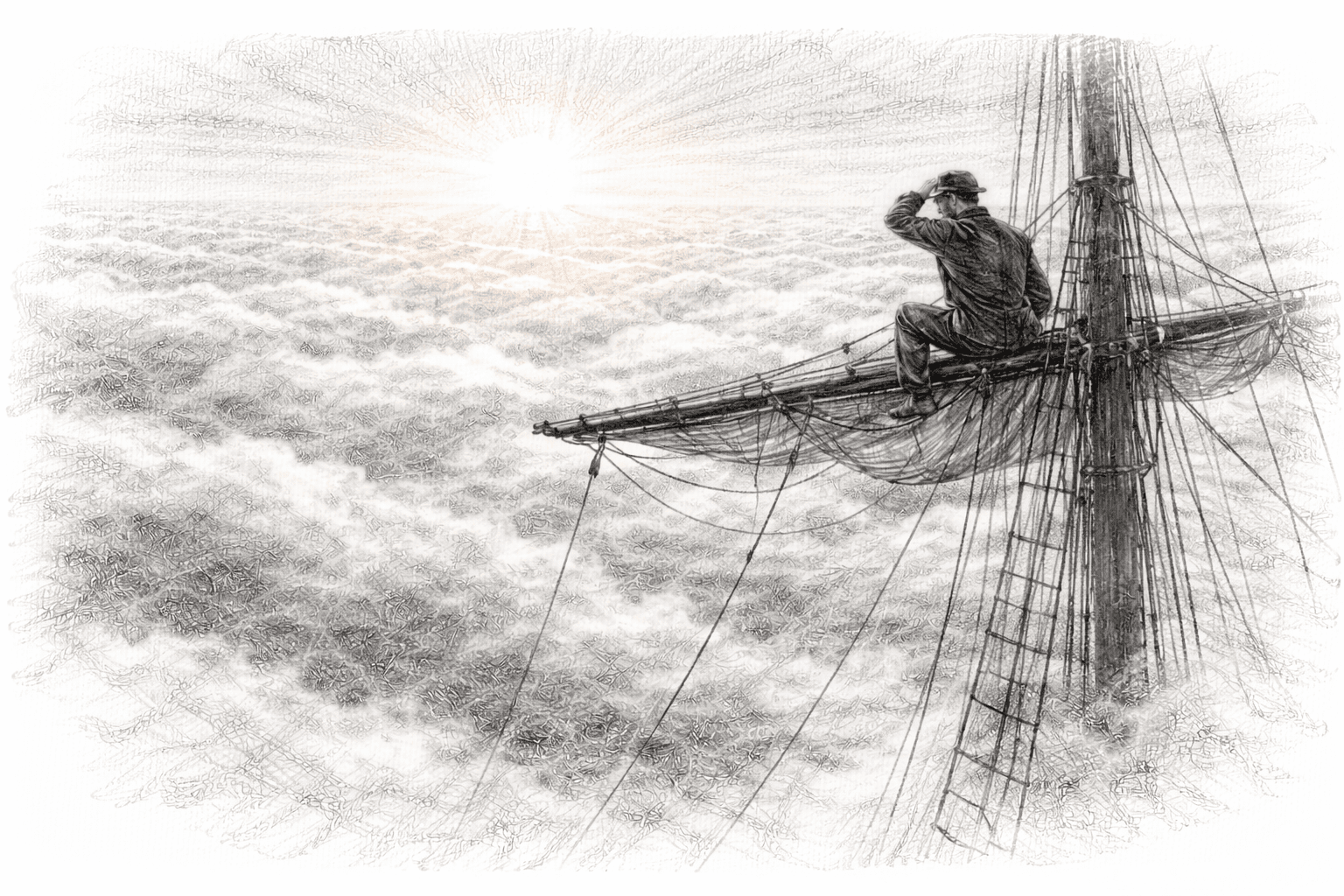
We ran into a heavy fog, as heavy as I have ever seen, and the temperature fell, so we had to use mittens when at the wheel. I was sent aloft to do some work; and when I came up on the upper topsail yard the sun was shining as clear and bright as ever. But the surprising thing was that when one looked out over the horizon it appeared like looking at the ocean itself, the fog going in billows like the sea, and at the horizon there was a sharp contrast between air and water. I look at it for some time, and was uncertain whether it was the sea or the fog that rolled in billows. Had it not been for the white color one would have said it was sea, - the White Sea. I took time to observe this wonderful phenomena. As soon as I went down below the upper topsail yard the fog was thick, and down on deck it was rather dark. It seemed as if we sailed under a sea, with only the top of the rigging over the surface. I told the members of the crew and they all went aloft to see the wonderful sight.
After a while we came out of the fog, and saw land ahead. It was Russia. Soon a pilot came on board. We headed in toward the mouth of the Dwina River, where lies the city of Archangel.
There were no tugs here, as in many other harbors in those days, so we had to sail clear into the town which, however, was not so very far from the mouth of the river. The coast was low and the land overgrown with large pine woods. The mosquitoes were also large and numerous, and did not ask for leave to come onboard.
The town was small, and, as it appeared to me, hard favored. There was only one ordinary street. Beyond that the gray huts were spread out over the flats, among the big tree-stumps. All wharves were built of slabs. The men of the common variety, were full-bearded and dirty looking; and the women were both thick-set and swarthy, with coal-black hair. Black was also the general color of the hair and beard of the men.
The bread used by the laboring men in the town was course, almost black, rye bread, on the top of the loaves of which there had been baked in a salt herring, which served instead of butter.
One of the most memorable things about this town was the strong 'Russia-smell.' Every one and every thing had this smell. We bought some articles of fur, caps, mittens, etc. We believed the smell would gradually leave these things. But not so. We had to throw them all overboard eventually. We also bought some of the renowned Russe bowls. Big wooden bowls they were, very artistically painted and lacquered. And we bought some boxes or baskets made of birch bark, carved and colored very fine. These we determined to take home with us; but it took years before the Russia smell came out of them. I could not find out or imagine what that smell came from. It was everywhere and everything was permeated with it. It was worse than the Negro-smell in Jamaica.
There was big export of rye, oats and linseed from Archangel. All these products came down the river from the south, in big lighters. The lighters were built of small tree trunks, split, and round side turned outward. They were flat-bottomed, with upright stem and stern. Limbs of trees were bent to form the frames for gables and the rafters for roof. From the distance they appeared like loghouses with rather flat roofs. These boats or lighters were loaded with rye, oats or linseed, far up stream, and floated down. None of them were ever taken up stream again, because there were no tugs; so they were shunted aside into some bayou when unloaded. A new lighter had to be built for every load that came down the river, but they were so large that each of them held nearly a ship-load. I have never seen such lighters as those anywhere else.
We discharged our ballast, took out the bow port-lid and commenced to load planks. The crew had to do the loading. We received the end of each plank into the port hole, and from there we had to carry them to the hold and stack them. It was fairly heavy and slow work, and it took us 2 – 3 weeks to take in our load. Our hips were sore before we got through.
Then leaving the place we were glad to come out to the clean and fresh air of the open sea again, where we heard no more the phrases, 'Da da' (yes), and 'Njaeto' (no), or 'volsjen dobra' (very well).
The weather continued fair, and when we came opposite North Cape a smacking breeze of north came up and sent us flying south-westerly down between the Faroe and Shetland Isles, on past the Hebrides and down the St. Georges Channel to the mouth of Bristol Channel. Here we were taken by a tug and pulled into Cardiff at high tide.
When our ship had been moored at the lower end of the dock, and everything had been cleared up, I went over to the other side of the dock for some purposes, and there I was told I could go down and inspect the dock gates, crossing on a narrow plank bridge for that purposes. When I came down there I was surprised, indeed, and hardly able to believe my own eyes: The sea had fallen away below the dock. There was probably 25 feet from the now bare and slimy bottom to the top of the gates. Quite a distance out there lay a two-masted schooner listing on its side, aground, and far beyond it, probably a half mile, I could see the water.
Flow and ebb tide in this place may vary as much as forty feet. I had never seen the like before, and was quite astounded at the sea drying up like that in a few hours.
Cardiff was a good-sized city, lying on the west side of the docks. On the east side there were only coal-chutes. It was the place of greatest coal export in England. Several hundred ships were in the docks at the same time. I believe it was said the docks were two miles long, and they were wide. One story I heard was that one man owned practically the whole city. My thought at that was, if this were true, he ought to have put up better houses than the miserable tumble-down shacks in which the laboring class lived. They were in great contrast with the big and extravagant looking business buildings and homes of the wealthy class. But he probably knew the laborers could not pay the rent in better quarters.
Eventually, our cargo was out, and we took in ballast, as we were ordered to proceed to Wilmington, North Carolina, U.S. It did not pay to take coal to America. A tug took us out to sea at high tide. I saw no more of the slimy bottom outside the dock. Well clear of land, the tug came alongside, received the pilot, and we set course westward.