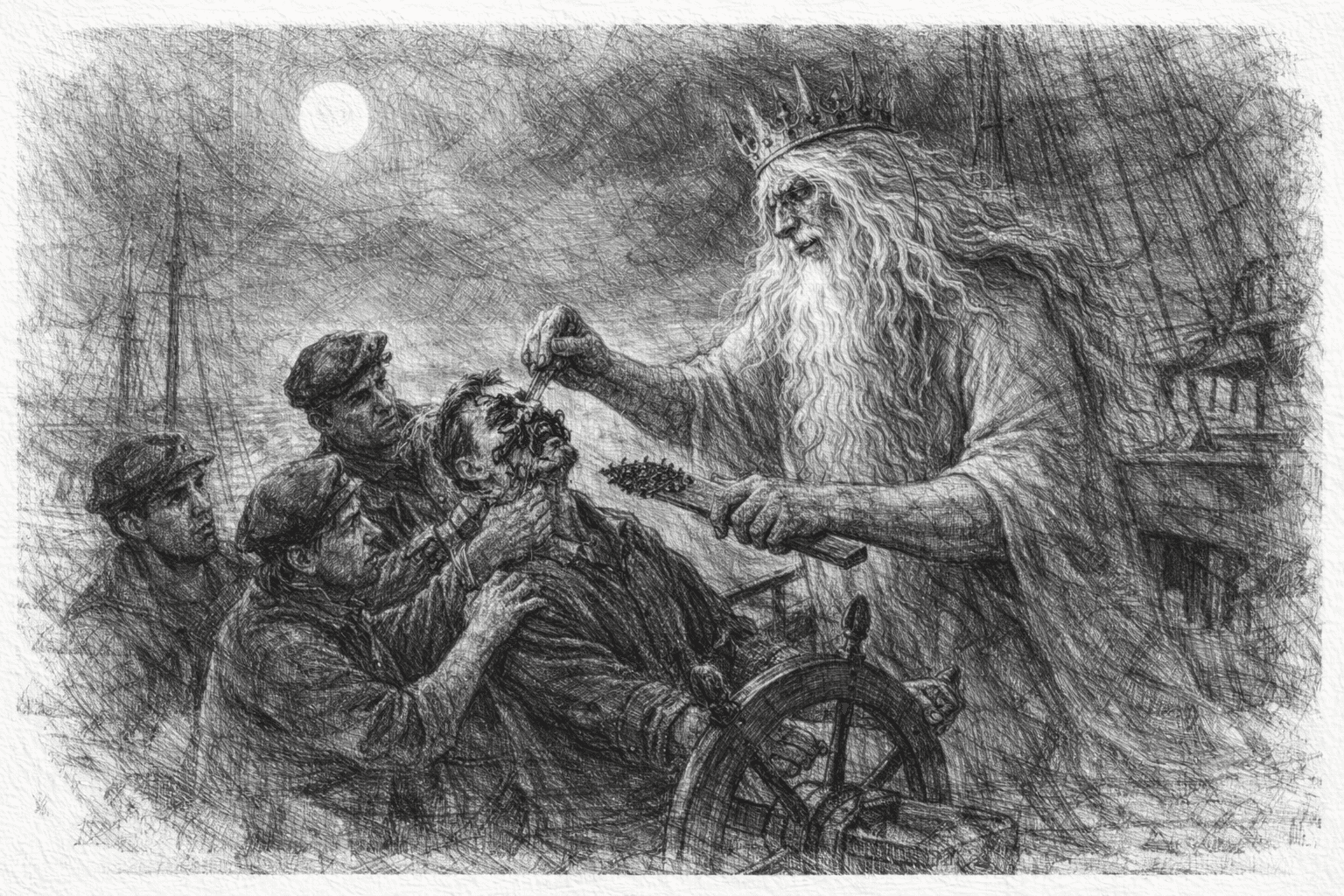

We were nearing the Equator. There is a maritime fable, known to all experienced sailors, and sometimes so vividly related as to be quite effective on the novices, who are approaching the Equator for the first time. The story is to the effect that, just as the ship goes over the line the sea-god Neptune comes aboard for a visit. If he then finds a man onboard who is bearded and who has not crossed the Equator before, such man is liable to have trouble. The easiest treatment he may expect is to have his whiskers shorn before he goes over the line. But if he resists Neptune may take him along when he goes back into the ocean.
Now, we had a steward onboard, a middle-aged man, from Farsund, who had a great, heavy, black full beard. He was the only bearded man onboard who had not crossed the Equator before. He was warned by the other boys, several days in advance, that he better get rid of his beard before we came to the line, but he took it to be only playful sport, though it was made in all apparent seriousness.
It was a fine, moonlight evening. We had eaten supper and the men had gathered on the forward quarterdeck for a social hour. The steward was among them, and he was a jovial chap and a good storyteller. The conversation eventually ran into the subject of Neptune. Someone mentioned that the officers had said we would pass the Equator that night. No one then had the desire to be in the position of the steward with his big whickers. He only laughed and scoffed at the idea of any visit by Neptune. Well, let it be as it may the boys thought, he may put in appearance at any time.
And, sure enough, there comes an apparition up the deck from aft, big and swaggery, with broad shoulders, capacious stomach, long, white hair and beard flowing like waves around his shoulders, and a crown on his head that shone like gold in the moonlight. In one hand he carried a pot, in the other a menacing knife about 30 inches long. 'There he is,' said someone. The steward arose and wanted to get away. But Neptune called out in a course, hollow voice: 'I am Neptune. Hold him.' Some of the boys then took and held him. Neptune comes up on the quarter deck and says: 'No man with a beard is permitted to pass the boundary of my realm for the first time with his beard unshorn. Sit down. Your beard must be taken.' The steward sat down, not saying a word, while a couple of the boys still held him. Neptune then takes a big paintbrush, dips it in a mixture of grease and soot which the pot contains, and swabs the whiskers and face of the steward with that for a lathering. Then he takes the big knife, which was of wood, and scrapes the steward down the cheeks and chin, the black grease dripping from the knife. The whiskers then remained pressed and stuck close to the face, and the victim looked like a shiny nigger.
We did not dare to laugh aloud under this serious and impressive ceremony, though it was difficult to keep quiet. 'Now I have shaved you and you may pass the line,' said Neptune. With that he bade good night and prosperous voyage, took his pot and wooden knife, dropped silently down to the main deck, and disappeared abaft. The steward continued silent. If he knew it was all a farce at his expense, he was wise enough not to become angry. It was, of course, some consolation that he still had his big, black beard. But it would require a good and thorough wash to get all the grease and soot out of the whiskers and skin.
I never found out who was acting Neptune; but he certainly played his role creditably. The steward seemed to carry no ill will or idea of revenge to anybody but was genial as before. He had now been solemnly initiated and favorably passed on by the god of the ocean himself and could now sail the southern waters forever without further lot or hindrance.
Well south of the Equator the polestar went down, and the Southern Cross appeared, and it continued to turn around apparently in the same spot. It was a beautiful constellation.
After some days we came out of the belt of calm and variable winds, and into southeast tradewind, and now it was to lay at bywind south-south-west under full press of sail. The breeze became stiff, and we made good time. Here we had easy days. Not a brace or sail was shifted, day or night, as the wind was steady and even from the same direction. And the temperature was suitable and pleasant. We sailed thus toward the southern point of South America Africa until we were in latitude about 40° South. There we came out of the southeast tradewind, and soon we found the wind changed to west, another tradewind which is said to blow in that direction here all year round. It blew a brisk gale. We had to shorten sail, leaving her scudding under reeved topsails. Thus, we bowled along for about 3 weeks on a straight easterly course. Our speed was about 11 knots per hour; and we were passing about 500 miles south of Cape Good Hope.