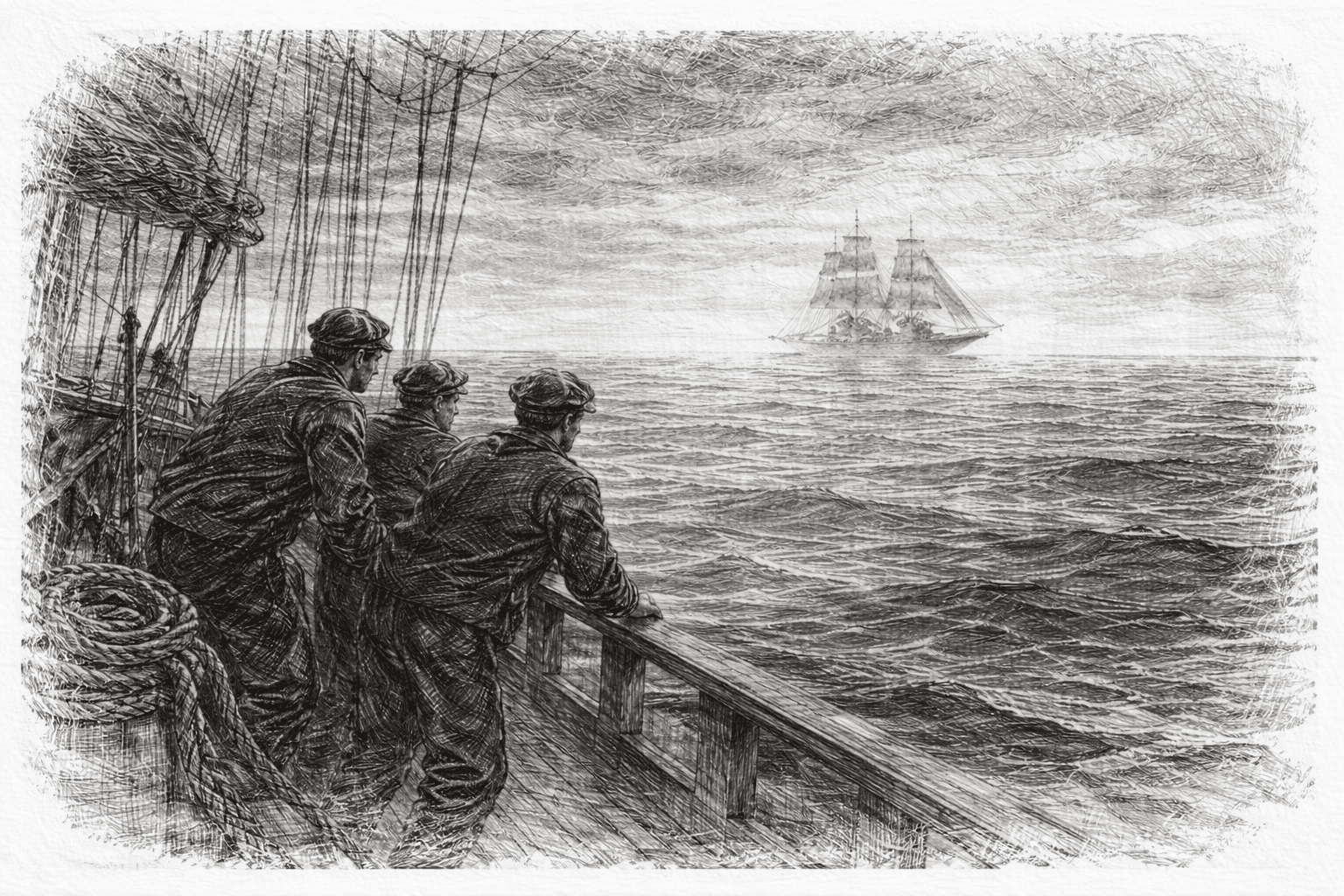

On one of those days while thus crossing the southern Atlantic we saw a sight that has always been a mystery to sailors, namely, the Flying Dutchman, or 'Death Ship'. It was shortly after noon; we were engaged in some work on deck. The air was clear and visibility good. We had not seen a ship since we got out of the British Channel, though we always looked for ships. All at once we saw a ship right to south of us, apparently about 8 to 10 miles away. It was a bark, and sailed the same direction we did. We could see it very plainly. It also had reeved topsails like our ship. Some of the boys asked: 'Where did that ship come from so suddenly? Did anybody see it before?' 'No,' nobody had seen it until all at once it appeared right opposite. We stood and watched if a while and were glad we at least had seen another ship. For about 6 weeks we had seen neither ships, land or anything but sea and sky. After we had looked at the ship for some time and wondered how it could have come so near us without being seen before, we became busy again and nobody looked at the strange ship for a few minutes. Then someone again looked in the direction of the ship, and called to the rest: 'What became of the ship?' We all looked up and out over the sea where we had seen the phantom a few minutes earlier, but no ship was to be seen anywhere. Then someone said: 'That was the Flying Dutchman. No wonder we did not see it while it approached us. It disappeared as rapidly and mysteriously as it had come in sight.
The story of it is old and has been related in various forms. Generally, it runs like this: At the time the Hollanders began to sail their ships to India there was among them a proud captain who wanted to complete his voyage in the shortest possible time. When he reached Cape Good Hope on his return to Holland there met him the stiff contrary gale from Northwest that frequently blows down along the west coast of Africa. But rather than seek harbor for a while and wait for favorable wind he set sail and began to tack against the storm. After a while, his officers and men became tired of fighting the gale and advised their captain to find a harbor and wait for fair weather. 'We shall round the Cape and up the coast of Africa without waiting for any abatement or change in wind or weather,' he said, 'and we shall do it if we have to sail in all eternity.' His words became his fate, as it is said, and there he is sailing to this day. So runs the story, but the fact is it is a mirage or fata morgana. The ship we saw was probably the reflection of a ship hundreds of miles away, and by some mirror effect in the air it became visible to us for a few minutes.
When we had come almost over to Australia we set our course northerly again, and there we came into the southeast tradewind, which was favorable till we again reached the Equator in the Indian Ocean. And here we had to pass through a belt of calm or variable and unsteady wind until we reached the northeast tradewind. When we came out of it, we had very fine weather and suitable winds until we reached Rangoon.