
We sailed around the west end of Cuba and then northeastward up through the strait between the Bahamas and Florida. The wind was now against us, but it was weak and, as the strait is narrow for tacking we did not try to do that, but braced our fore-rigging aback so we lay almost still with side to the wind, and the current carried us against the wind up the strait.
This current is the Gulfstream, which comes out of the Gulf of Mexico and runs here northeastward at a speed of about 5 miles per hour. When well out in the Atlantic, we set sail for England. We were to go to a little town, called Goole, 20 miles up the Humber river from Hull.
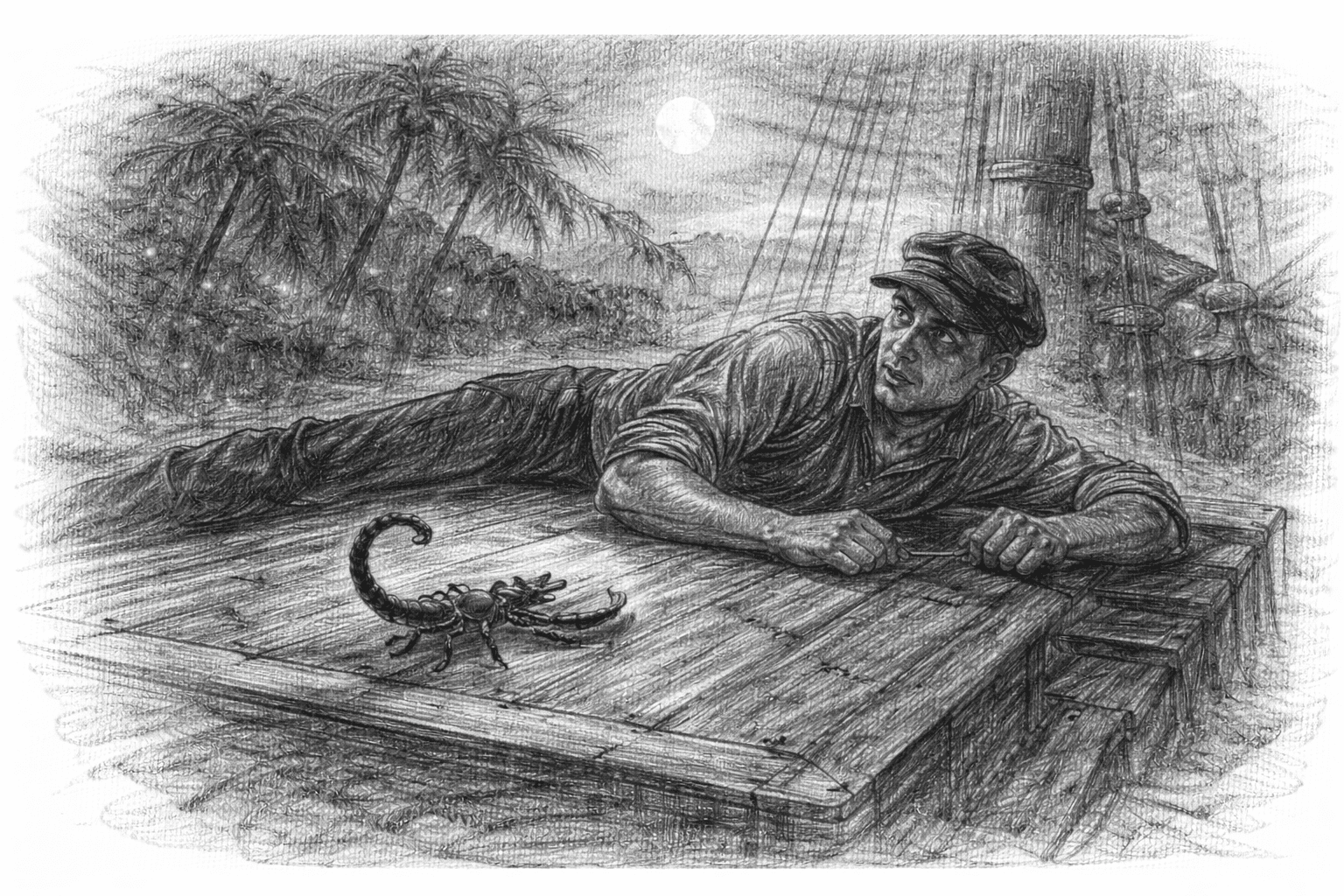
Not long after we were out of the strait of Florida, in a fine clear moonlight night, it was my watch on deck. There was nothing to do at the moment, so I laid down on the tarpaulin cover of the main hatchway, with folded arms over chest. The position was not quite comfortable and I lifted my head a little to rest more comfortably, and then laid back again. But it came to my mind that I had seen the shadow of something.
I looked up again, to make sure, and there right close to my naked arms was a big scorpion. Jumping up I saw the scorpion run across the hatch and hide in a hole or fold of the tarpaulin at the edge of the hatch-cover. Then I found a little stick and made the creature come out of its hiding, while, in great rage, it struck constantly at the stick. Holding it down with the stick it could not escape. Its body was about 1¼ inch long and ¾ inch wide. It had four feet on each side, and two claws at the head. Its tail was 3½ inches long, bent upward and had several joints, and a big sharp point at the end of it, bent downward.
When it struck it would lift the tail up over its back and then strike down back or to the sides. They are deadly poisonous. It was quite fortunate I happened to lift my head and see this enemy in time to avoid his strike.
Such bugs are not comfortable companions on board ship, and I disposed of it. There were probably many of them in the cargo, but they could not come on deck, as all hatches were closed. They had come aboard lodged in the holes or crevices of the logwood.
One day we were sailing in the Gulf Stream I happened to look and examine the sea-water I had hauled on board in a bucket. I was astonished to see in it a great number of insects or sea infusoria of various sizes and shapes, many of them being transparent. There were thousands of them in this small amount of water. I wondered if these were not good fish-food, and if it is not by reason of their presence in the water that there is so much good fishing in the northern seas, both on American and European shores.
This famous and wonderful Gulf Stream begins at the west coast of Africa, runs across the Atlantic at Equator, up along the coast of northern Brazil and Venezuela, into the Caribbean waters Central America and the West Indian islands, into the Gulf of Mexico, where it turns and goes out the Florida Strait, continues northeasterly across the Atlantic to the British Isles, Iceland and Norway, and disappears in the Arctic Ocean. Think of this mighty stream of food for all the fish, coming from tropical shores and bottoms, running steadily up to the northern coasts. Is not this the reason for the great abundance and also the good quality of the fish in northern Europe and Atlantic North America? The many small varieties of fish live on these small sea creatures and grow fat and trim; and then, as we know, the big fish lives on the smaller. True it is that there is an enormous amount of food carried by this stream from the great pantry of the tropics up to the northern waters. And the temperature of the water of the stream has a very beneficial effect on the climate of the northern lands. Once I measured the of the water in the Gulf stream, in the latitude of New York and found it to be 70° F. Before we came into the Gulf stream the temperature of the water was 50° F.
A very large tarantula had in some way got aboard our ship in Jamaica. It was about ten inches between the ends of the out-stretched feet. It was discovered, standing on the wall outside one of the bunks in the forecastle. By the use of a shoe or some similar weapon we tried to hit and kill it. Every time we struck at it, by some lightning speed it moved about 3 or 4 feet, and then sat perfectly still as before. First one and then another of us tried to hit it, but failed. Its movement was so rapid we could not follow it with the eyes. We had to abandon this attempt, as we could not hit it. After a while it disappeared.
Having come up to the entrance of the British Channel, one day we were about to wash the storm deck, as we had done many times since we left Jamaica. When the water washed in under a board at the railing a scorpion came out. It was rather slow in its movements coming out of the sea bath, but was more lively than might be expected after 3 weeks on deck without food. This was the last one of its kind that we saw on deck. After about four weeks from Jamaica we came in to Hull. We had a tug take us the 20 miles up to Goole.
Here I saw something interesting. The land was a broad valley and wide flats out from either side of the river, held to its course by high dikes. We went up on flow tide and at high tide the water was not so very far from the top of the dikes. But I believe the ship's bottom was then higher than the valley floor on either side of the river. It seemed as if we were on an elevated road. Very interesting experience it was to sail on a river probably 15 feet higher than the surrounding land. I saw windmills here and there, used for pumping water out of the land and into the river. This was evidently their draining system.
We came into the dock and began to discharge cargo. The wood was weighed as it was taken off the ship. A little platform scale was used, and the wood put on it in small bunches.
Here I had an opportunity to be weighed, and found I weighed 203 pounds, clothed in a light working suit. There had been a good gain in weight since we left the West Indies. We had had ravenous appetites and plenty of good food while crossing the ocean.