
Here we were in Jamaica, one of the most fruitful and productive islands of the West Indies.
There was a forest of tall cocoapalms on the hill-sides skirting the bay. Behind the town, which was situated at the end of the bay there was an extensive plain. There were large sugar plantations in the vicinity, and bananas and many other tropical fruits grew here in abundance.
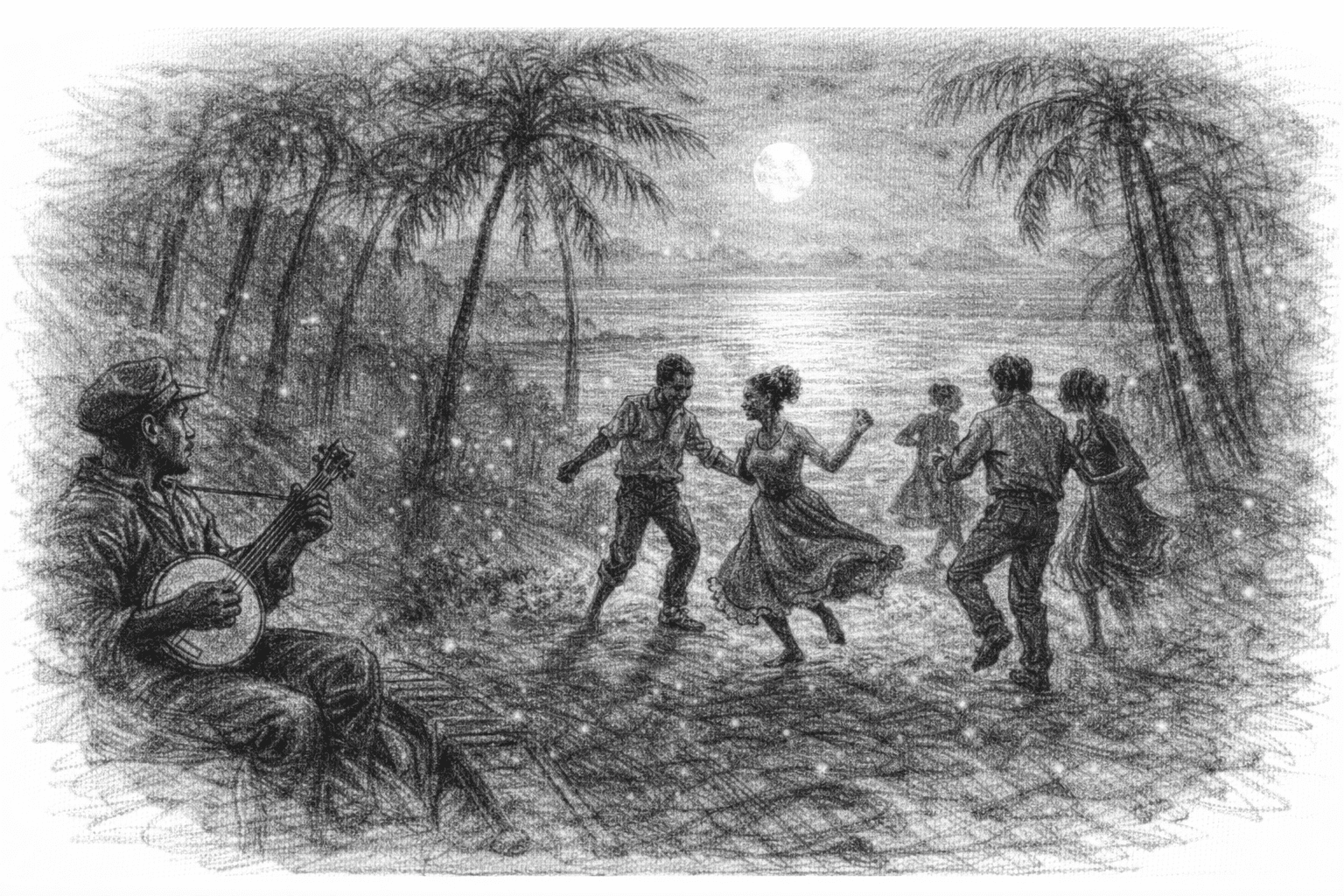
The heat was unbearable. Not a breath of cool air day or night. At noon the sun stood directly overhead. When the sun went down and darkness set in the air was full of fireflies, appearing like myriad sparks of fire. And the mosquitoes made life miserable at night. They were so big we used to say we could ride them, and so poisonous that every sting would result in a big hard lump.
Thus it was that the broiling sun in the daytime and the mosquitoes at night made life very unpleasant here in the tropical paradise of wonderful vegetation.
And that was not all. In the woods there were lizards, snakes, scorpions and centipedes, all poisonous and many of them dangerously so. The sea was full of sharks, so we could not go swimming, but had to take water onboard in buckets and pour over each other to cool our bodies.
We dumped the ballast out right where we lay, and then began to take in our cargo of logwood, which was brought out to our ship in small lighters. This wood came in pieces about 6 feet long and from 2 to 10 inches thick. The captain hit upon the idea of sawing the smaller and more crooked pieces into shorter pieces so as to load more compactly. The cargo was by weight. So we got some saws, took them down in the hold and there we sawed and packed the pieces.
With only an overall for clothing and pair of cut-off boots for shoes, the sweat would fill the shoes and flowed over their tops. We drank a lot of water, in which oatmeal had been soaked. This was thought to prevent weakening of the body from the unusual perspiration. We bought some green cocoanuts, cut holes in them and drank the milk. It was almost like sweetened water. I like that milk, and it was nourishing.
Curious about that grove of cocoanut palms which could be seen from our ship, one evening I determined to explore it and secure a supply of green cocoanuts. Taking a boat I rowed ashore, and going up the incline, I saw a big tree with a thick branch extending horizontally from its trunk, and on top of the branch, a few feet from the main trunk, there was a beautiful plant. It appeared like one of those house pants I had seen at home. I wanted to examine it.
The branch stood about ten feet from the ground. But I saw a hole in the trunk about 9 feet from the ground, and thought, if I could reach and get hold in that hole then I could get up on the branch. The main trunk was thick.
With some extra effort I reached up far enough to put my hand in that hole, attempting thus to pull myself up. But, what a fright! A perfect stream of lizards came out of the hole, going down over my arm, shoulder, head and back. Naturally, I dropped on the ground at once, and tumbled or rolled down the incline to a more level sport where I landed, sitting in some dry leaves.
The lizards ran with lightning speed in all directions around me, apparently determined to do no harm. They were of various colors, yellow, gray and brown. I don't remember seeing any that were green, which were said to be deadly poisonous. Those I saw were from 12 to 14 inches long, and about as thick as a penholder, appearing like small snakes. They traveled very fast. I could scarcely see them, but noticed the movements in the dry leaves, where they ran here and there. They were probably as much frightened as I was, and tried to find places to hide.
But I had had enough of this fun. The pretty plant up in that tree would be left alone, as far as I was concerned.
Getting up and walking up the hill I looked for a palm that was suitably tall for me to climb. I had heard and read about cocoa palms, but here I was right in the modst of them. They are, generally speaking, straight, naked trunks with a fairly good sized crown of leaves at the top. These leaves, 12 to 18 feet long, consist of a strong stem of petiole, with blades standing out from its sides. The stem can be 8 to 10 inches wide at the trunk. There are new leaves forming constantly at the top of the palm, and the lower fall off gradually as the tree grows. When these leaves fall they leave a bract in the bark of the tree. It is by use of such bracts the bare-legged Negros climb the palms like monkeys.
I was not trained for such climbing, so I looked for a tree that was not so tall. Finally, I found one such, and it also had a slight bend in the middle, so I selected it, and with some exertion climbed up till I got hold of one of the lower leaf-stems. Then, creeping up among the leaves, I seated myself, to rest a little on of the stems.
Here I saw a sight of cocoanuts of all sizes, from the size of peas to those that were 8 or ten inches in diameter. They grew in clusters of eight or ten, all on the same head stalk. With the growth of the fruit the stalk extended farther from the trunk until, when ripe, the shuck turned brown and shrunk up on those farthest out, and those nearer the tree still remained green, with some green leaves among them.
Using my jack-knife I cut down about a dozen or more of those I thought would not be too ripe. Then I went down and made haste to get to my boat, as the mosquitoes were beginning to swarm around me. With cocoanuts in each hand, one under each arm and two in my teeth, not being able to handle more, I started down the hill. But now I was unable to fight the mosquitoes, which were stinging unmercifully. I had only a thin shirt and overall on, and that was no protection against their murderous attacks. Sliding on my back most of the way down to the boat, I got in and came on board with my cocoanuts, the sweat running off my body, and swelled up all over from insect bites, and with such intolerable itch from their poison, I figured out it was my poor business to steal cocoanuts, and determined I would not try it again.
We secured two Negroes to help us load. One was a big, strong chap, called Tom. Being a musically inclined man, he would sing all day while he worked in the old, and the sweat was running down his naked back. In the evenings we could get him to sing for us by the hour. He knew an endless variety of Nego songs, as well as English. He never tired of singing, and we never tired of listening to him. He was ashore on Sundays, and evening after six o'clock.
Going into the country occasionally, we observed something of the conditions of life among the Negros. They had some small, straw-thatched huts, here and there among the palms, often invisible from the highways or main roads. Tom was acquainted everywhere and with everybody. When we passed a certain place, Tom would call out, 'Hello Charley', and the answer would come from the dusk of the forest, 'How are ye, Tom.' Then they could hold a conversation, Charley sitting in his hut and Tom walking along the path. The transmission of sound was unusually good in the forest in still evenings.
These people did not seem to have much to be worried about. If they needed a house they would go into the bamboo swamp and cut some stalks, split them into strips 2 – 3 inches wide, stick them into the ground about 6 inches apart around the desired ground area of the hut. Then they would take other split strips of bamboo and weave in horizontally, as a basket, up to a height of 7 or 8 feet. Then some bamboo rods were set up on all sides of the structure, bent over and tied together over the center, to make a roof, with suitable pitch, over the hut. Other rods were then laid across over the incline of the roof; and finally, long, course rushes, or swamp grass was tied on top and extended out over the sides for eaves.
So the house was finished, with a little opening in the wall for a window, and a grass-mat for door. The earth was the floor. Chimney was unnecessary. If fire was made inside, it was on the middle of the floor, and the smoke easily vanished through the walls.
Furniture there was none, except, perhaps, a couple of boards put up about two feet from the ground in a corner, used for a bed. No dishes or tinware for cooking or dining. Some cocoanut shells and some large snailhouses were the only dishes or utensils we saw. And sometimes they had a big iron kettle, which seemed to be the only thing used for cooking.
Their food was mostly cocoanuts, bananas and other fruits. But the Negros smelled terribly from all the oil in the cocoanuts they ate.
Life here was as primitive as one could imagine in a land supposed to be civilized. But then, they were not lacking any of the necessaries for their existence. Food there was in abundance around about them. Of clothing they used very little, - only some thin pieces of cotton, - on Sundays. The women ordinarily used a sort of shawl, which they put on I n a manner or place of a skirt.
These Negros were jolly and carefree. One evening we went with Tom out into the forest to a dance. There was a large gathering of young people. Several played banjoes. Everybody had a good time, playing and dancing in the moonlight, among the palms.
Their laughter was so hearty and goodnatured that it added considerably to the merriment. It marked like a contagion on all who were present.
The English must be given credit for maintaining good order in Jamaica. There were school and churches. The Sabbath was strictly observed, and the darkies went to church, en masse, in all the variegated and gaudy costumes of the island.
There was an English clergyman in the town; and he, together with his two grown daughters called on us two times.
The other darky who helped us with the loading was of medium stature, but rather heavy, and he was also good-natured and friendly.
One evening we were to have some entertainment on deck, including some athletic stunts. Among other things we were to see who could kick the key off the yard. For this stunt we tied up a spar horizontally, about 7 feet from the deck, greased it well on the upper side, and laid a key on it, then threw a loop of rope over the spar, put the left foot in the loop, and held the loose ends of the rope one in each hand. Thus one was to stand, clear of the deck, and then kick the key off the spar with the right foot.
Trying it first, I kicked the key off the spar. When the negro saw hot it was done he jumped up and said he could do that well enough. The key was put up again. The Negro took the loose ends in his hands, put his left foot in the loop, and gave a violent kick at the key with the right foot; but, somehow, both his feet went up, and his head hit the deck with great force. If it had not been the skull of a darkey it would certainly have broken.
We were frightened for a while until he raised himself to a sitting position. He put his hand on the back of his head and remained thus sitting for some time, then he got up, and appeared uninjured. His thick, strong skull had saved him. It was, or course, our fault, as the Negro had had no experience in such monkey-shines. We believed, however, that he would first have tried and found out it was difficult, which, unfortunately, he did not do. But I feel sure he did not try it again.
One Sunday we went ashore in the morning to remain all day, and really make inspection of the country. At the first opportunity I bought two dozen of those large, juicy bananas, which were tree ripened. They were not like the tough, hard and small things we ordinarily find for sale in semi-tropical or temperate zone markets. Those we bought here needed not to be chewed. They melted in the mouth, and were delightfully good tasting, luscious and refreshing. I intended to eat one now and then during the day, as it was hot and water was not obtainable everywhere; and then take those I had left over along with me to the ship. But they were all consumed before evening. I could hardly believe it. They were so large. And yet my stomach did not seem to be over-filled. And I drank a quantity of cocoanut milk. And I could have eaten a dozen more bananas if I had had them.
We saw orange trees with blossoms and also ripe fruit on the same tree. Lemon trees there were, loaded with fruit; and also breadfruit trees in bearing. Pineapples were growing here and there
The banana trees, if they can be called trees, have a single stem, about twelve feet tall, with great, broad leaves all the way to the top. The banana trees that I saw were only 6 inches or less in diameter at the ground, and their texture was soft, almost like a turnip or rutabaga, so we could stick a knife to the handle in them. There was only one bunch of fruit on each tree, hanging down from its top. When the fruit was to be taken the tree was bent to the ground and bunch of fruit taken off, after which the tree was barren and useless. Each tree bore fruit only once.
There was also another fruit, called Savasap. It grew on a shrub or bush near the ground. The fruit could be 8 or 10 inches long, 6 inches wide, and a little flattened at the top. Its color was dark green, and on one side it had diamond markings like pineapple. The inside was a snow-white soft pulp, which had to be eaten with a spoon. There were some large seeds, like those in a watermelon, which were easily separated from the meat. This fruit was slightly tart, but with a little addition of brown sugar it was the most palatable and delicious fruit I have ever tasted. In the old phrase, one could swallow his tongue after it. This kid of fruit I have never seen since.
One day we were permitted to go up and see the sugar mill, where raw sugar was made. The cane was brought in large loads, but ox-carts, from the surrounding fields, to the press, consisting of two big iron cylinders, rolling against each other, like the rollers of a clothes wringer. The came was put through this wringer, squeezing out the sap, which flowed into a basin below the press.
From the basin there was a spout which sent the juice to eleven large kettles, set on a large oven of mason work.
There the juice was cooked, and the skimming from one kettle put in the next until, from the last kettle, the skum was put in barrels and proved to be brown sugar.
The sugar cane grown here was very tall, up to ten or twelve feet, and about 2½ inches in diameter at the root. It was yellow in color when ready to cut, and the leaves were mostly dried up and removed by the wind and weather, but the stalks were heavy with juice.
When they were squeezed out they were taken to a rum factory where there was extracted from them the famous Jamaica rum. This is about the most potent liquor in existence, too strong to be drunk unmixed by the average person. We tried to put the juice of two or three lemons in a pint of rum; then took 2 tablespoons full of the mixture in a glass, and filled it with water, and found then that the drink was very refreshing.
One Sunday evening we came walking along a path in a plain where there was high grass and saw a little Negro boy striking in the grass with a stick. We sent over to see what he was trying to hit. He showed us a large, green crab and said he was looking for some more of them. We asked if they were in the grass, to which he made an affirmative gesture. Then we secured canes and began to strike the grass and sure enough, they would jump out here and there, and they could run so rapidly that we had to hustle to reach and waylay tem before they reached their holes of hiding in the ground. We could hear the water splash in the holes when they dropped into them.
The incrusted part of their bodies were about 4 by 5 inches, with smooth rounded edges. Their feet and claws were also smooth, so they had little difficulty traveling through the grass.
These crabs undoubtedly had to find their food on dry land rather than in the water, and were, therefore, land crabs.
The Negros roasted and ate them, as we eat sea-crabs.
Thus I ascertained that it was not simply and imagination when we were told about land crabs, but that there really are such crabs which live, for the most part, on dry land.
We lay four weeks in this oven of a place. Then there was no more logwood to be had there.
To get out of this bay we had to watch our chances when a thundershower came, and the wind stood out the bay. Then, one evening we lay all ready, sails up, pilot aboard (the same one who brought us in), ready to weigh anchor. So, when the shower came, the wind took us out to the open ocean.
Then we nosed into another bay, not far from the first one, and not quite so land-locked, and there was a little trade-wind blowing, and here we completed the loading of our ship.
One day, while here, another lad and myself rowed the captain ashore, and were ordered to wait for his return. We tied our boat to a low pier, where the water was not more than 4 or 5 feet deep. We were barefoot, and hung our feet over the side of the boat and splashed in the water to cool them.
A Darkey came by, and when he saw us he called out; 'Get your feet out of the water if you don't want to lose them'. I believed he said that merely to scare us, but we took our feet out of the water, in any event. A couple of minutes later we saw two sharks about five feet long come sneaking up to the ide of the boat where our feet had been. We were naturally very much frightened. We could never have believed these big sharks would come into such shallow water. If the Darkey had not warned us it is not easy to say what had happened to our legs.
We were preparing to go to sea, and we have to have potatoes, among other things in provisioning of the ship. There were delivered on board some big roots that we judged to be roots of trees, about 4 or 5 inches in diameter, and up to 3 feet in length. They had been cut from longer roots or tubers, so I don't know how long they had been originally. They were called yams. Inside they were white and did not taste so bad when cooked as potatoes, cut in thick slices.
Possibly this is enough about Jamaica. We had now been here about six weeks, during July and August, the hottest time of the year. We were full fed and red-cheeked when we came to Jamaica but now we were pale and thin as skeletons. Our flesh had been much reduced by the constant perspiration, night and day. We were glad to come out on the ocean again.