
Sails up, the course was set for Madeira, lying west of the strait of Gibraltar, on latitude about 32° north. Here, it was thought we would get into the northeasterly tradewind.
The weather favorable, we soon came far enough south to begin to feel change in the temperature. In the vicinity of Madeira we came into the northeast trade; then, setting course more southwesterly, we lay toward Cape Verde Islands.
These islands are under latitude 16 or 17° north. Fine weather and a steady favoring breeze now, and with a rising temperature, we threw our boots and went barefoot, except when going aloft. A shirt and an overall was all we needed for clothing, the temperature being so even, night and day.
At length we reached Cape Verde Islands. There are several of them. They belong to Portugal. The biggest island is St. Anthony. One of the smaller is St. Vincent, on which there is a town of the same name. Here England had a coaling station. And here we came into a beautiful large bay, the channel or entrance to which was rather narrow. The elevation of the land surrounding the bay was such that ships lying there were somewhat shielded from the wind, but the swell rolled in at the entrance, and kept the ship in motion all the time.
We had to use sacks to unload the coal. This was hard work, and it was slow.
The population in the town was nearly all Negro, with only a few English people in official positions. The town was pretty as it lay on an incline to the east of the bay. But there appeared to be practically no vegetation on this whole island, the surface nearly everywhere being dark gray crumbly rock, which contained so much alkali that we could us it for soap. Taking a little piece of rock we could crush it in the hand and proceed to wash as with soap. Something strange it was to make soapsuds out of sand.
There was no fresh water on this island, and, even if a shower would come, the water could not be used for drinking after it had come in contact with the ground. Rainwater could be gathered from the roofs. And there was a big old English ship, lying in the harbor, dismantled, that was used merely for distilling fresh water out of sea water. That was the waterworks of the town.
And here the sun was warm, as it stood almost directly over head at noon. It was, however, not unbearably hot, because the wind blew steadily right outside of the inlet.
The Negro boys here were, so to speak, half human, half fish. They would be rowing around the harbor every day in a little boat and look to the bottom for pieces of coal, lost from the unloading of some ship. The water was not more than 50 to 60 feet deep, and the bottom consisted of whitish yellow sand. The boys were naked, and when they saw a piece of coal they would dive and swim to the bottom and get it, and it was almost unbelievable how large lumps of coal they would be able to bring up. Such coal they would then sell, and earn a few pennies.
We had a Negro boy about 15 or 16 years old, helping us to unload. Once day, at noon, the captain called to him: 'Tome, if you can find this six penny piece when I throw it overboard, you may have it.' 'Yes,' said Tom, 'let it go.' The captain then threw the six pence piece out as far as he could, while Tom stood and watched to see where it fell. Then he jumped overboard and disappeared for quite a while. Finally he came up somewhere near where the six pence had hit the water, and as he saw the captain he took the coin out of his mouth and held in his hand. That, we thought, was very well done, even for such a fish of a boy.
We made shifts of men to be in the hold and fill the bags, as it was fearfully hot down there. It did not take long, in the coal dust, with the sweat running, before we all looked black. When we came out of the hold in the evening we would get out of our shoes, hop overboard with our clothes on, thus washing body and clothing at once. It was only shirt and overall we had on, and when we came up we would hang them to dry, so they would be ready to put on again next morning. There were no shares, so we spent considerable time playing in the suitably tempered water.
Our anchorage was at some distance from shore. One evening I took a boat and rowed ashore, where I found a number of tropical snail-shells of brilliant colors, the kind the Negros in West Africa use for money.
This was practically a desert island. But St. Anthony Island, which we could see at a s distance of about ten miles, was said to be quite fertile. We bought oranges and bananas which had been raised there. They were rather small, probably because of the scarcity of rainfall or moisture.
When the coal cargo had been taken out, we took some of the soapstone for ballast. Then we lifted anchor and set course for Jamaica, in the West Indies.
But, before proceeding further, I must relate that the stay at St. Vincent had been very pleasant in many respects, including the fact I had received a letter from Olava. In this letter, she gave an affirmative answer to the question, in my letter from Britsol, if she would be my wife. This is the fate of a sailor: Pop the question from the west coast of England, and be accepted on the west coast of Africa. So we were now engaged, but she was, unfortunately, thousands of miles away, and the only way of communication was by letter. Still, those were happy days, in spite of everything. In a year or so I would be at home, and then we were to retrieve all that had been lost.
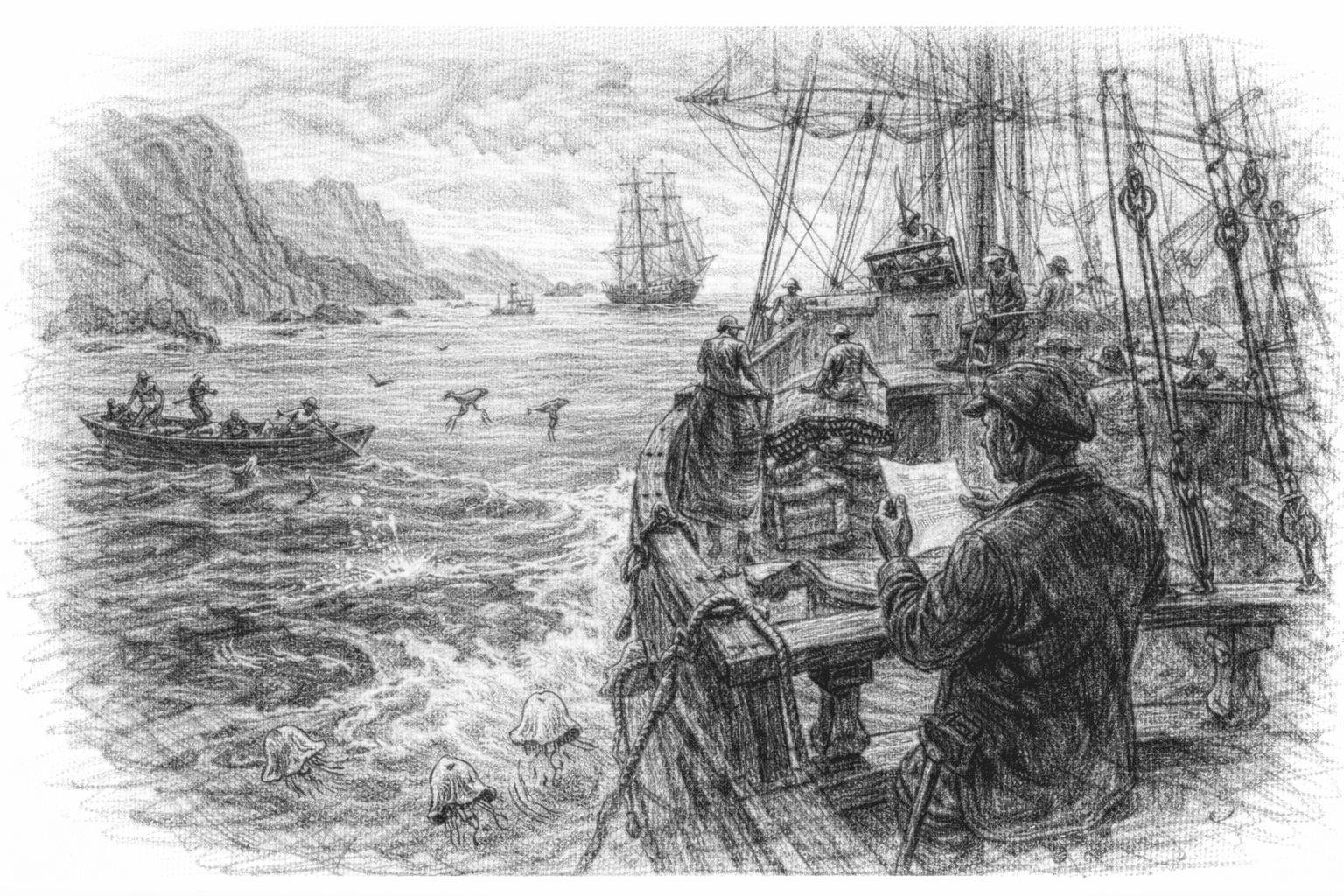
Meanwhile we stood westward in the most pleasant weather one could imagine. Soon we observed the Spanish Men-of-War, a kind of jellyfish that live near the surface of the sea in this locality. They have a sort of sal that is transparent, in form like a half moon, sticking up out of the water about 6 inches; and they sail apparently with this sail close-hauled to the wind, all of them going in the same direction. They glitter in the sun, reflect all the colors of the rainbow, and in certain places they are very numerous.
And the flying-fishes, shining and beautiful, 8 to 14 inches long, with transparent wings, about 4 inches wide and 6 to 7 inches long. The larger fishes, such as the dolphin or bonetta, give them chase, they jump out of water, spread the wings and fly long distances before alighting again. If then there happens to be another enemy they immediately jump out again and go another direction. Sometimes there are large schools of them, all taking flight at the same time, and going in all directions. Usually they do not fly high, but sometimes it would happen that one would come in over the railing and land on deck. They were goo to eat. I took the wings of several of them, spread them out and laid them in a press where they direct and were well preserved when I came home to Norway.
We could not fish for flying fishes; but there were the greedy dolphins, which would be up to 3½ feet long, and possibly 8 to 10 inches broad. Angling for them we used a heavy line and a halibut hook. Fastening a white rag to the hook, we would go out on the bowsprit, dip the rag into the water and jerk It up again rapidly. The dolphins thought it was a flying fish and watched when it touched the water again, then grabbed it. Sometimes they would grab the rage even when it was several inches out of water. They were heavy to pull up; and when we get them up to the bowsprit we had to put them into a bag before we released them from the hook. One day I got hold of one that was so large it straightened the hook and I lost it. The dolphin was good for food, tasting like codfish. The boneta was another kind of fish, short and thick, tasting about like mackerel. Some of them weighed about 15 to 16 pounds. They would also bite on a rag. One day when they were not biting so well, I secured a salt mackeral from the steward and put it on the hook, and then they jumped out of water to get hold of it.
Sailing in the trade wind is the most pleasant experience a sailor can have. Every sail is spread, to stand day after day, week after week. We fastened the braces and haliards, and there they stood, except once in while, as they dried out and became slack, they needed tightening.
The sky was not quite clear. There were some light, fluffy clouds flying from northeast to southwest. But they were so thin we scarcely noticed them when they passed before the sun and moon. The temperature was almost the same day and night. Our leisure hours we used in fishing or making models of ships. We would make a board or plate of wood, paint it sky-blue, then fasten the half model of ship to the board with the lee one half of all spars, rigging and sails. The sails, or as much of them as was visible, were in position and filled with a good breeze.
I made a model of our ship, which the captain bought and presented to one of his friends in America. This was the first model I completed. The captain praised it and said it was an excellent likeness of his ship, 'Hjemmet'.
While we were yet in the trade wind, one evening the steward came into the forecastle with a great bowl of punch, and announced that his was the birthday anniversary of the captain's wife, and that he would, in honor of that event, treat the boys to a glass. Well, the toddy was good and we drank tht health of the captain's wife amain. It was my turn at the wheel from 10:30 to 12:00 that evening, and I could very well notice the influence of that liquor because I became very sleepy and could scarcely hold my eyes open. I watched the clock continually, and thought the time was dragging slowly. Finally it was near 12 o'clock, lacking only 15 minutes. I think I must have fallen asleep then. When I opened my eyes, knowing I had slept, the captain stood with his back turned right in front of me, looking at the compass. I was frightened and thought at once that the ship must be off its course. I bent sidewise so I could see the compass, and could scarcely believe my eyes: The ship was exactly on its course, and, as I looked at the clock, it was twelve midnight. I grabbed the bell rope and struck eight bells. The captain walked away, not saying a word. I am sure he had seen me asleep, but what could he say when he saw the ship was on its true course, and eight bells were stuck correctly on the minute. But to steer a ship while asleep, keeping it on its course for 15 minutes, that is something not so easily understood.
The captain was, as before mentioned, a very good singer. HE would promenade on the storm deck, especially in the evening, and sing: 'Holy Darling, 'Sweet Belle Mahone', 'Darling, I am growing Old', 'Sweet By And By' and many others. He had an organ, also, in his cabin, on which he played and sang, 'I Walk In Danger All The Way', and other hymns. Such fine singing, out on the ocean, in such fine moonlight evening was something unusually beautiful, and gave me inspirations such as not even the best concerts I have heard have ever given.
Then, one evening just as the sun had gone down, the captain said, 'Go up on the fore upper topsail yard and look forward at lee bow, and let me know if you see a light.' I went up and looked, first from the forecourse yard, then from lower topsail yard, and there was no light to be seen; but when I came on the upper topsail yard there stood the gleam from the lighthouse, clear as could be, and exactly in the direction the captain had told me to look. Here was a striking proof of the captain's ability as a navigator, knowing exactly how many feet from the surface of the sea one must go in order to see the light.
It was St. Thomas, in the West Indies, we were approaching, but we did not reach it before full daylight next morning. This is one of the first islands one may see, in approaching from the east. It is quite high in the center and leans gradually to the water on each side.
We passed several small islands. But then there was quite a stretch of open ocean again before we came to the three large Islands, Haity, Cuba and Jamaica. These islands lay about straight south of Florida, Jamaica being on about 18° North latitude.
Our destination was Kingston, the capital of Jamaica, for orders. That is, we could there learn where we were to go and take in cargo
We came to anchor outside the fort, Port Royal, which is on a low point outside of Kingston Bay; and there we received orders that we were to go up to the east side of the island and take on a load of logwood, a kind of red wood used for dyeing, for knife-handles and other things.
Lifting anchor, we tacked up along the south side of the island to a place where there was a bay and a small town. I have forgotten the name. It was port something. We could see on the line of the coast, marked on the chart, where this town should be, but it was quite impossible to see anything but a straight coastline as we came along. We tacked foreward and backward for two days, but no bay could we discover, though we went near to the coast. And no pilot came out.
Then, on the third day, all at once, here we see a little dug-out canoe with two darkies in it, coming up to our side, asking that we throw them a rope, which we did, and they came on board. One of them was an old man, barelegged and bareheaded. A pair of short trousers was all he had on; and he was very lame on one foot. As soon as he came on deck he approached the captain, pointing to his chest, and said: 'Me pilot'. The captain stared at him, apparently not knowing whether to believe him or not. It was probably the queerest looking pilot he had ever seen.
The other negro was the son of the first, and was dressed in the same fashion. The father then told the son to take the wheel, while he hobbled forth and back on the storm deck, looked aloft and ordered us to set sail, one after the other until every sail was set, while the ship was standing straight in shore.
There was a fresh breeze and it looked dangerous to approach the coast with all sails set.
The captain asked the pilot if it would not be best to shorten sail. 'Me pilot, me pilot,' was all the answer he got. The captain asked the mates what they thought about this man, - if he could be trusted or not. The situation was serious. But every time he asked the pilot anything he got the same answer as before: 'Me pilot,' while he limped back and forth on deck, and uttered authoritative commands.
The coast was steep and high. The waves struck up over a high cliff, not far from our bow, while we were headed straight toward the rock with considerable speed.
This was the worst situation imaginable. The man must be crazy. Not before we were right in the midst of the breakers did we see a little opening to the right, just beyond the rock. The ship was turned sharply to starboard, and in a few minutes it was wheeled port, and there we see a long bay, surface calm and mirror-like, no wind touching its surface.
The ship had considerable speed as it entered this bay, and with the momentum it sailed far in, with every sail set. When it was finally lying still, the pilot ordered the anchor down.
Now we understood the pilot was not crazy, as we had feared he was. There were no tugs available here, and we had to enter the inlet with all the speed possible in order to make the ship go as far as possible into the bay.
The old Negro knew what he was about when he said repeatedly, 'me pilot'. We became to admire him, old barelegged, limping darkey as he was. And the son was no less admired for his ability to steer the ship safely through this narrow and crooked inlet, between sharp and dangerous crag s and breakers.